


Production mobile units are increasingly present in new production environments beyond traditional sporting events: from television series to corporate presentations or concerts. This article offers a look at their historical evolution and analyzes the technical parameters that determine their quality, reliability, and operational performance


*This content is included in the February issue of TM BROADCAST. You can access the full magazine here.
Audiovisual production has greatly benefited from the possibility of carrying out multi-camera productions outside fixed facilities such as TV studios. In English, this is known as OB (Outside Broadcasting). It is not only about taking technical equipment outside these facilities — that is, simply transporting the equipment in a truck (as if it were a move) — but about being able to rely on an effective, convenient, professional, and high-quality solution for both production and transmission.
These circumstances have led “to search for and find” content, wherever it may be, in order to fill more hours with audiovisual material within the programming of the different windows present in today’s market (TV, social media, live streams…). In English-speaking environments, the term EFP (Electronic Field Production) is used generically to designate any type of production carried out outside the studio or stage, which includes the work performed with mobile units.
In many cases, the sets of a TV series have been built in industrial warehouses where the audiovisual infrastructure had to be resolved by resorting to a mobile unit
Many of our readers will surely associate mobile units with sporting events (national and international, such as a Football World Cup or the Olympic Games), but they are increasingly present in other production environments: TV series, galas and tributes, commercial, institutional and social presentations, in the field of music and live concerts, and across a wide range of event types. This is because technology and manufacturers have made the mobile unit offering more cost-efficient, adapting both to different types of content and to the variety of budget levels.
In recent years, we have witnessed a progressive increase in the variety of situations in which the presence of a mobile unit has been required and, consequently, in the number of companies specifically dedicated to providing this service. Television fiction production, for example, has not always been located in suitable facilities. In many cases, the sets of a series have been built in industrial warehouses where the audiovisual infrastructure had to be resolved by resorting to a mobile unit.
The success of the expansion in the use of a mobile unit lies in being a solution in which a production mode prevails, with specific production resources that allow the capture of a “live” output (whether true live broadcast — transmission — false live or delayed) and in working with different video sources (multi-camera) at the location where the content takes place.
Luis Sanz, a Telecommunications Engineer with more than 50 years of experience in the design, planning, management and operation of Spain’s TVE production centers and a regular contributor to TM BROADCAST, describes the origins of mobile units as follows:
“The first television mobile unit of which there is record was developed in Germany in the early 1930s and was used for the first time at the inauguration of the Berlin television center of the Reichs Rundfunk.”
In an article published in TM BROADCAST, the same author continues:
“In England, the first unit was built on two Regal trucks and with a Marconi’s Wireless Telegraph transmission system, which was used for the first time at the coronation ceremony of George VI on May 12, 1937. In both systems, as in others of the time, the recording of transmitted images was carried out on film, since videotape recorders did not exist. It was from 1950 onwards that mobile units equipped with a videotape recorder for recording were developed.”
In Spain, in 1977, the first color mobile unit was inaugurated in Barcelona for the public broadcaster RTVE, equipped with four cameras and a 24-channel audio console.
All of us who work in the audiovisual sector, when we have been asked to “cover an event,” and have thought about setting up three cameras, with live sound, with the possibility of including captions and graphics… and an endless number of technical resources in favor of the content — whether for a theatre play, a friend’s concert, a daughter’s Sunday match, a friends’ wedding or a promotional event… After renting the equipment separately (paying attention to the smallest detail), loading it into a van, assembling and dismantling everything, and encountering the difficulties of something failing or not working, we have always reached the same conclusion: everything would be much easier if this equipment were perfectly installed and ready to be used.
The first television mobile unit of which there is record was developed in Germany in the early 1930s and was used for the first time at the inauguration of the Berlin television center of the Reichs Rundfunk

That, ultimately, is a Mobile Unit (MU): audiovisual equipment integrated into a transport vehicle prepared to provide an audiovisual solution when covering an event or content that takes place outside the facilities of a television broadcaster, using multi-camera production techniques. There are mobile units specialized in production (PMU)/contribution; and others dedicated to transmission/link (TMU) or communication.
In this article we focus on production mobile units (PMU). Depending on the country of origin, they receive different names: mobile production control room (PCR); production truck; scanner (a BBC term); mobile unit (MU); remote truck; live truck; OB van / OB truck; or live eye.
All these denominations share one main characteristic: mobility. This is obvious, since having a dedicated transport vehicle allows access to a multitude of places and locations.
Their flexibility is also noteworthy. The ability to adapt to different working situations, types of content, audiovisual market regulations and/or client requirements. We are referring to the decision-making process carried out from the outset, which encompasses the construction and design of the mobile unit together with its technical configuration and equipment. This even allows us to request a “made-to-measure” mobile unit (customized solutions), enabling decisions ranging from the type, model and size of the vehicle to technical details, access points, finishes and the technology to be used.
The mobile unit market already offers a catalog of finished mobile unit types in order to facilitate selection (purchase/rental), adapting to different budgets and to more standardized technical and creative needs when covering an event.
Finally, quality control and reliability are two differentiating elements compared to any solution considered for multi-camera production in outdoor environments. From a production standpoint, a mobile unit reaches broadcast category status by complying with professional audiovisual sector standards (SMPTE 292M and 259M) and fully meeting occupational risk prevention requirements that may arise in this working environment (access, thermal and acoustic insulation, electrical protection, load and overweight control, driving, etc.).
Both PMUs and TMUs evolve at the pace of the technological transformation experienced by the television and live events sector itself. Therefore, in terms of image, we find workflows based on SD (increasingly less common), FHD, UHD, 4K and even already 8K. Of course, adapted to HDR content production. And in reference to sound, with stereo solutions, Dolby encoding, 5.1 sound… Mobile units offer both cable-based connectivity (BNC-SDI, IP, fiber optic) and fully wireless solutions.
In England, the first unit was built on two Regal trucks and with a Marconi’s Wireless Telegraph transmission system, which was used for the first time at the coronation ceremony of George VI on May 12, 1937

Since each PMU is a unique, adapted and integrative solution combining different audiovisual technical systems and equipment, this article recommends becoming generally familiar with some of the spaces and equipment to be taken into account:
- Physical dimensions of the vehicle body (length, height and width excluding the driver’s cab). This is known as the chassis or body. There are major vehicle manufacturers such as Iveco, Mercedes, MAN, Volvo, Scania or Renault in the case of large chassis.
Dimensional data are important to understand the space occupied in common situations such as parking or passing through different areas (streets, squares, roads, paths, bridges…). And, in relation to the interior, they are relevant for knowing the capacity for technical/artistic personnel and achieving an adapted and comfortable working environment.
These dimensions, specifically the width, may vary if the mobile unit features a retractable side pod or expandable area (single, double or triple). It is also important to know whether the roof of the body is accessible for possible use — that is, whether it can support additional weight.
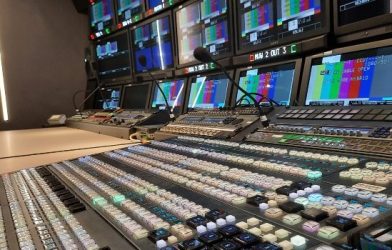
- Work areas or spaces: each designed with technical ceiling/floor systems and panels for the proper connection and distribution of cabling. The most notable areas include: production control (the largest space), audio control, camera control, VTR and EVS area (usually located in the expandable section of the mobile units), production room, technical control area, mini TV studio + chroma (also placed in the retractable side section of the body), among others.
- Storage compartments: located either at the rear or perimetrically within the vehicle body, allowing storage of cable reels, complementary material and camera accessories.
- Power/consumption: complete electrical installation, including an uninterruptible power supply system, main service and backup — UPS and backup systems — for example: 380/400 Volts + N + T with UPS, dual input, connection type: Cetac CEE 125A with three-phase 9 kW generator.
Any production mobile unit that aims to be competitive in the audiovisual sector must offer Broadcast / Events equipment across the different work areas it may include:
- Camera equipment: this refers to the number of EFP, compact, POV, robotic and/or PTZ cameras; different lenses; camera cabling runs (triax, IP and/or fiber optic); tripods or pedestals…
- Production control equipment: video mixer/switcher, number of VTRs/Decks, number of EVS servers, character generator/graphics system, monitor wall…
- Audio equipment: audio console, microphones (handheld, wireless, headset, lavalier), monitors, returns, encoders-decoders, various players, telephone hybrid, communications system 4H link 6 lines, ISDN codec…
- Quality control equipment: video matrix, monitoring, CCU, patch panel, MFO, vectorscope, signal converters…
- Communication equipment: transmitters/receivers and intercom matrix, D-Link network, wireless router…
- TV studio + Chroma equipment: chroma background, LED lighting, PTZ cameras…
Production mobile units are often accompanied by communication/transmission mobile units, where modulation, antenna, and amplification equipment for the corresponding connections/repeaters are installed
It is very important to know the type and model of vehicle (brand, engine, speed, consumption…) and the reliability of the hydraulic stabilization and leveling system, the independent air-conditioning system for both environment and equipment, custom technical furniture and all other elements necessary for the proper operation of the mobile unit, enabling comfortable facilities for technical personnel in accordance with the occupational risk prevention and health plan.
In this regard, it is mandatory that every mobile unit has CE/IEC certifications for its different components, UPS with bypass and surge protection, effective grounding and current detectors/circuit breakers; fire prevention measures such as smoke and temperature detectors together with appropriate extinguishers for electrical/energy risks; emergency signage and exits in accordance with the evacuation plan; clearly marked circulation areas; proper ergonomic standards for technical personnel; cable-free floor areas and controlled access signage restricted to authorized technical staff only.
No less important are working conditions in terms of lighting (uniform, glare-free light, intensity control and production/live status indication – tally); the type of furniture and finishing of the spaces (ergonomic chairs, anti-vibration floors, adjustable desks and acoustic panels on walls and ceilings, soft and warm colors); and environmental conditions in terms of climate/temperature and humidity control, which require professional ventilation solutions (20–24 °C, 40–60% RH).
In Spain, in 1977, the first color mobile unit was inaugurated in Barcelona for the public broadcaster RTVE, equipped with four cameras and a 24-channel audio console

With regard to the standards and regulations that must be applied in the design and equipment of a mobile unit, these are framed within the regulations established by organizations such as SMPTE, EBU, ITU and AES, ensuring interoperability, operational stability, electrical safety and signal quality.
- Video area: SMPTE ST 292 (HD-SDI); SMPTE ST 424 (3G-SDI); SMPTE ST 2082 (12G-SDI – UHD); SMPTE ST 2110 (IP-based production); BT.709 (HD); BT.2020 (UHD); BT.2100 (HDR – HLG / PQ); and EBU Tech 3320.
- Audio area: AES3 (Digital Audio); AES67 (Audio over IP); BS.1770 and EBU R128 (Loudness measurement); BS.2051 (Immersive Audio); EBU R128 (Audio level normalization).
- Quality control and synchronization: SMPTE ST 2059; PTP (IEEE 1588) for IP systems; Black Burst / Tri-Level Sync for SDI systems; EBU Tech 3276.
We can include in this text an updated classification of the types of mobile units available in the audiovisual market. Each company that provides mobile unit services usually assigns a number to each unit it operates: MU1, MU2, MU3… and sometimes even a number identifying the number of cameras incorporated into the mobile unit, for example MU2 – 10.
The history of mobile units has traditionally used the following classification:
- Type A: Mobile units that feature a retractable side pod or expandable area (single, double or triple) added to the dimensions of the vehicle body.
- Type B: Mobile units whose working space consists solely of what is offered by the size of the vehicle body itself.
- Type C: Mobile units that could be joined in parallel, forming a set of two twin units, generating large internal working spaces and greater technical equipment potential. For this reason, they are the largest.
They have also been referred to as large, medium and lightweight (PEL) mobile units, and even compact units, integral units and large trailers. Other non-Spanish companies use the designation Basic, Bronze, Silver, Gold and Platinum mobile units.
In 2018, I had the opportunity to study the national and international mobile unit market offering, which allowed me to develop a more universal typology, independent of the manufacturer or service provider:
| MU S (Small) | MU M (Medium) | MU L (Large) | MU XL (Extra Large) | MU XXL (Extra Extra Large) | |
| Length (meters) | +/- 6 m | +/- 8 m | +/- 10 m | +/- 14 m | +/- 14 m |
| Width (meters) | +/- 2 m | +/- 2 m | +/- 2.5 m | +/- 2.5 m | More than 2.5 m + extended area |
| Height (meters) (*) | +/- 3 m | +/- 3 m | +/- 3.5 m | +/- 4 m | +/- 4 m |
| Personnel / Technicians | +/- 6 | +/- 10 | +/- 15 | +/- 20 | +/- 30 |
| Video Mixer / Switcher | Compact | Compact | Broadcast | Broadcast | Broadcast |
| Number of Cameras | Up to 4 | 5 to 8 | 9 to 13 | 14 to 20 | 20 to 40 |
| Number of VTR / Decks | 2 | 3 | 4 / 6 | 7 / 10 | 10 / 15 |
| Number of EVS | 0 | 1 | 2 / 3 | 4 | 6 / 8 |
| Intercom Positions | 4 / 10 | 10 / 16 | 16 / 24 | 24 / 48 | 64 / 96 |
| Work Areas | 3 | 4 | 5 | 6 | 8 |
| Access Points | 1 | 2 | 2 | 3 | 4 |
| Use | Compact LIVE events | Compact LIVE events | TV Production | Premium Events and Productions | Premier or Prestige Events and Host Broadcast Production |
(*) Internal height for standing operators and rack design is ≥ 2.1 m.
Production mobile units (PMU) are often accompanied by communication/transmission mobile units (TMU), where modulation, antenna and amplification equipment for the corresponding connections/repeaters are installed (microwave – DENG –; satellite – SNG/DSNG – using two devices to uplink the signal to the satellite, Flyaway and DSNG; LiveU systems or RF systems). There are even production + transmission units available on the market, providing greater immediacy for content to reach our homes live.
A production mobile unit (and communication unit) allows coverage of highly diverse events such as Champions League football matches, national political party conventions, music or film award ceremonies, first division league matches, bullfights, various festivals, TV series, etc. An ideal solution for the new challenges of remote production (REMI) within the audiovisual and live broadcast environment.
This article is yet another confirmation of the major technological changes within the audiovisual and live sector in recent years. A technology that has modified equipment and facilities, responsibilities and professional profiles within human teams, and production routines.
The global OB vehicle market size was valued at approximately USD 2.1–2.3 billion in 2024 and is expected to grow at a compound annual growth rate (CAGR) estimated between 4.5% and 6.5%, reaching values between USD 2.4 and 3.5 billion by 2033–2035.
(Source: “Global Outside Broadcast Trucks Market Report” and “Outside Broadcast Vehicle Market Research Report”).
In short, we can affirm that audiovisual production in the broadcast and events environment is on wheels — specifically thanks to production mobile units (PMU).
The global OB vehicle market size was valued at approximately USD 2.1–2.3 billion in 2024 and is expected to grow at a compound annual growth rate (CAGR) estimated between 4.5% and 6.5%




Comments are closed