


Cameras are arguably the most iconic symbol of the broadcast world, and their evolution has been instrumental in shaping the industry as we know it today. That’s why we regularly take a close look at key models and trends to provide an accurate snapshot of the current landscape.


*This content is included in the August issue of TM BROADCAST. You can access the full magazine here.
For this edition, we’ve structured the report into three main sections. First, we’ve selected flagship models from leading manufacturers, using a general classification as our guide: studio cameras for television sets; EFP cameras for productions outside the studio, such as sports events or concerts; ENG cameras or camcorders for news coverage and field reporting; digital cinema cameras; and robotic PTZ cameras.
In some cases, we’ve chosen to highlight product lines that manufacturers themselves have brought to TM BROADCAST’s attention within this framework; in others, we’ve selected—based on our editorial criteria—the most representative, innovative, or iconic model in the category or categories where we believe each brand presents its strongest offering.
Second, we’ve focused on cabled camera systems—one of the most clearly emerging trends shaping the market. For this section, we asked one of our regular contributors, Carlos Medina, to provide an article detailing the evolution, key features, and main applications of these systems.
Lastly, we also explore camera supports and accessories—equally essential elements for ensuring optimal performance. To do so, we gathered key insights from two companies specialized in this area: Telemetrics and Villrich.
A look at the industry’s leading models:
Grass Valley
LDX 100 Series – Studio and EFP cameras
The LDX 100 Series from Grass Valley delivers groundbreaking advancements in broadcast camera technology. Designed for high-performance production environments, these cameras combine exceptional image quality with innovative features, enabling broadcasters to capture dynamic content with unmatched precision and creativity.

Features
- Superior Image Quality
The LDX 100 Series cameras utilize advanced imaging sensors that provide exceptional detail, vibrant colors, and superior low-light performance. With a global shutter always operating, they consistently deliver the highest quality in every shot.
- Flexible Operational Modes
The LDX 100 Series adapts to diverse production needs, supporting multiple formats—including HDR, 4K, and HD—simultaneously. With integrated LUT-based HDR-to-SDR conversion, it ensures seamless transitions between production standards.
- Robust and Flexible Design
Built with an adaptable architecture, these cameras allow easy function expansion through software options—both permanently and daily. This ensures long-term versatility and readiness for future production demands.
LDX 110 and LDX C110 – Premium-quality entry-level broadcast cameras

The LDX 110 and LDX C110 are premium-quality entry-level broadcast cameras designed to deliver exceptional performance. Both models utilize a single 2/3” CMOS imager with a Bayer pattern color filter, offering high sensitivity and an excellent signal-to-noise ratio. This ensures outstanding image quality, even in challenging lighting conditions. They natively support all HDR formats, featuring exceptional dynamic range and integrated LUT (Look-Up Table) processing for seamless SDR conversion.
The LDX 110 supports UHD (Ultra High Definition) at standard frame rates and HD (High Definition) at up to 3x high-speed capture, making it ideal for a range of production needs. Its robust imaging capabilities meet the demands of modern broadcast environments while maintaining ease of use.

The compact version, LDX C110, provides the same advanced feature set and format support as the full-size LDX 110 but in a smaller, lighter form factor. This makes it particularly well-suited for applications where space and weight are critical factors, such as cable cams, Steadicam rigs, and pan/tilt head systems. It also features flexible connectivity options, including compatibility with Grass Valley’s XCU base stations, offering seamless integration into existing production workflows.
Together, these models deliver high-end imaging in a streamlined, cost-effective package.
LDX 135/150 and LDX C135/C150 – High performance for every speed

The LDX 135 and LDX C135 are top-tier solutions for single-speed broadcast applications, delivering exceptional image quality and reliability. For productions requiring high-speed capabilities, the LDX 150 and LDX C150 are the ultimate choices, offering advanced slow-motion performance without compromising quality. All four models are built on the same optical platform, featuring three 2/3” CMOS imagers with a precision prism beam splitter. This design ensures high sensitivity, excellent signal-to-noise ratio, and outstanding image clarity in all lighting conditions.

They natively support all major HDR formats and feature exceptional dynamic range, with integrated LUT (Look-Up Table) processing for smooth SDR conversion. This guarantees consistent, optimal results regardless of format or environment.
The LDX 135 and C135 support UHD and HD in single-speed operation, while the LDX 150 and C150 extend functionality with support for up to 3x speed in UHD and up to 6x speed in HD, making them ideal for capturing fast-paced action in sports, live events, and studio productions.

All models also support NativeIP connectivity and offer optional JPEG XS compression for high-quality, low-latency video transmission—ensuring seamless integration into modern IP-based workflows. Together, they deliver versatility, performance, and future-ready production power.
LDX 180 – Bringing cinematic depth into media production workflows
The LDX 180 brings a new dimension to live storytelling, delivering cinematic depth that enhances every close-up, every expression, and every emotional beat. It draws viewers closer to the action, blending the aesthetic of film with the energy and immediacy of live broadcast. As part of the LDX 100 Series, it integrates effortlessly into your existing ecosystem, supporting shared accessories, transmission systems, and workflows for streamlined, efficient production.
At its core is Grass Valley’s in-house developed Super 35mm Xenios CMOS imager, offering true Global Shutter performance and oversampled UHD resolution. This ensures crystal-clear imagery with reduced motion artifacts, even in fast-moving scenes. Its PL mount allows compatibility with a wide range of iconic cinema lenses, giving creators the flexibility to craft a unique visual style while maintaining the speed and reliability required for live production.
With the Creative Grading system, the LDX 180 can be color-matched and controlled alongside the entire Grass Valley camera range. Operators gain intuitive, real-time visual control of all image parameters—not just through numbers, but through immediate feedback—empowering creative decisions in even the most demanding lighting and production environments.

Panasonic
AK-UCX100 studio camera
The Panasonic AK-UCX100 is a compact, full-featured IP studio camera system designed for modern, flexible broadcast and live production workflows. Equipped with a 1-inch MOS sensor, it delivers rich 4K/60p video with HDR (HLG) and BT.2020 color support.
While it integrates seamlessly with Panasonic’s CCUs and ROPs for traditional control, the UCX100 also supports CCU-less operation — ideal for productions aiming to reduce equipment bulk or simplify remote and mobile setups. It can output full-quality video directly from the camera body via 12G-SDI, HDMI, or IP including ST2110, making it perfect for flyaway kits, compact studios, OB trucks, and remote-controlled installations.
The camera also includes a high-performance anti-moiré filter, minimizing unwanted visual artifacts and ensuring clean, crisp images even when shooting fine patterns, textures or against LED walls, essential for professional broadcast quality.
Critically, the UCX100 now supports Dante for networked audio integration — a key requirement for modern IP-based environments — enabling seamless routing of audio over standard networks with low latency. In addition, it offers full bandwidth NDI support (via optional license), expanding its IP capabilities for high-performance live production, alongside native NDI|HX, SRT, and RTMP compatibility.
Optional ST 2110 IP support enables uncompressed video, audio, and data over IP networks, with PTP synchronization, eliminating the need for SDI cabling in IP workflows.
With a native B4 lens mount and fanless design, the UCX100 balances professional image quality with versatile, quiet operation, suitable for a wide range of production environments.

Panasonic AG-CX370 camcoder
The Panasonic AG-CX370 is a compact, shoulder-mounted 4K camcorder built for news, events, and live streaming. Featuring a 1-inch MOS sensor, it captures UHD 4K/60p video with 10-bit HEVC recording for outstanding image quality and efficiency. It records in HEVC, AVC-Intra, or MOV/MP4 formats to dual SDXC card slots, allowing for relay or simultaneous recording.
Enhanced features include 5G mobile streaming via USB-C, face detection autofocus, GPS metadata tagging, and wireless timecode sync for multicam shoots. The CX370 supports HDR recording (HLG/PQ) and advanced LUTs for professional color workflows. A 12G-SDI output enables uncompressed 4K delivery to broadcast switchers.
Its integrated IP capabilities include RTMP/RTSP, NDI|HX, FTP, and browser-based remote control. Built-in Wi-Fi, LAN, and USB-C tethering offer flexible connectivity.
Optics include 20x optical zoom, optical image stabilization, and dual XLR audio inputs with manual controls. Lightweight at 1.9kg, the CX370 is rugged and ready for the field.
Ideal for journalists, corporate teams, and streamers, the AG-CX370 delivers versatile recording, seamless streaming, and pro-grade performance in one reliable camcorder.

Panasonic AW-UE160 PTZ camera
The AW-UE160 is Panasonic’s flagship 4K PTZ camera, engineered for high-end broadcast, live production, and studio applications. It features a large 1-inch MOS sensor, delivering stunning 4K/60p video with HDR (HLG) and BT.2020 for rich, accurate color reproduction. With excellent low-light performance (F9/2000lx) and a 20x optical zoom, it excels in venues from stadiums to studios.
A key strength of the UE160 is its native ST 2110 support, enabling full broadcast-grade IP workflows without external converters. It delivers uncompressed video over IP, synchronized audio/video, and PTP timecode — ideal for complex, multi-camera productions.
Now with support for both full bandwidth NDI and NDI|HX, the UE160 offers even greater IP flexibility, allowing seamless integration into a wide range of networked production environments, from high-performance to bandwidth-constrained systems.
The camera also supports SRT, RTMP, 12G-SDI, and HDMI, providing broad compatibility for hybrid workflows. Built-in auto framing with AI-based subject tracking enhances remote and dynamic productions in corporate, education, or studio settings.
Another standout feature is the free built-in auto framing — leveraging intelligent AI tracking to automatically frame subjects in real-time, ideal for corporate events, education, or remote-controlled studios.
With additional features like FreeD for AR/VR, Genlock, tally, and return video, the UE160 is designed to integrate smoothly into demanding setups. It’s a powerhouse PTZ that combines cinematic image quality with robust IP production tools.


Ikegami
UNICAM-XE studio camera series
UNICAM-XE is the family name of Ikegami’s latest studio camera range. The family is growing every year, this year on IBC 2025 adding the wireless camera type UHK-X700RF. The UNICAM-XE series comprises two studio camera versions (UHK-X750 and UHK-X650) plus 4 portable camera models, UHK-X700, UHK-X600, HDK-X500 and now UHK-X700RF.
All models share the same technology platform, i.e. the same 2/3-inch CMOS sensor technology with global shutter architecture and the same DSP (Digital Signal Processing). As such, all cameras share similar key features, such as dual filter wheel operation for ND and CC filters, HDR operation with WCG (Wide Color Gamut, BT2020), RBF (Remote Back Focus), OVC (Optical Vignetting Correction) and an integrated 16-axis color corrector.
The portable models were designed with strong focus on operability, low weight and a perfect center of balance. In combination with a Large Lens Adaptor (SE-U430) telephoto box type lenses can easily been employed, transferring the portable camera head into a true studio version within a few seconds only.
UHK-X750 and UHK-X650 are the studio camera versions of the portable sister models UHK-X700 and UHK-X600, offering exactly the same specifications compared to their portable companion sister model. They were designed as native studio camera heads, offering some operational advantages, e.g. a lower center-of-gravity and easier staging compared to a portable camera with telephoto lens and large lens supporter. In addition, these full studio cameras feature a greater design emphasis on ease of service and operation.
The difference between all these camera models will be visible when looking at their native resolution and supported frame rates:
- HD frame rate is supported as a standard feature (i.e. 1080@50P/i, 59.94P/I and 720@50P, 59.94P) by all UNICAM-XE camera models.
- UHK-X700, -X750, -X600, -X650 and -X700RF are all equipped with the same type of native UHD resolution sensors (3840×2160 pixels) with global shutter technology.
- UHK-X700 and -X750 support UHD frame rate (2160@50P, 59.94P) as a standard feature.
- UHK-X700 and -X750 can support UHD frame rate in up to 2x speed and HD framerate in up to 8x speed by adding an optional hardware to the base station (Type: BSX-100 + BSX-HFR)
- UHK-X600 and -X650 only support HD frame rate as a standard feature, UHD frame rate is an optional SW license key.
- UHK-X600 and -X650 can employ High Frame Rate (HFR) in HD by adding an additional SW license key (Type: HFR-X700) for up to 4x speed in HD.
- UHK-X700RF supports UHD frame rate (2160@50P, 59.94P) and HD frame rate.
- HDK-X500 is equipped with a newly designed CMOS-sensor with native HD resolution (1920×1080) and global shutter architecture, supporting standard HD frame rate.
All UNICAM-XE models can easily be integrated into an IP infrastructure (ST-2110) by either adding an MoIP board (option) into the base station (BSX-100) or by using the new IPX-100 mini CCU. No matter which of these camera models will be chosen for the specific production, the user can be 100%-sure to obtain a state-of-the art performance.
| Camera Type | UHK-X700 UHK-X750 | UHK-X700RF | UHK-X600 UHK-X650 | HDK-X500 |
| Sensor Resolution | 3840×2160 | 1920×1080 | ||
| Frame Rates | ||||
| 720@50P, 59.94P | OK | OK | OK | OK |
| 1080@23.98P, 25P, 29.97P | Option | Option | Option | Option |
| 1080@50i, 59.94i | OK | OK | OK | OK |
| 1080@50P, 59.94P | OK | OK | OK | OK |
| 1080@100i/119.88i | Incl. HFR-1 | — | Incl. HFR-1 | Option |
| 2160@50P, 59.94P | OK | OK | Option | — |
| HFR-1: 1080P/i@2x, 3x, 4x | Option | — | Option | — |
| HFR-2: 1080P/i@6x, 8x | Option | — | — | — |
| UHD-HFR: 2160@2x | Option | — | — | — |


UHL-X40 PoV camera
The UHL-X40 is a new ultra-compact box style UHD/HD HDR camera designed for broadcast applications, where space plays a major role. With its small size and ultra-high performance, UHL-X40 meets a wide variety of PoV camera purposes, including high-end surveillance applications.
The UHL-X40 consists of two elements, the small sized und ultra-low weight camera head plus the compact CCU (CCU-X40). The low weight of the camera head allows the use of a Pan&Tilt head with a low payload, thus saving installation space and costs. The CCU-X40 includes the digital signal processing and all necessary connections to the traditional broadcast infrastructure. The UHL-X40 camera head connects with the compact CCU-X40 via up to 10km of duplex single-mode fiber carrying uncompressed RGB raw pixel data. Included with the fiber link is a 1G Ethernet trunk for external data such as pan/tilt/zoom control.
This special box-type camera head incorporates three high quality 2/3-inch UHD sensors with a global shutter pixel architecture and native UHD-resolution (3840×2160) capturing natural images even when shooting LED screens, clear of geometric distortion during still frame replay. The global shutter imagers also minimize artifacts when televising flash/strobe-illuminated stage environments.
The UHL-X40 features a high sensitivity of F11 (at 2160/50P) at signal-to-noise ratio of 62 dB. With its B4 mount it is compatible to the majority of all broadcast TV lenses.
Two integrated optical filter wheels allow separate control of color temperature and incoming light. UHL-X40 supports HDR (High Dynamic Range, HLG and optional PQ) as well as WCG (Wide Color Gamut, BT2020). Further features are RBF (Remote Back Focus), OVC (Optical Vignetting Correction), HD Cut Out Function (from CCU-X40) and an Image Reverse function.

Sony
HDC Series broadcast cameras
Sony’s HDC Series comprises high-performance system cameras tailored for live broadcast, sports, studio, and OB‑van environments. These units deliver premium 4K/HD HDR image quality in a compact, cost-effective design.
At the flagship level, the HDC‑5500 offers exceptional image clarity, portability, and creative flexibility for high-end live production setups. The HDC‑3200, equipped with a highly sensitive 4K 3‑CMOS global-shutter sensor, produces crisp, low‑noise pictures and operational versatility. Complementing the 4K models are the HDC‑3100 and HDC‑2500L, which continue the series’ live-production strengths, offering refined picture performance and advanced feature sets-
Compact point-of-view variants like the HDC‑P31 (HD) and HDC‑P50 (4K) extend the series’ reach to mobile and tight-space applications. The HDC‑P31 delivers superb HD imaging with high sensitivity, while the P50 pioneers a 2/3″ 4K global-shutter 3‑CMOS design for exceptional compact image capture. The lineup also includes the HDC‑F5500V, featuring a Super‑35 4K CMOS sensor and integrated variable ND filter for greater creative control.
Overall, Sony’s HDC Series stands out for combining state‑of‑the‑art global shutter sensors, 4K/HDR output, and modular scalability, supporting a wide range of broadcast scenarios—from multi-camera studio productions to nimble on‑field operations.

Venice 2 cinema camera
The Sony VENICE 2 is a flagship digital cinema camera designed for high-end film productions. It features a full-frame 8.6K sensor (also available in 6K), offering up to 16 stops of dynamic range and dual base ISO at 800 and 3200, delivering exceptional performance in both low-light and high-contrast environments. The camera supports internal recording in 16-bit X-OCN and Apple ProRes formats, eliminating the need for external recorders. With built-in 8-step ND filters, support for anamorphic lenses, and a compact, modular design, the VENICE 2 combines image quality, flexibility, and reliability for the most demanding shoots.
Blackmagic
Blackmagic URSA Cine
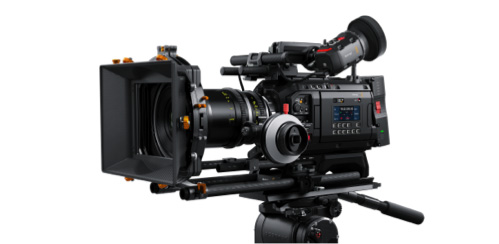
The URSA Cine platform is built for productions that need high-resolution, large-format digital cinematography with streamlined post integration.
The URSA Cine 12K LF features a full-frame 36 x 24mm RGBW sensor, capturing up to 12K 3:2 open gate at 80fps. It’s joined by the URSA Cine 17K 65, which steps up to a 65mm-format RGBW sensor delivering a massive 17520 x 8040 resolution in 2.2:1 open gate, aimed at IMAX, VFX, and virtual production.
URSA Cine captures at resolutions up to 12K and 17K, while allowing users to record lower resolution Blackmagic RAW files, including 8K and 4K, directly from the full sensor area. This delivers the benefits of large-format oversampling, improved image quality, and manageable file sizes, without compromising creative flexibility.
Both cameras offer 16 stops of dynamic range and use Blackmagic RAW with built-in h264 proxy generation. An internal 8TB media module and 10G Ethernet enable real-time syncing to Blackmagic Cloud and DaVinci Resolve, allowing editorial to begin during acquisition. Lens mounts are interchangeable (PL, LPL, EF), with the 17K also adding support for Hasselblad.
Recommended for: While the 12K LF is suited to commercials, music videos, narrative and documentary productions looking for a flexible, cost-efficient full-frame workflow, the 17K 65 targets premium large-format use cases where resolution, sensor size, and visual scale are critical, offering an accessible route into ultra-high-end digital cinematography.
- URSA Cine 12K LF
Sensor: Full-frame RGBW 36 x 24mm
Resolution: Up to 12K (12288 x 8040) 3:2 open gate
Dynamic Range: 16 Stops
Media: 8TB internal Blackmagic Media Module, optional CFexpress
Connectivity: 10G Ethernet, 12G-SDI, USB-C, WiFi, Lemo, Fischer, XLR
Frame Rates: 12K 3:2 open gate up to 80 fps, 12K 17:9 up to 100 fps, 12K 2.4:1 up to 120 fps, 9K 3:2 Super 35 up to 100 fps, 8K / 4K 3:2 open gate up to 144 fps, 8K / 4K 2.4:1 up to 224 fps
- URSA Cine 17K 65
Sensor: 65mm RGBW ultra large format
Resolution: Up to 17K (17520 x 8040) 2.2:1 open gate
Dynamic Range: 16 stops
Media: 8TB internal Blackmagic Media Module
Connectivity: 10G Ethernet, 12G-SDI, USB-C, WiFi, Lemo, Fischer, XLR
Frame Rates: 17K 2.2:1 open gate up to 60 fps, 12K 2.4:1 up to 90fps, 8K 2.2:1 open gate up to 100 fps, 8K 2.4:1 up to 170 fps
Blackmagic URSA Cine Immersive
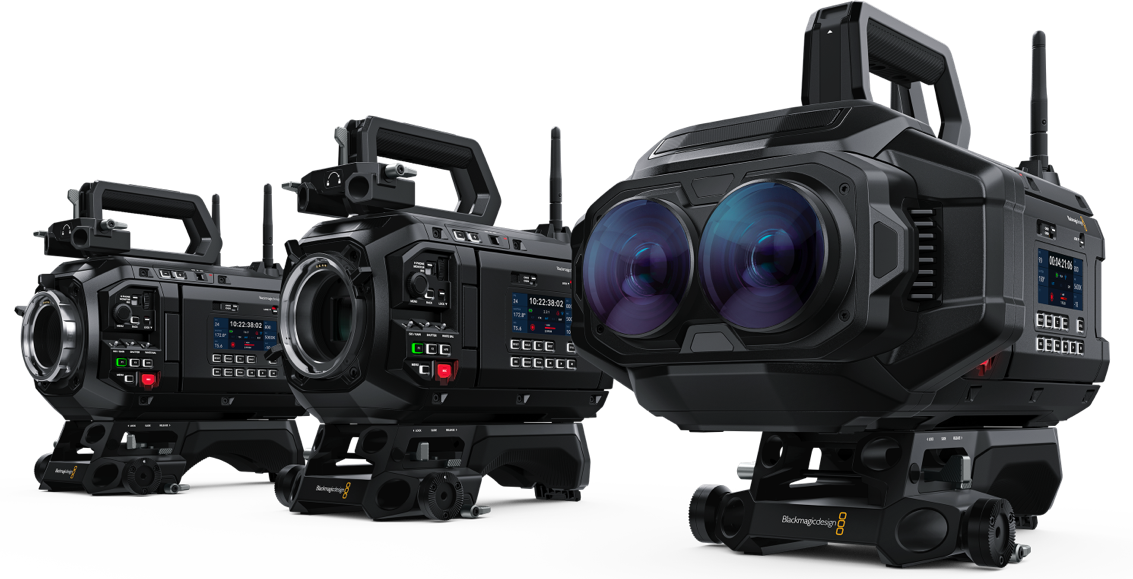
The URSA Cine Immersive is Blackmagic Design’s entry into stereoscopic capture for Apple Vision Pro. Built on the URSA Cine platform, it’s designed specifically for spatial video production, using a dual-lens, dual-sensor configuration to capture 8K per eye at 90fps with 16 stops of dynamic range.
Unlike traditional VR rigs, the system records both eyes into a single Blackmagic RAW file, with factory-calibrated metadata for lens geometry and alignment. This helps simplify ingest and post, especially when working in DaVinci Resolve Studio, which now includes dedicated support for immersive timelines and deliverables.
An 8TB or 16TB internal media module handles high-bandwidth recording and supports real-time sync to Blackmagic Cloud, enabling teams to start reviewing or editing footage almost immediately. Connectivity includes 10G Ethernet, 12G-SDI, USB-C, Wi-Fi, and mobile tethering, mirroring the professional I/O found across the URSA Cine line-up.
Recommended for: URSA Cine Immersive is aimed at productions working in spatial immersive formats, whether for live events, branded content, documentary or narrative.
Sensor: 8K stereoscopic 3D immersive image capture, Dual custom lens system for shooting Apple Immersive Video for Apple Vision Pro.
Resolution: 8160 x 7200 resolution per eye with pixel level synchronization
Dynamic Range: 16 stops
Format: Dual 90 fps capture to a single Blackmagic RAW file.
Connectivity: 10G Ethernet, 12G-SDI, Wi-Fi, USB-C, mobile data
Media: 8TB internal network storage, proxy support
Blackmagic PYXIS
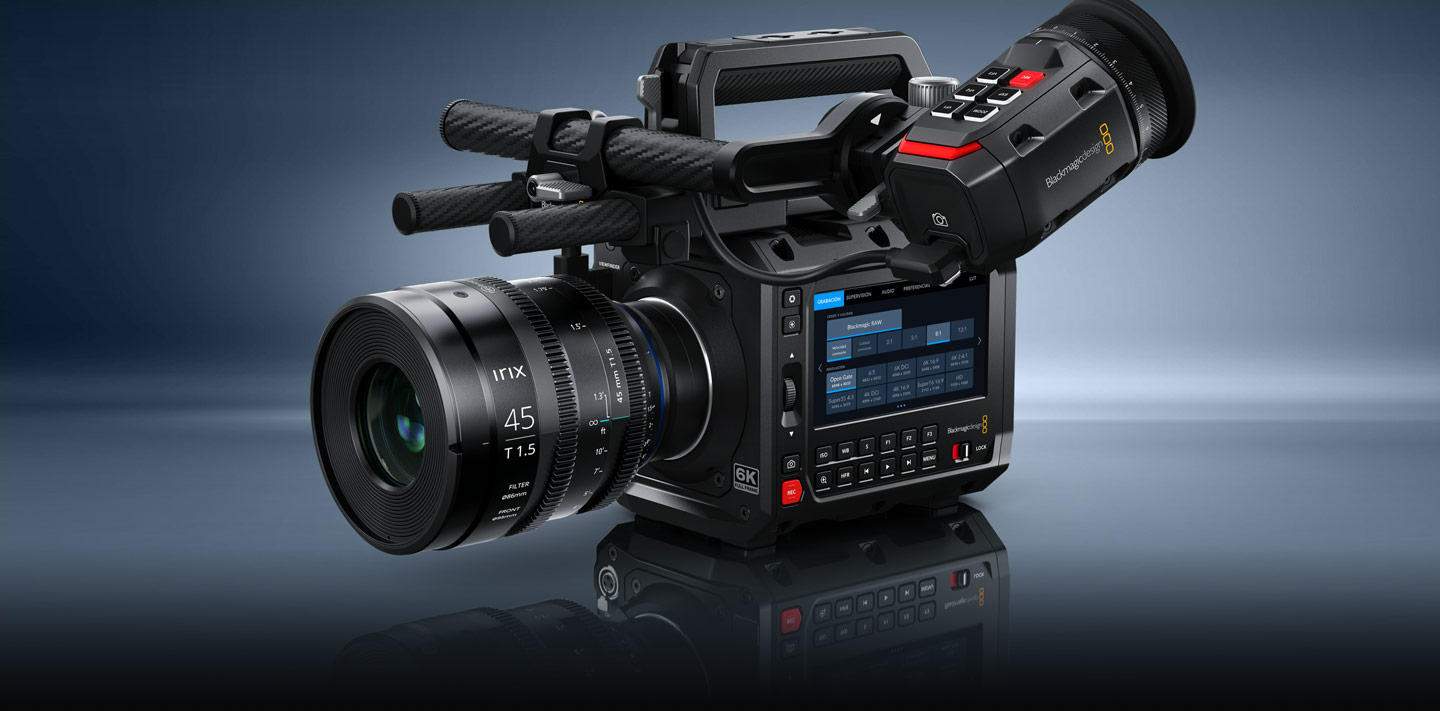
The Blackmagic PYXIS 12K takes the same full-frame RGBW sensor found in the URSA Cine 12K LF and places it into a smaller, more modular form factor. With a 36 x 24mm sensor capable of 12K open gate recording and 16 stops of dynamic range, the camera is designed for flexibility, particularly where space, weight, or rigging constraints come into play.
It’s available in PL, EF, or L-mount configurations and is housed in a CNC-machined aluminium body with multiple mounting points for cages, gimbals, drones, or handheld builds. Recording is handled via dual CFexpress slots and a USB-C port, with support for simultaneous Blackmagic RAW and H.264 proxy capture.
Like its larger sibling, PYXIS integrates with Blackmagic Cloud and DaVinci Resolve Studio, allowing media to be synced and accessed in near real time. A 4-inch HDR touchscreen provides on-set monitoring, and the camera is compatible with the URSA Cine EVF for more traditional operating setups.
Recommended for: PYXIS is aimed at productions that need high-end image quality without the bulk, whether for documentaries, commercial work, aerial cinematography, or second unit shooting where mobility and speed are critical.
Sensor: 36 x 24mm full frame RGBW 12K 12288 x 8040 sensor.
Resolution: Multi scale RGBW sensor for capturing 12K, 8K or 4K at the full sensor size.
Dynamic Range: 16 stops
Mounts: EF, PL, L-Mount
Connectivity: 12G-SDI, 10G Ethernet, USB-C, 4G/5G mobile via tethering, mini XLR with 48 volt phantom power.
Frame Rates: Records full resolution up to 40 fps or 112 fps at 8K.
RED
RAPTOR [X] 8K VV and V-RAPTOR XL [X] 8K VV cinema cameras
RED has expanded its DSMC3 line with the introduction of the V-RAPTOR [X] 8K VV and V-RAPTOR XL [X] 8K VV cinema cameras. Both models build upon the capabilities of the original V-RAPTOR platform, now incorporating RED Global Vision, a new system enabled by an 8K full-frame global shutter sensor. This upgrade enhances low-light performance, image fidelity, and exposure control, while maintaining the compact form factor and high-speed recording features of their predecessor.
A central innovation of Global Vision is the Extended Highlights mode, which enables the sensor to preserve detail and color in extreme highlights, achieving over 20 stops of dynamic range and smoother highlight roll-off, particularly useful in uncontrolled lighting conditions. Another notable feature, Phantom Track, facilitates virtual production workflows by capturing separate R3D clips per LED wall view using technologies like GhostFrame™ or frame-remapping, while offering live monitoring via SDI outputs.
The V-RAPTOR [X] retains the compact body of its predecessor and includes upgraded in-camera audio preamps, dual 12G-SDI outputs for simultaneous monitoring views, a locking Canon RF-style mount, and CFexpress Type B media support for data rates up to 800 MB/s. Frame rate capabilities include 8K up to 120 fps, 6K up to 160 fps, and 2K up to 600 fps, even with global shutter readout.
The larger V-RAPTOR XL [X], aimed at high-end cinema and television, features an integrated electronic ND filter, adjustable in 1/4, 1/3, and full-stop increments. It supports dual-voltage batteries (14 V and 26 V V-Lock or Gold Mount), offering flexibility across production environments.
Both models capture 16-bit REDCODE RAW and are compatible with RED’s IPP2 workflow, reinforcing their role as flagship tools for demanding production settings.
 ARRI

ALEXA 35 Premium and Base models
ARRI has introduced a more accessible version of its flagship ALEXA 35 camera, expanding the platform with the launch of the ALEXA 35 Base model and a flexible licensing system. The existing model, now called ALEXA 35 Premium, continues to offer all high-end features by default, while the new Base version retains identical hardware but offers a reduced core feature set at a lower price point. Key functionalities can be unlocked on demand via temporary or permanent software licenses.
Both models share the same Super 35 sensor, 17 stops of dynamic range, and ARRI’s REVEAL Color Science, ensuring no compromise in core image quality. The Base model includes ProRes recording up to 60 fps in 4K 16:9, ARRI Look File support, Enhanced Sensitivity up to EI 6400, and three independent 10-bit outputs supporting SDR and HDR monitoring.
To provide flexibility for varying production needs, ARRI now offers five modular licenses: ‘120 fps’, ‘ARRIRAW’, ‘Open Gate/Anamorphic’, ‘Pre-record’, and ‘Look’ (which includes ARRI Textures and the Look Library). These can be activated for 7 days, 30 days, one year, or permanently. Users may also choose the Premium License, bundling all features into a single upgrade. If purchased outright, the total cost remains equal to that of the Premium model.
ARRI has also enhanced the ARRI Shop for easier online license purchases, supporting multiple payment platforms and currencies. Licenses can now be purchased by production companies, not just camera owners.








Comments are closed