


What will virtual productions look like in the future? We certainly can’t predict it, but if there’s one company with the authority to guide us on the path this technology will take from now on, it’s Dimension. Over the years, this company has evolved from an immersive content studio to a comprehensive virtual production creative partner across various sectors, including film, entertainment, advertising, live events, and emerging digital platforms.


In this interview, its co-founder and CTO, Callum Macmillan, discusses the key technical challenges they face with these types of productions, their most cutting-edge implementations— such as their custom-modified Unreal Engine environment or their ‘Virtual Humans’—and answers all our questions about the future of this technology.
Don’t miss it!
First of all, how has the company evolved in recent years?
In recent years, Dimension Studio has evolved from being an immersive content studio to a comprehensive virtual production creative partner for productions. These significant changes have seen us expanding both our technical capabilities and our market reach, and has driven investments both in technology and in talent. We’re now in a position where we’re delivering the most sophisticated solutions across filmed entertainment, advertising, live events and emerging digital platforms.
As a pioneering studio in the implementation of virtual production, what major advances have you observed with this technology? What types of innovations are possible now that were not feasible a few years ago?
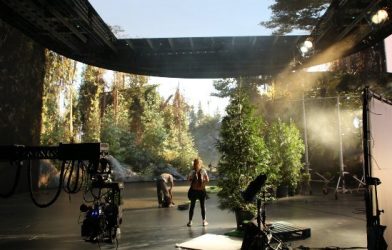
The most recent advancements in real-time rendering has been transformative. Right now, we can achieve photorealistic ICVFX results in realtime that used to need hours of post-processing. Although virtual production is not just about LED volumes, LED wall technology has matured significantly, enabling better color accuracy and higher resolution. We’re now on our third iteration of panel technologies and second generation of image processing hardware which is having a huge impact.
Integration between physical cameras and virtual environments has become seamless, allowing for more natural camera movements and creative freedom. We use all camera and object tracking systems, from large scale optical to maker-based (with SLAM) and even ultra wideband radio technologies..
Perhaps one of our most exciting innovations has been combining Virtual Humans (either puppeteered metahumans or volumetric video captures), with ICVFX virtual production environments, creating hybrid experiences that weren’t possible even a few years ago. Our recent project Evergreen demonstrates really well how we can create directable mid-ground characters that are fully virtual. Populating real-time VP environments with virtual humans to bring life to the mid and background elements of a scene is also something we’ve recently done for the Colosseum shots that Dimension worked on for the Amazon Prime series ‘Those About To Die.’
What are the main technical challenges and difficulties you’ve faced in recent years when developing virtual productions?
One of our primary challenges has been pushing the boundaries of real-time rendering while maintaining in camera visual effects (ICVFX) quality output. Working on productions like Time Bandits (Apple TV+) with Taika Waititi and Here with Robert Zemeckis has required us to develop custom solutions.
This led to our proprietary version of Unreal Engine, which we’ve enhanced specifically for film production. We’ve gone beyond the standard build, integrating specialized hardware acceleration and machine learning and AI libraries at a low level.
Another significant technical hurdle we’ve overcome is the implementation of SMPTE ST 2110 standards, enabling seamless IP-based workflows for real-time production and playout.
Have you recently upgraded any of your studios or acquired new equipment to optimize your virtual productions? If so, could you provide us with some details?
Our most significant advancement has been the development of our custom-modified Unreal Engine environment. This isn’t just an off-the-shelf solution; it’s an optimization of the engine specifically tuned for high-end film production. Working on ambitious projects like Masters of the Air for Apple TV+ and Those About to Die with Roland Emmerich has driven us to continuously evolve our technical infrastructure.
The integration of SMPTE 2110 standards has been crucial, allowing us to handle complex IP-based workflows with frame-accurate precision, which is something we’ve now rolled out on our first virtual production. This architecture has significantly increased our performance envelope, giving us more compute budget to push the visual quality of our environments.
How do you teach technical operators for this type of production? Do you handle this task internally?
Our approach to developing talent is comprehensive and three-pronged. We have strong ties with academic institutions across the UK and beyond, with our team members actively conducting presentations and hosting events at our volumes for students. This academic outreach is crucial for nurturing the next generation of virtual production talent.
Second, we operate a structured work placement program, partnering with training institutions to provide hands-on experience in real production environments.
Third, we’re constantly developing our onboarding process, where senior team members provide hands-on guidance across various disciplines, which makes sure we can transfer knowledge and get teams up to speed quickly with our workflows and best practices. AI is helping here too.
One of the features that differentiate you from others is the so-called ‘virtual humans’ that you’ve already mentioned. Could you explain to our readers what these are and what opportunities they bring?
Our work on digital crowds exemplifies the rapid evolution of our virtual humans technology. The progression from our work on the Whitney Houston biopic I Want to Dance with Somebody to Wicked, directed by Jon M. Chu demonstrates the remarkable advancement in what we’re delivering.
While both projects demanded high-end feature film quality digital crowds at scale, the underlying pipeline has been transformed. For Wicked we implemented significant workflow improvements which made processes much more efficient, showcasing how quickly this technology is evolving. We worked closely with our partners at Arcturus on both projects. Their platform provided much of the scale required to deliver in the time available.
Regarding the demand for this type of production, what trends have you noticed in recent years? Do you think virtual productions are becoming more accessible to lower-budget projects?
There’s absolutely more demand from a wider range of projects for virtual production support. A few years ago, it was predominantly reserved for the biggest projects with significant ‘blockbuster’ budgets, but now we’re working with more independent projects thanks to the way virtual production technologies have become more efficient, and therefore more cost effective.
We’re heading towards a world in which more people will want to setup and operate virtual production studios, something that Dimension is really looking forward to seeing, and being a part of.
Could you share any recent project that you are particularly proud of due to the technical challenges it presented?
Our work on Robert Zemeckis’ Here represents a particularly significant milestone in virtual production innovation and was a project on which we really pushed the boundaries of what’s possible with realtime technologies.
The project required us to create an evolving virtual world viewed through a single window across different time periods. We implemented sophisticated vehicle simulation systems with 55 physics-enabled vehicles, developed complex weather systems including rain, snow, and seasonal changes, and pioneered new approaches to interactive lighting. The use of realtime depth cameras based on laser systems (nLight’s HD3D) provided unprecedented depth information integration, enabling seamless blending between physical and virtual elements. This project exemplifies how far virtual production has evolved from simple LED volumes to sophisticated realtime production tools.
What can you tell us about artificial intelligence and how it’s transforming virtual production workflows?
AI is fundamentally integrated across our entire operation. We use large language models to optimize our production workflows and project tracking, while also maintaining comprehensive departmental knowledge bases. Our artistic teams use text-to-3D and mesh-to-3D tools, and generative AI accelerates our pre-visualization processes through fast 2D imagery generation.
One of our most significant implementations is in procedural content generation, which has revolutionized our environment and layout building processes. This multifaceted AI integration demonstrates how machine learning can enhance both technical and creative aspects of virtual production.
What direction do you think this technology will take in the future? How will it impact the user experience when watching a movie or live event? Do you foresee significant changes in this area in the coming years?
The future of virtual production will be an increasingly seamless integration between physical and virtual elements, as demonstrated in projects like Here, Time Bandits, and Masters of the Air.
We’re seeing a convergence of realtime technologies, AI, and traditional filmmaking – systems will become more modular, volumes will become more flexible and dynamic be that for led production for the performance capture or for volumetric capture, they all exist in a volume – that’s revolutionising how stories can be told. The viewer experience will become more immersive as the line between practical and virtual elements continues to blur.
We anticipate even more significant advancements in realtime rendering quality, enhanced by AI and machine learning, leading to even more photorealistic results. The integration of technologies like SMPTE 2110 and our custom-modified Unreal Engine implementations suggests that virtual production will become increasingly accessible while maintaining the highest quality standards.
In particular, how do you think virtual production is affecting the world of post-production?
Virtual production is fundamentally reshaping post-production workflows.
The traditional linear progression from production to post is evolving into a more integrated, parallel process. Our experience on Here demonstrates this shift perfectly – we were able to capture final-pixel quality imagery in-camera while maintaining flexibility for creative decisions. The integration of realtime depth information and sophisticated environmental controls means that many traditional post-production tasks are now being handled during principal photography.
This doesn’t eliminate post-production but rather transforms it – we are working hard on the turnover process to visual effects, how do we aggregate all the data that we have handled and pool that in the most meaningful way for comp if required – allowing teams to focus on enhancing and refining rather than building from scratch. The result is a more efficient, creative, and collaborative process that maintains the highest quality standards while enhancing efficiency and reducing costs in post-production.





Comments are closed