


Lola Post Production, a pioneering visual effects (VFX) boutique based in London, was founded in 2000 by acclaimed VFX supervisor Rob Harvey. With a rich history that includes work on Ridley Scott’s “Gladiator,” Harvey and his team have built a reputation for delivering high-end, award-winning visual effects for film and television. Over the years, Lola has expanded its portfolio to include commercials, music videos, TV presentation graphics and long-form TV shows, embracing a diverse range of projects that showcase their agility and innovative approach.


In this exclusive interview with TM Broadcast International, Rob Harvey discusses the origins of Lola Post Production, the unique qualities that set them apart in the competitive VFX industry, and their recent projects, including the BAFTA-nominated “Universe” for the BBC and the ambitious “Walking With Dinosaurs” revival for BBC Studios. Harvey also shares insights into how Lola has adapted to the evolving landscape of audiovisual post-production technologies, their innovative use of Unreal Engine, and the strategies they employ to foster creativity and collaboration within their team. Join us as we explore the journey of Lola Post Production and the vision that continues to drive their success in the ever-changing world of visual effects.
How did Lola Post Production come into existence, and what inspired its founding?
Lola was founded in 2000, among the first boutique visual effects (VFX) companies in London. I was a director at Millfilm and one of the VFX supervisors on Ridley Scott’s Gladiator. Upon the completion of that project, a small group of us decided to establish our own facility. We had valuable contacts and clients who were highly supportive and encouraging. It was a significant and challenging decision, as our company was relying on external financing to cover the initial set-up and equipment costs. This presented a clear focus for our business strategy.
At the time, we identified an opportunity to make a move as the market was experiencing a decline in equipment prices. For instance, Flame was available at a competitive price of approximately £250,000. This allowed us to explore new avenues and pursue a more tailored approach to our business.

What are the unique qualities that differentiate Lola Post Production from its competitors in the industry?
We are a highly agile company, with a strong track record in commercials, music videos, and TV presentation graphics. However, we have also expanded our capabilities to include long-form TV shows such as Ancient Egyptians (Channel 4/Wall to Wall) and Jack and the Beanstalk (Hensons), which represents a new genre for us. Furthermore, we expanded our client base to include feature films and documentary and docu-drama projects. We embrace the diversity of our work and strive to avoid being pigeonholed.
I have been in the industry since the mid-eighties, when CG was in its infancy. As a result, I have considerable experience of ‘old school’ techniques such as physical SFX, high-speed studio effects, animation and models. We continue to combine these techniques with more cutting-edge technology, which allows us to create a distinctive approach and visual style while effectively managing challenging budgets.
Can you provide insights into recent projects successfully completed by Lola Post Production, challenges and how did you overcome them?
We have worked on some really diverse projects over the past couple of years. Universe for the BBC featuring Professor Brian Cox was nominated for a VFX BAFTA required us to create almost two and a half hours of VFX, from the Big Bang to the Death of the Universe. We have also finished three Natural History Shows: Our Living World and Our Planet II for Netflix and David Attenborough’s Dinosaurs: The Final Day.
For Dangerous Liaisons (Starz/ Lionsgate) we recreated the splendour and slums of 18th Century Paris, including a full CG model based on historical maps, and in our spare time worked on The Completely Made Up Adventures of Dick Turpin (Apple TV+), Bad Sisters (Apple TV+) and Alexander: Making of a God (Netflix). Despite the challenges of Covid, remote working and strikes in the US, our rather diverse projects have kept us really busy.
We are currently working on Working With Dinosaurs, a six part series for BBC Studios that was officially announced yesterday. https://deadline.com/2024/06/walking-with-dinosaurs-bbc-pbs-25-years-1235958452/
It’s by far the biggest project Lola has undertaken and is due to finish at the end of the year. It’s around 1000 shots featuring a cast of around 50 dinosaurs, appearing in location plates shot around the world. We have had to expand the company quite considerably and build a robust creature pipeline and crew of specialist creature artists and animators.
The challenges for all these projects are always schedule and budgets. In most cases we get involved at the script stage, often even before the scripts are written or before the shows are officially green-lit. We offer advice to the clients about methodology and techniques and how to keep the ambition realistic, and we spend a great deal of time working things out on paper before we start – storyboards and concept art are a big thing at Lola.
How has Lola Post Production adapted to the evolving landscape of audiovisual post-production technologies?
We try to keep our core team quite small and crew up depending on the project, also our tech and pipeline tends to evolve rather than us investing enormous sums of money in one go. Until recently we were a self-funded company, so we won’t usually jump on a bandwagon until we have a use for the tech. We do occasionally get very excited at new toys, back in the day we were very early fans of (amongst others) Houdini and Arnold and helped the guys at Tinder tools (before world domination), and we are currently knee-deep in Unreal Engine and having fun with that.
Could you share any innovative approaches or strategies Lola Post Production has implemented recently?
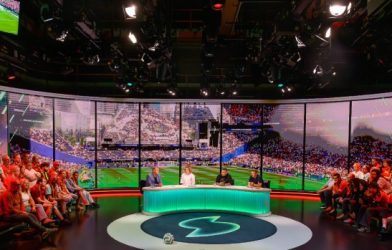
On the subject of Unreal, we were asked to build an Unreal pipeline to create environments to then shoot in a virtual studio with Sir David Attenborough for the Dinosaurs: The Final Day. Unfortunately, we only had six weeks between go-ahead and shoot so that was quite a steep learning curve! We have incorporated Unreal now into our production pipeline and are using it for location scouting, pre-vis, post-vis and in final post…. It’s very exciting.
How does Lola Post Production foster creativity and collaboration within its team to deliver exceptional results in post-production projects?
We have a core team of very talented Supervisors and leads and everyone gets involved in pitches, R&D and tests on shows. We also encourage anyone to come up with ideas and reference images, this includes production, and editorial as well as the artists. Our initial ideas can come from anywhere, a painting, installation, film, even something unrelated to art or media.
Once a show is in production we give our crew quite a lot of responsibility and encouragement and have regular meetings, online or preferably face to face in the studio to run through the work and discuss it in a wider group. We have noticed that since the pandemic and now remote working is more commonplace, artists can get very isolated and particularly the younger members of the team can miss out on one-to-one mentoring which is so important to develop skills, both on the box and with others on the team.

How do you incorporate AI-driven editing tools into your workflow, and what benefits do you see in using these technologies?
I think the jury is still out regarding AI. We currently don’t really use these tools, maybe with some re-speeds or other really simple tasks, but in terms of generating content we avoid it. There are issues, both moral and practical around copyright and we are finding that we are having to sign waivers saying we are not using AI on some projects.
Having said that, I have used image generators to kick off some ideas for pitch concepts, the rather random nature of AI can bring things up that are so left field that I’d never come up with them myself.

What are the most significant trends in audiovisual post-production that you have observed in recent years, and how do you see them shaping the future of the industry?
This is a tricky question. I think the industry is struggling at the moment, the pandamic was a disaster but when we came out of lockdown and the studios and broadcasters needed content, there was an explosion of new commissions on top of the ones that had been delayed or cancelled, many new post and VFX companies and therefore shortage of talent across the board. This bubble has deflated, if not completely burst, but then going into the strikes and a slow down in production has left companies struggling and many people sadly out of work.

What strategies do you use to ensure collaboration and communication among team members, particularly when working on complex projects with multiple stakeholders?
It’s all to do with communication, we use Shotgrid across Lola and our clients use it to view progress and feedback. We also have daily meetings with groups on the team, it could be Production, the animation department, the Supervisors, compositing or a team across several department to chat about a particular sequence or episode.
We are lucky to have quite a few returning clients and a regular team of freelancers and contractors, so often the teams are familiar and have a relationship. Clients come into the studio as much as possible to view shots with the team face to face.
I hate to admit it, and wouldn’t encourage it, but I’m often called in the evening or at a weekend for chat with a director or producer. Having said that, many of them have been friends for years so I can’t complain.
What upcoming projects does Lola Post Production have in the pipeline for the near future?
We have a couple of series in the pipeline, unfortunately as is common these days they are under strict NDAs so I can’t mention them by name… sorry! I can say we have a comedy series, a historical drama recon and possibly a feature film on the horizon, so a bit of everything.
How do you envision the future of post-production evolving, and what new technologies or techniques do you see becoming increasingly important in the industry?
In the 24 years that Lola has been going, I would say the industry hasn’t really changed that much. Companies and technology come and go – or evolve, but the basic process is pretty much the same. Clients tend to have bigger ambition than the budget may allow, and schedules are always an issue. I think there has been a seismic shift in terms of younger people’s viewing habits and over the coming years we will probably see very different content and viewing platforms becoming the norm.
What advice would you give to aspiring post-production professionals looking to break into the industry, and what skills or knowledge do you think are essential for success in this field?
The million dollar question! So much can be down to luck, nepotism, being in the right place at the right time, but if I could offer any advice it would be to be patient and listen. It’s unlikely you’ll be VFX Supervisor on a feature or Head of Production within six months, whatever your parents have told you.
Obviously, there is hard work and talent involved, but be prepared to learn and gain experience and if possible get into a studio environment where you can interact and become part of a team and hopefully gat some mentoring from more senior team members. Social skills, diplomacy, talking to people and asking questions is so important – you may go into the industry with a clear idea of what you want to do, and then find another path that’s more interesting.
Personally, I like artists with Art School experience, we can teach the software, but having a good eye and ideas is just as important. There are some great courses out there, depending on what you want to do, and many post and VFX companies are involved with the colleges and actively look to cream off the best students. A runner is usually a good starting position, and remember a good CV with no spelling mistakes or bad grammar!





Comments are closed