


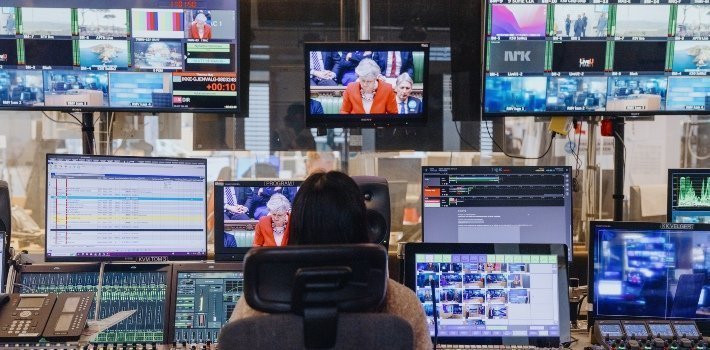
We speak with its CTO, Pål Nedregotten, to explore the main technical challenges of this process and to provide an overall assessment of its current technological landscape


*This content is included in the June issue of TM BROADCAST. You can access the full magazine here.
By now, no one doubts that the transition to IP is one of the major technological revolutions in the broadcast sector. But implementing it is another matter entirely, involving many factors due to the scale and complexity of such migrations. The Norwegian public broadcaster NRK is currently immersed in this process.
“We are in the process of standardizing our systems and have developed a working Minimum Viable Product (MVP) for this new IP-based infrastructure,” CTO of NRK, Pål Nedregotten, tells TM BROADCAST. “This shift also necessitates a significant upgrade in our workforce’s skillset, moving from traditional broadcast engineering to software and IP-based integration skills.”

Pål Nedregotten shares with us the key elements of this transition and gives us a preview of what’s next: “The first major delivery will be for our new Trondheim location in 2026, which will feature the first production-ready version of our new IP-based platform.”
We also take the opportunity to provide a broader overview of NRK’s current technological status. This conversation with its technical director is part of a special series of reports on the current media ecosystem in the Nordic countries. In previous editions, we spoke with executives from Sweden’s SVT, Denmark’s TV 2, and Iceland’s RÚV (you can access those articles by clicking the links below).

“We are moving away from legacy, building-dependent systems and replacing our entire production technology stack”
Below, the full interview:
To begin with, I’d like to hear more about your technological transformation.
NRK is currently undergoing a complete and fundamental transformation of its technological infrastructure. This is driven by the upcoming relocation of our main facilities in Oslo and Trondheim. We are moving away from legacy, building-dependent systems and replacing our entire production technology stack.
The most significant upgrade is the transition from traditional, battle-tested SDI to a modern, IP-based stack built on the SMPTE 2110 standard. This new architecture is designed around highly resilient, shared data resources that are engineered to be accessed remotely. We are in the process of standardizing our systems and have developed a working Minimum Viable Product (MVP) for this new IP-based infrastructure. This shift also necessitates a significant upgrade in our workforce’s skillset, moving from traditional broadcast engineering to software and IP-based integration skills.
So, what are your next steps moving forward?
Our primary focus for the near future is the complete technological outfitting of our new, custom-built facilities. This is a massive undertaking with hard deadlines. The first major delivery will be for our new Trondheim location in 2026, which will feature the first production-ready version of our new IP-based platform.
The larger and more complex project is the relocation of our Oslo operations, scheduled for 2029. This involves moving 2,400 people and replacing the entire technological core for our numerous radio and TV studios and editing suites. While the foundational IP architecture is set, we are still analysing future production needs to determine the final scale of studios, control rooms, and editing suites required in the next decade. The entire project is a delicate balancing act of building the future while maintaining current broadcast operations.


“NRK has an in house developed HTML graphics solution called NORA that basically handles our main graphics demands”
In which resolution are you currently broadcasting?
We are producing in 1080i25 at the moment, but are considering 1080p50 for selected productions. Our distribution chain is prepared for going 1080p50. We also consider HDR more valuable to the viewer than UHD, which also makes sense from a cost perspective.
How do you approach graphics, and to what extent have you tested immersive technologies or augmented reality?
NRK has an in house developed HTML graphics solution called NORA that basically handles our main graphics demands. For specific immersive technologies we have used Unreal and VizRT. We are in a process of phasing out VizRT.
Considering you’re in the middle of a transformation process, have you acquired any significant equipment recently? Which manufacturers do you usually rely on?
As we are in a transition to IP workflows we have chosen DHD DX2 series audio mixers for our Radio studios and production rooms such as editing suites and pre-production radio. In the Video galleries we have chosen Panasonic Kairos. As we are aiming for a true SMPTE 2110 workflow, it showed to be a good fit for our goals.
What would you say is the current state of 5G adoption in your workflows?
We have an interest in 5G as technology, but we have been slow at adopting it. We made some interesting trials during the Nordic Skiing championships in Trondheim, where we collaborated with Telia to produce roaming camera production using private 5G networks, while trying to use public network during medal plaza production in the evening. We learned that it has a lot of potential, but we are dependent on private networks. We also learned that latency quickly becomes an issue.

“The larger and more complex project is the relocation of our Oslo operations, scheduled for 2029. This involves moving 2,400 people and replacing the entire technological core for our numerous radio and TV studios and editing suites”
To what extent are you adopting artificial intelligence and process automation in your workflows? How do you see their influence in the near future?
AI has the capacity to both strengthen, facilitate and upend a lot of our current and future processes, and AI tools are increasingly present in all the software we licence. Some of the opportunities we see are tremendous, some are frankly more hype (and cost!) than real value.

Automation in text to speech in our user-facing products, automatic generation of metadata, and speech to text in production processes show a lot of promise – but currently the entire business is applying AI to known problems, sometimes with tangible benefits. I think, however, that the real gamechangers are ahead of us – where we see entirely new opportunities not tied to our current thinking.
What is your level of confidence in and adoption of cloud technologies compared to on-premise systems?
We have a significant amount of containerised code in the cloud, spread across two of the largest hyperscalers. Cloud services are a crucial part of our technological setup, although we’ve experienced that the cost benefits aren’t always there, and that sometimes it makes sense to retain a service on-prem. It’s very much a question of utilising cloud offerings in the right way, for the right kinds of services. We’re still planning to retain a significant presence in hosted data centres for our core production processes. The key issue is finding the right balance and flexibility – and making informed choices as the technology develops and opportunities arise.
Finally, what is your position regarding OTT services?
In terms of OTT, I think it’s fair to say that the tipping point from linear to streaming is very close. In many user groups, it’s clearly already happened. Currently, roughly one third of our viewers choose streaming when accessing our content. Linear holds steady compared to last year, while streaming is growing. So our total reach is actually increasing – but it’s very much streaming that is the growth factor.
This is a trend that potentially has a profound impact on the way we approach our programming. But it’s also a shift that in time has the potential to impact the entire technological value chain, from the choices we make in distribution, to internal discussions on the right technological quality. And of course it impacts the way we approach the player end. The user-facing view and navigation of our player is crucial to get right, and to continue to develop with a clear eye on shifting user habits. While we could never compete with the budgets of the worldwide streaming platforms, we’re nonetheless judged by our users using the same yardstick.
Also, compatibility on older smart TV sets has been and continues to be an issue, while new entrants into the TV field opens up discussions about player support. Maintaining and developing across a whole range of different operating systems with varying degree of technological support is, quite frankly, expensive. Just last year we had to cut off access to older Samsung smart TV sets – because it was simply impossible to support them functionality-wise, and cost-wise. That’s a difficult decision to make – I fully understand viewers who are disappointed that we will no longer support their TV sets – but unfortunately these dependencies are out of our control.

“As we are in a transition to IP workflows we have chosen DHD DX2 series audio mixers for our Radio studios and production rooms such as editing suites and pre-production radio”





Comments are closed