


We break down the key technical aspects behind the audiovisual production of Spain’s premier cycling race, based on first-hand information from the country’s public broadcaster


*This content is included in the November issue of TM BROADCAST. You can access the full magazine here.
La Vuelta a España is one of RTVE’s most demanding yearly projects. The public broadcaster has been responsible for the technical coverage of the cycling race since its inception. Coinciding with its 80th edition, TM BROADCAST visited RTVE’s mobile production compound deployed at one of the event’s most emblematic mountain finishes: Puerto de Navacerrada, in Madrid.
There, we witnessed first-hand the effort and coordination of RTVE’s technical teams—an experience that inspired this in-depth feature, in which the broadcaster’s own professionals explain the main elements and challenges of this ambitious sports production.
The full report is available in the Spanish edition of TM BROADCAST. The following is an adapted extract for our international readers, focused on the essential technical aspects that place this coverage on par with the world’s major sports events.
Overview
RTVE acts as host broadcaster of La Vuelta, deploying a complex production setup designed to tell the story “from within” the peloton. The coverage combines on-board acquisition (motorbikes and helicopters), air relays, ground reception, satellite uplink, and a finish-line compound with several interlinked OB vans. The overall design pursues three key goals: broadcast continuity, image and sound quality, and resilience under changing conditions such as mountainous terrain, weather variations, and topographical challenges.

The overall design pursues three key goals: broadcast continuity, image and sound quality, and resilience under changing conditions
Pre-production and planning
Preparations begin several months in advance and are structured around three main areas:
- Host broadcast operational design: camera mapping, sizing of OB units, air and ground coverage, and service catalogue for third parties (official graphics, UCI VAR, international clean/dirty feeds, etc.).
- RF architecture and site selection: 3D terrain simulations and route analysis define follow-up sites that guarantee line-of-sight with aircraft throughout each stage. Accessibility and permits are verified on site.
- Comprehensive testing: ground and flight trials with the full RF ecosystem (motorbikes, helicopters, aircraft), matrix adjustments, portable earth stations (ETT), video servers, and intercom systems.
Capture on the road: Motorbikes and helicopters
The narrative “heart” of the race lies in five motorbikes (one with a commentator and four with cameras) and two Wescam helicopters:
- Optics and cameras (motorbikes): 4K lenses (8.5–128 mm) for 2/3″ sensors with variable-angle prism stabilization to minimize vibration. The commentary bike also carries a minicamera for on-the-move interviews (e.g., with sports directors).
- Encoding and modulation (motorbikes): the HD-SDI 1080/50i signal is encoded in HEVC 4:2:2 Main10 (H.265) with low latency, MP1-Layer2 audio (128 kbps), and modulated in DVB-T2 2K QPSK (≈5.1 Mbps per stream). Wescam units transmit similarly in DVB-T2 2K QPSK (≈6.4 Mbps).
- Frequency management: each airborne or ground camera operates on a dedicated uplink frequency to avoid interference and facilitate switching.

The RF backbone: Airborne relays
To carry signals from the race to the finish line, aircraft orbiting above the peloton act as airborne relays:
- Tracking and pointing: aircraft belly antennas steer their beam using embedded GPS telemetry from each ground transmission. Pilots maintain wide-radius turns to avoid shadowing emitters under the coverage cone.
- Aggregated re-transmission: each aircraft aggregates and re-forwards up to seven signals over four DVB-T2 (6 MHz, 16QAM) carriers to the designated follow-up site for that stage, ensuring line-of-sight. A UHF repeater supports production intercom links with motorbikes and helicopters.
- Weather resilience: if an aircraft faces operational constraints, a helicopter equipped with a backup transmitter can temporarily assume relay functions.
Ground reception, uplink, and return feeds
At the follow-up site, DVB-T2 carriers are demodulated and multiplexed into ASI streams (four trunks ≈20 Mbps) for satellite uplink via two redundant ETTs (four 18-MHz carriers, up to ~33 Mbps).
- Cross redundancy: ASI allocation (e.g., motorbikes 1–3, motorbikes 4–5 + Wescam 1–2, duplicated in pairs) ensures that if one ETT fails, all seven sources remain available.
- Returns and coordination: the satellite link also carries programme returns and coordination orders via UHF (director, Wescam, commentary bike, etc.), minimizing decision latency.

The narrative “heart” of the race lies in five motorbikes (one with a commentator and four with cameras) and two Wescam helicopters
Finish-line compound: OB vans and matrices
At the finish line, three interlinked OB vans (PEL and B1) are connected through Riedel MediorNet (25 Gb or Compact Pro stage boxes). Their typical roles:
- PEL 3 (stage finish): controls five cameras (including super slow-motion) along the final ~400 m and handles 10 replay/2 record EVS channels. Often coordinates Wescam 2 (landscape/beauty shots).
- B1 (international feed): produces the host signal with seven own cameras at the finish (line, podium, interviews), plus PEL 3 cameras and aerial/ground signals. Networked EVS provides up to 20 record / 4 playback channels. Integrates official graphics (profiles, timing, classifications) as fill/key from the graphics provider. Delivers the “dirty” PGM (with international stereo, English commentary, Radio Vuelta, etc.) to the event’s satellite operator.
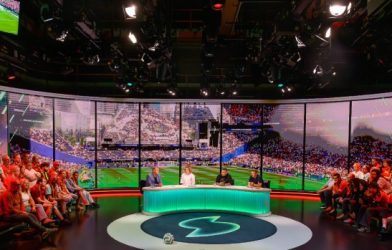
- PEL 1 (domestic feed): builds the national broadcast with its own set (presenters, commentators) and takes the international clean feed from B1 to enrich it with local graphics and content. Sends its PGM to the links unit for DTT distribution and IP backup via FTTH.


Quality control, color, and latency
The seven race feeds are demultiplexed at the finish-line links unit and converted to HD-SDI 1080/50i. Since each arrives duplicated over two paths, the best contribution is selected in real time—mitigating RF shadows from forests or terrain. Motorbike feeds are color-matched via remote color correctors over a dedicated Ethernet LAN. End-to-end latency from capture to matrix injection is around 600 ms.
International distribution and third-party services

As host broadcaster, RTVE provides:
- International “dirty” and “clean” signals for rights-holding broadcasters.
- Feeds for official graphics (timing), the UCI VAR system (all cameras), and venue/VIP screens.
- International audio mixes, English commentary, N-1s, and other requested formats.
Radio and multi-angle digital output
- RNE (Radio Nacional de España): commentary is produced from an onboard workspace using IP audio over 4G/5G with portable codecs (redundant RF on low bands plus LEO satellite backup). This approach simplifies operation while maintaining consistent quality in congested environments.

- OTT platform: digital audiences can access multiple live feeds (main programme and motorbike/helicopter feeds). SRT streams sent via FTTH from the finish line are decoded at the control centre, converted to baseband, and republished to CDN in adaptive profiles for multiscreen consumption.
Daily operation and workflow
Each race day follows a well-defined pattern:
- Power-up and cabling of the compound, setup of finish-line sets and cameras.
- Activation of the follow-up site (ETT, satellite alignment) and flight checks.
- On-route ENG coverage for ambience/interviews, ingest and transcoding at the unit server.
- On-air coordination between international production (B1), domestic feed (PEL 1), replays/storage (PEL 3), and third-party services.
- Disassembly and relocation to the next stage for overnight parking and preparation.
Resilience and design philosophy
The system relies on horizontal and vertical redundancy: dual reception chains (ETT), ASI duplication, backup paths (helicopter relay), best-signal selection at destination, unified colorimetry and control, and parallel distribution channels (satellite + IP). This design ensures continuity, signal traceability, and consistent quality across complex topographies and rapidly changing environments.
Conclusion
Producing La Vuelta demands a mobile architecture that blends immersive capture, robust RF infrastructure, distributed processing and switching, and multi-format delivery for both linear and digital platforms. RTVE’s setup integrates the entire chain—from motorbike to satellite, and from there to broadcasters and OTT services—with fine quality control, low latency, and comprehensive third-party support, achieving a coverage standard fully aligned with the world’s top-tier sporting events.

Producing La Vuelta demands a mobile architecture that blends immersive capture, robust RF infrastructure, distributed processing and switching, and multi-format delivery for both linear and digital platforms





Comments are closed