


By Luis Sanz, Audiovisual Consultant


For the drafting of this article we have relied on the information included in the document “Olympic Games Paris 2024 Media Guide” by OBS y comments by Isidoro Moreno, Chief Engineer at OBS.
OBS and the revolution of INTEL’s modular, virtualized production
As the host broadcaster of the Olympic Games, OBS has faced a specific set of challenges when planning the Mobile External Broadcast Units (OB Vans) or mobile systems that are essential for live event coverage. Key factors include the space required in the broadcast enclosure at venues, the internal space needed to accommodate both equipment and production staff, as well as ensuring that all hardware devices are configured and up-to-date to deliver top-notch production quality. Logistics is equally crucial, as it encompasses procuring production units, transporting them globally, shipping specialized equipment, staffing for technical and production teams, and setting up at the venue. In addition, it is essential to consider the environmental impact associated with the carbon footprint, thus avoiding the unnecessary transfer of large amounts of hardware, especially servers, from the other side of the world, and choosing local solutions whenever possible, given that it is COTS (Commercial Off-The-Shelf) hardware, which reduces the need to mobilize specific equipment and contributes to more sustainable logistics.
To address these challenges, OBS has partnered with global sponsor INTEL in order to explore more flexible and modular production environments. This innovative strategy has aimed to streamline logistical and operational complexity, increase flexibility and reduce the total broadcast space at the venues. Through this collaboration, OBS and INTEL are opening a new era in broadcast technology, thus creating scalable and adaptable solutions that cater to the demands of Olympic broadcasting while setting new benchmarks for efficiency and sustainability in the industry.
The move towards virtualized OBs will continue as technology advances and broadcasters look for more efficient, flexible, and sustainable production methods. With progress seen in cloud computing, artificial intelligence (AI), and real-time communication, virtualized OBs will likely become a standard in sports broadcasting, offering unprecedented capabilities and transforming the way live events are covered.
What is a virtualized OB?
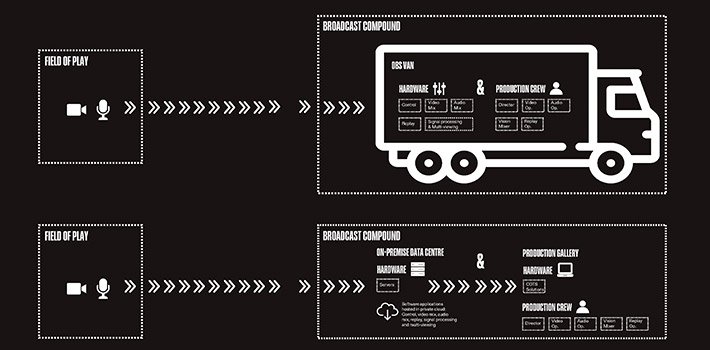
A traditional OB is a mobile production unit equipped with all the technology needed to produce live broadcasts, including cameras, audio equipment, mixers, matrices, and control panels. A virtualized OB decentralizes much of this equipment, using a software-based, cloud-hosted architecture that replicates the function of a traditional OB and off-the-shelf (COTS) commercial solutions to handle many production tasks. This transformation offers several advantages:
- Efficiency: A traditional OB has numerous elements that provide maximum flexibility, but in many cases these may be unnecessary for a specific operation. In contrast, a virtual unit virtualizes only the necessary elements within the TV production chain for a particular event, thus optimizing resources and reducing operational complexity without compromising the quality of the broadcast.
- Reduced footprint: Virtualized production configurations are designed to significantly reduce the technical, logistical, physical, financial, and ecological footprint. Less equipment is needed on site, resulting in smaller and more mobile units, and less space and resources required at sites.
- Scalability: Cloud resources can be scaled up or down depending on the requirements of the event, making this a cost-effective solution.
- Remote production capabilities: Production equipment can operate from anywhere, offering greater flexibility and resiliency.
Main features
- Cloud-based infrastructure: Core production tasks such as video switching, video-audio mixing, and replay generation are performed by using cloud servers. This configuration reduces dependency on on-site hardware.
- Remote operations: Directors, producers, and technicians can collaborate and control the broadcast remotely, allowing for more efficient use of staff and resources.
- Resiliency and redundancy: Cloud solutions provide built-in redundancy and failover capabilities, thus ensuring uninterrupted transmission even when facing hardware failures.
Benefits
- Cost-effectiveness: By reducing the need for large equipment and staff on site, a virtual OB reduces production costs.
- Flexibility: it can be quickly adapted to different types of events and scales.
- Improved quality: Advanced cloud technology enables higher-quality production capabilities on demand.
- Sustainability: Smaller physical footprint (and potentially reduced travel for production teams in a completely remote setup) contribute to lower environmental impact.
- Future-proof: As streaming technology continues to evolve, a virtualized OB can easily integrate new innovations without significant overhauls of the physical infrastructure.
Challenges
- Bandwidth and latency: Reliable, high-speed cloud connections are crucial to the smooth operation of a virtualized OB. Latency can be a major issue for live broadcasts.
- Training and adoption: Production teams should be trained to adapt to the new workflows and technologies associated with a virtual OB.
- Cybersecurity: Ensuring the security of cloud-based operations is vital to protect against cyber threats and unauthorized access.
History
January 2021: Development starts
February 2022: Proof of Concept (POC) at Beijing 2022
The virtualized OB was deployed in the curling enclosure, in parallel to the main production setup. The purpose of this test was to check functionality and interoperability, as well as the ingestion and processing of the 1080p50 SDR video streams from 18 cameras used for the coverage of one of the curling sheets, along with the audio streams. An on-premises data center replicated the cloud-based architecture platform. In addition, four additional native IP cameras dedicated to the virtualized OB project were connected, thus eliminating the need for camera control units. The performance of the virtualized OB exceeded all expectations.
March 2022 – December 2023: Development period
To ensure that the virtualized OBs meet the strict OBS production standards, multiple POCs, test events and a close collaboration with partners and suppliers were carried out. Collaboration with OBS host producers played a key role in ensuring that technology is ready for live use, demonstrating its practicality and robustness in real-world scenarios. This rigorous process included production teams verifying quality standards, thus ensuring virtualized OBs delivered exceptional performance and reliability. Significant progress has been made in the field of virtualized transmission solutions in the last two years, coming closer to matching the capabilities of traditional broadcast equipment.
January 2024: Implementation of live production. Stage 1 at Gangwon 2024
The virtualized OB was initially deployed at the curling venue in week 1 and then reinstalled at the ice hockey venue in week 2, strictly adhering to the technical setup and specifications planned for Paris 2024. This application demonstrated the feasibility and efficiency of the solution as an alternative to traditional broadcast equipment in a live coverage environment and helped fine-tune preparations for Paris 2024.
July 2024: Implementation of live production. Stage 2 at Paris 2024
At Paris 2024, OBS has deployed virtualized OBs at three competition venues to produce 14 multilateral broadcasts across five sports. They have been located at Roland Garros (for side tennis courts), Champ-de-Mars Arena (for judo and wrestling) and Chateauroux Shooting Centre (for shooting).
Virtual OBs have been used on 7 tennis courts. In the 4 central tennis courts, neither traditional nor virtualised OBs were used, but the camera signals were sent, within the Roland Garros facilities, to cabins in which racks were located with the hardware in SMPTE 2110 as necessary for the production of the final broadcast signal.
The virtual OBs for tennis worked with the cloud, using edge server installations, a Data Center or outpost (local data center infrastructure at the OBS headquarters) that was also installed at Roland Garros with the collaboration of the sponsor INTEL. The production of the signal was carried out with software applications installed as cloud services. Having the data center so close to the cameras made it convenient to make camera copies locally; copies of more than 80% of the cameras used in the games were handed over to the committees and broadcasters. Furthermore, due to the proximity, latency was practically non-existent.
An in-depth look at Olympic virtual OBs
The deployment of virtualized OBs marks a significant leap in broadcasting technology, spearheaded by OBS. These state-of-the-art units are set to revolutionise the way live Olympic events are broadcast, particularly in large-scale environments such as the Paris 2024 Olympic Games.
Configuring a virtualized OB
Virtualized OBs are powered by a suite of sophisticated VOB software, comprising five key pillars. Each pillar is made up of top-tier manufacturers offering virtualized solutions, selected after careful research and development.
The implementation of a virtualized OB reflects the configuration of a transportable hardware flypack system. The local data center comprises racks of COTS (Commercial Off-The-Shelf, equipment mass-produced products available to the general publi)c to which cameras, microphones, etc. are connected as sources… Together with these are the production galleries, designed to look a lot like traditional production units. This design requirement ensures minimal visible and operational impact on production equipment.
Configuration times are progressively reduced as the integration of various software components becomes more agile by means of sophisticated IT-based mechanisms. This trend promises even faster and more efficient setups in the future.
OBS employs a simple multilateral approach with minimal video layers in the video mixer, which typically uses a GFX signal and avoids complex picture-in-picture configurations. This simplicity allows for optimal use of available resources, thus resulting in improved efficiency and performance.
Ensuring low latency and high reliability
One of the main challenges in cloud-based broadcasting is managing latency, particularly for on-site multilateral program delivery, which must be accessible with minimal delay for commentator positions, large screens, and other local uses. To address this, OBS has opted for private on-premises data centers (edge computers), which has avoided the need to route signals back and forth to the cloud. This setting has ensured that latency is maintained within the 100 -150 milliseconds range.
Theoretical configurations suggest that these private data centers could be centralized in the International Broadcasting Center (IBC) or in a nearby commercial data center, as long as the physical distance does not exceed certain limits (considering the speed of light, approximately 5 milliseconds per 1000 kilometers of fiber).
In addition, latency issues are exacerbated by the encoding and decoding of IP transmissions. OBS mitigates this by using uncompressed signals (SMPTE 2110-20 and 2110-30) or -in exceptional cases- ultra-low latency processing types such as JPEG-XS per SMPTE 2110-22. While uncompressed signals are large and demand software, this approach minimizes latency significantly. Future developments may focus on improving video switching capabilities at the network edge.
A visionary leap
With a clear vision on the future and strategic goals aligned with technological advances, the shift towards virtualized systems represents a great leap forward for OBS and broadcasting of the Olympics.
The journey of virtualized OBs has been remarkable, starting with smaller-scale deployments and culminating in full integration at three key locations for Paris 2024. With an eye on the future, OBS is preparing for the Milan-Cortina d ‘Ampezzo 2026 Winter Games, where an escalated implementation of these systems is foreseen. A central hub in Cortina will be critical as it will simultaneously serve numerous locations, thus demonstrating the versatility and operational efficiency of these innovative systems.
OBS envisions a large-scale deployment of virtualized OB systems for the 2028 Los Angeles Olympics. This effort will be optimized through the co-location and centralization of the core hardware. Rapid advancements in COTS technologies, coupled with improved processing capabilities, are bound to open up new possibilities, thus facilitating a more effective and longer-range broadcast experience.
Virtualized OBs make a significant contribution to sustainability and cost-effectiveness. By minimizing physical space and optimizing resource allocation, these systems align with the sustainability goals of the industry at large, positioning virtualized OBs as a forward-thinking solution, especially in terms of scalability.
Technological evolution in the next decade
The next five to ten years will see a radical change in broadcast technology. As cloud capacity expands, more broadcasting processes will migrate to the public cloud. The current one-to-one relationship between software and hardware, dictated by high processing demands and vendor specifications, will evolve and this will pave the way for applications from different manufacturers to operate on a single piece of hardware, thus offering greater flexibility in software allocation and hardware usage.
The manufacturers’ operation dashboards, which are currently tied to specific software, will become independent of the underlying software. Protocols will be aligned, allowing users to choose their preferred operator panels, whether button-based or touchscreens, regardless of the connected software.
The horizon for virtualized OBs is a promising one, with numerous improvements in the works. OBS is working closely with vendors to automate and streamline software deployment on available hardware. In the near future, operators will be able to quickly configure control rooms by selecting various parameters, such as the number of playback channels, mixer inputs, audio DSPs, and other settings, with applications and configurations automatically deployed in seconds. Customization and template implementation are also areas of focus. OBS is exploring the use of planning documents and artificial intelligence to automate resource allocation, thus reducing the need to recreate configurations for every single event.
Future improvements in cloud technology, such as greater processing power, increased cloud performance, and greater abstraction from the underlying hardware, will further enhance the capabilities of virtualized OBs. These advances promise to deliver more sophisticated, efficient, and flexible broadcast solutions, setting new standards for the industry.
Conclusion
The Olympic virtualized OB project is set to reshape the future of sports broadcasting. With clear strategic goals, a commitment towards technological innovation, and a focus on sustainability and profitability, OBS is paving the way for a new era in broadcasting. As OBS prepares for the upcoming Olympic Games in Milan, Cortina d’Ampezzo and Los Angeles, the potential of virtualized OBs is enormous. This innovative approach promises a future where flexibility, efficiency and cutting-edge technology converge to deliver unparalleled live coverage.







Comments are closed