


The Korean Broadcasting System (KBS), South Korea’s public broadcaster, has upgraded its HDTV-4 outside broadcast (OB) van with Lawo’s IP-based audio solutions. This modernization is looking forward to enhance the van’s flexibility, performance, and efficiency in live production, to try to ensure top-quality coverage of major events, as the company claims in a statement.


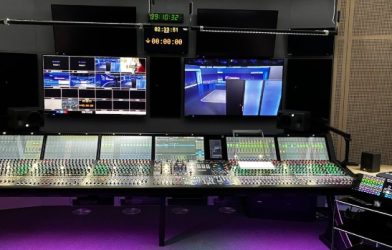
The HDTV-4, KBS’s OB vehicle, is designed for high-end productions with its 16-camera setup and workspace. To focus n reaching the growing demands of live broadcasting, KBS renewed the van’s audio infrastructure, replacing legacy equipment with a Lawo mc²56 Audio Production Console, an A__UHD Core audio engine, a Power Core Gateway, and an A__stage64 stagebox. System integrator Dongyang Digital (DYD) executed the overhaul, ensuring seamless integration with the existing infrastructure.
Looking for live production flexibility
Live broadcasting is requiring adaptable setups within OB vans. Choelho Park, responsible for the overall management and the sound mix of the KBS HDTV-4, explained, “The OB van can become a production stage anywhere outdoors, so every event requires a complete reconfiguration from scratch. From the signals exchanged with the production site to fader strip layouts, routing, and production techniques—everything varies depending on the program, making flexibility crucial.”
The mc²56 console, designed for fast-paced, high-pressure environments, provides DSP, a user-friendly interface, and customizable workflows. With support for SMPTE ST 2110, AES67, and RAVENNA, the console integrates into KBS’s IP-based infrastructure.
Audio management for events
KBS covers from sports and concerts to entertainment shows. Lawo’s equipment is designed to try to manage a diverse array of audio signals from multiple sources. Park stated, “During sports broadcasts, the OB van system receives individual microphone and commentary signals to create immersive sound. For music programs, we collaborate with external sound production companies, managing various signals (Analog, AES3, AES10) for program production. The mc²56 console accommodates these external signals, as well as internal signals from file players, graphic equipment, CD players, and reverb units, ensuring seamless mixing and high-quality audio output.”
The integration of Lawo’s Power Core Gateway and A__stage64 provides robust and scalable audio networking.
Why Lawo?
Park explained the factors that influenced on his decision of choosing this company: “We needed a system that could reliably process various program signals as part of the primary/backup setup and seamlessly integrate with the OB van’s VSM control system. Additionally, the equipment had to fit precisely into the limited rack space without hardware issues during OB van expansion or reduction.”
Its focus on acquiring stability, high audio quality, and cost-effectiveness were considered. “With our transition to an IP-based infrastructure, we needed a solution that guaranteed reliability,” Park continued. “Lawo’s excellent system stability, combined with outstanding sound characteristics, was a decisive factor.”
Jung-Yeoul Lee, Technical Sales Division at DYD, highlighted the impact of the installation: “KBS now has a cutting-edge, future-proof audio setup that allows them to produce top-tier content with complete creative freedom. Seeing this system come to life is truly rewarding.”
Proofing KBS’s Broadcast Operations
Before this upgrade, KBS relied on an aging mixing console that had reached the end of its lifecycle. The transition to Lawo’s scalable IP-based infrastructure has been made to try to obtain long-term reliability and adaptability to future technological advancements.




Comments are closed