


The University of Cape Town (UCT), located in South Africa, has adopted Blackmagic Cloud to streamline production, cut turnaround times, and support digital-first learning. This transformation has the intention of facilitating easy access to online resources with students undertaking distant learning courses, as the company has claimed in a statement.


The Digital Media Unit at UCT was established in 2014 to support the Centre for Innovation in Learning and Teaching’s (CILT) initiative to explore Massive Open Online Courses (MOOC). The goal was to see if the university could create engaging digital resources to make the online learning experience more interactive.
Tasked with capturing and editing all videos for the initiative, the digital media team’s aim was to eliminate the costs of using external production resources.
Today the Digital Media Unit comprises a team of in house production specialists operating three customisable studio spaces for live production, visual podcasting, and digital content creation. It serves more than 2,000 students and teaching staff every year.
“The facility’s ethos is to support digitally enabled education, ensuring students have access to state of the art facilities and industry leading equipment. Access to these studios also provides students with social capital to make and own their craft in the professional world”, explained Evan Zerf, Head of the Digital Media Unit. “I joined the team in 2023 and I pushed for us to adopt the Blackmagic ecosystem. It made sense to streamline everything from recording to editing”, added.
“We wanted the space to feel safe and inclusive for students and staff alike”, noted Zerf. “Everything, from the walls we painted to technology, was designed to balance professional production standards with a welcoming educational experience, so even those with little technical experience wouldn’t feel overwhelmed.”
The facility’s three studios house an automated one button studio, a dedicated podcasting space, and a customizable open studio designed to facilitate various media production needs.
The one button studio was inspired by the University of Pennsylvania’s open-source manual, which provides a framework for institutions to build their own automated teaching and learning system. “The model automated the recording process, but it didn’t handle the conversion or uploading of footage”, he explained. “Our learning technologists and programmers then integrated the physical recording system into the university’s Learning Management System”.
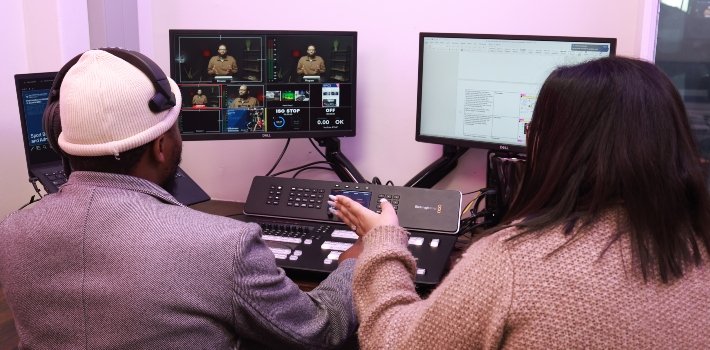
The beating heart of the Digital Media Unit is the control room powered by an ATEM Television Studio HD8 ISO live production switcher. It connects with three Blackmagic Studio Camera 6K Pro camera’s which are used throughout the different studio spaces and can be customized as needed. The control room also uses a HyperDeck Studio HD Plus recorder to route audio for the program feed to back up the recordings.
“Communication between our control room and the studio presented some challenges, but thanks to the ATEM’s talkback features, I was able to route all the comms through the switcher, add a separate speaker in the studio for the guest to hear the gallery, and monitor everything from the control room”, recalled.
The ATEM Television Studio HD8 ISO records up to eight isolated camera inputs (ISO) while generating a DaVinci Resolve project file that reflects the live program cut. That project and the associated media are then synced to Blackmagic Cloud for collaborative editing in DaVinci Resolve Studio. To try to support local storage and speed up access to proxy media, the team also installed a Blackmagic Cloud Store Mini 8TB network storage solution.
“After attending a Blackmagic workshop in Cape Town, we saw how the ecosystem could streamline our workflow. Being able to take the live switched ISO project and recordings straight from the ATEM to DaVinci Resolve has made a huge difference, and we’ve never looked back”.
“Since moving to a Blackmagic Cloud workflow this past year, everything has become more centralised and intuitive. We can access projects from anywhere, making collaboration seamless. I can jump into any project whether to assist creatively, review progress, or provide direction without disrupting the team’s flow or momentum”, affirmed.
“The new workflow has cut our turnaround time for filming from weeks to days”, concluded Zerf. “That means we can spend more time supporting the students and utilizing the studio spaces, without compromising on quality. It’s made a real difference”.





Comments are closed