


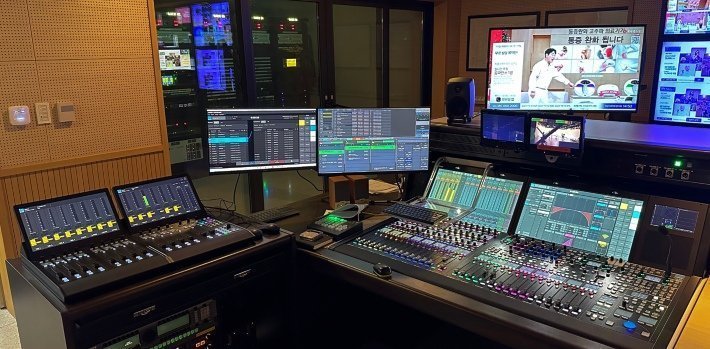
Home & Shopping has completed an upgrade of its broadcast infrastructure, transitioning to an IP-based system powered by Lawo technology. The project was designed and implemented by Lawo’s South Korean partner and systems integrator, Dong Yang Digital Co. Ltd. (DYD), and aims to mark a move toward scalable operations and future-proof workflows based on SMPTE ST 2110 standards, as Lawo has claimed in a statement.


Founded in 2011, Home & Shopping initiated a complete renewal of its technical infrastructure. DYD was tasked with delivering a solution that was able to combine innovation, long-term reliability and seamless hybrid integration.
Move to IP-Based architecture
The transition to IP was driven by the need to replace the existing SDI-based system, which had reached its limitations in terms of scalability, interoperability and integration with modern workflows.
“The former baseband infrastructure had become a bottleneck for innovation”, explains Myoung Ho Seo, Senior Engineer at DYD. “Our goal was to implement an IP-based environment that not only supports current production requirements but is also adaptable for future developments such as remote production, cloud workflows, and additional channels and formats. Lawo’s system architecture met these goals precisely, offering flexibility, operational transparency, and powerful integration tools”.
To try to ensure a stable and seamless transition, Home & Shopping opted for a hybrid configuration that supports both IP and SDI. This setup is designed to allow the broadcaster to continue regular operations while gradually adopting new IP workflows.
Lawo Home Platform
The installation’s IP backbone is managed by Lawo’s Home platform, which looks forward to offering centralized control, automatic device discovery, intuitive stream routing, user authentication, and real-time diagnostics. With Home, engineers can manage and monitor all connected IP devices and services from a single interface, on-site or remotely.
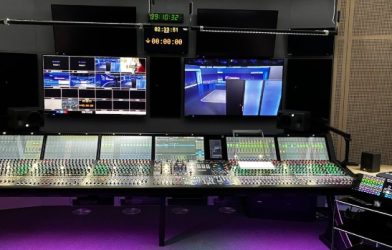
At the core of the audio infrastructure is a Lawo mc²56 MkIII audio production console, powered by an A__UHD Core engine. This combination is tailored for broadcast applications and offers support for SMPTE ST 2110-30/-31 and AES67 audio-over-IP standards. The mc²56 provides up to 1,024 DSP channels and supports multi-format I/O and control protocols including NMOS and Ember+. Designed for redundancy and high availability, the system uses ST 2022-7 for stream protection and features redundant processing paths.
For backup operation, Home & Shopping relies on a Lawo crystal console combined with a Power Core mixing engine. This compact and modular solution offers 96 DSP channels, full ST 2110 and AES67 compatibility, and redundant network and power options in a space-saving 1RU design. The consoles interface with a Lawo A__stage64 unit, which provides high-density, low-latency analog and digital I/O, including premium mic preamps and native AES67 connectivity.
IP workflows
Given the demands of Home & Shopping’s live programming, which can run up to 20 hours per day, system resilience was a key requirement. The installation was designed with a fully redundant architecture, to try to ensure uninterrupted operation even in the event of a failure.
“Lawo’s proposal for a triple-redundant setup—including redundant cores, networks and control paths—aligned perfectly with our requirements for live production”, says Heekwang Yoo, Broadcast Engineer at Home & Shopping. “We were also impressed with how easily the new system integrates into our hybrid SDI/IP environment. This allows us to maintain stability while progressively moving toward full IP”.
Since going live, the new system has reduced manual effort, while stream routing and resource allocation enable faster reconfiguration and easier maintenance. The move to IP has also led to a cleaner technical footprint, with reduced cabling and less reliance on hardware-bound infrastructure.
“The adoption of Lawo technology has been a key milestone in our efforts to build a modern and highly stable broadcast environment”, Yoo notes. “We’re proud to have laid the groundwork for a flexible production workflow that can easily adapt to the changing demands of content creation”.
“Lawo’s open architecture, technical depth and responsive local support were essential in helping us meet the customer’s vision”, adds DYD’s Myoung Ho Seo. “The result is a future-ready broadcast infrastructure that delivers exceptional operational performance and reliability”.
Mr. Yoo concludes: “The success of this upgrade is the result of true partnership. DYD provided outstanding integration support, and Lawo’s IP technology has exceeded our expectations. We are confident that this system will support our broadcast needs for many years to come—and continue to evolve with us”.




Comments are closed