


From unified newsroom workflows to HTML graphics and AI-driven tools, Morwen Williams, Director of Media Operations at the BBC, explains to TM BROADCAST how the broadcaster is adapting for a multi-platform future, the strategic and operational challenges it faces, and some key insights for navigating this process


*This content is included in the March issue of TM BROADCAST. You can access the full magazine here.
Large media organisations’ news departments are undergoing a profound process of transformation. As we have been analysing in TM BROADCAST, the shared objective —with all the nuances introduced by the circumstances of each corporation— appears to be moving towards a digital-first model.
This implies a gradual convergence of radio, television and digital newsroom teams, as well as the development of tools capable of unifying workflows, optimising resources and facilitating the exchange of content between teams. The logic behind this shift is clear: to take advantage of the synergies created when any piece of content can be made available to the entire newsroom and adapted for multiple formats and platforms, from streaming and broadcast to social media.
However, beyond strategic considerations, implementing this model in practice raises complex challenges. Not all formats work equally well in broadcast and online environments, and the fragmentation of audiences requires both narrative approaches and technological tools to evolve.
In this context, technologies such as HTML graphics, new cloud-based editing systems and artificial intelligence applications are beginning to play a key role.
If we look for a major news organisation where these challenges can be observed in practice, the BBC is undoubtedly one of the first that comes to mind, given its scale and its influence on the global media ecosystem. To explore the issues and trends outlined above, we had the opportunity to gather some key insights from Morwen Williams, Director of Media Operations at the BBC.
“Standardising and simplifying”
In the case of the BBC, the ongoing transformation of newsroom workflows is being driven above all by a commitment to simplification, integration and cross-platform collaboration. From the perspective of Media Operations, this evolution is closely tied to the need to connect processes that have traditionally operated in parallel. “Standardising and simplifying our toolset is the big driver here,” explains Morwen Williams. “Working closely with colleagues in Technology and importantly listening to our journalists and their needs, we are starting to connect our workflows into one overarching space.”
“This will take us from plan and capture through to edit (on a single platform for various outlets digital and linear) and keeping the metadata through to archive,” she notes. The approach reduces friction within production processes and opens new possibilities for collaboration.
Alongside these structural changes, Williams highlights other pillars shaping the evolution of BBC News operations. As she explains, “it’s been in simpler workflows in our control room and a simplified presentation space for streaming, enhanced podcast and radio visualisation and more compelling studio looks for our audiences.”
Managing such an ecosystem is particularly complex given the BBC’s distributed operational structure, which spans multiple production hubs across the United Kingdom, including London, Salford, Birmingham and Bristol. Williams emphasises that while the organisation operates under a unified strategic framework, flexibility at a local level remains essential. “There will always be local autonomy because of the immediate nature of lots of the work we do,” she explains. “And local decision making with our production partners needs to be dynamic.”
At the same time, the organisation maintains a shared strategic vision across its leadership teams. “We have an overall strategy that we share among our leadership team – from our team leaders who are often operational to our more senior Head of Department. We try to meet up face to face several times a year, and leaders visit sites. We share regular updates to all this team in a 2-way nature to support them in their roles whatever and wherever that is based. But the overall model is a centralised strategy.”
“Working closely with colleagues in Technology and importantly listening to our journalists and their needs, we are starting to connect our workflows into one overarching space”
Convergence between online and broadcast operations
Convergence between broadcast, radio and digital platforms has become a central theme across the media industry, and the BBC is actively progressing towards more unified newsroom structures. “This is certainly the overall aim, and one we are well on the road with”, she explains. “It’s a much more effective and efficient way of working for the speed of output, and helps with career progression as teams could work across several platforms but using similar or the same tools to do so. We are not there yet, but it’s firmly in the action plan.”
In practice, the relationship between online and broadcast operations is already much closer than in previous years. According to Morwen Williams, the integration begins at the editorial level. “The journalism and work underpinning both broadcast and online is closer than ever,” she says. “The journalism and planning all works together. They sit alongside each other in our main London Newsroom.”
However, the final stages of content distribution still involve different tools and formats depending on the target platform. “Right now, we go to our audiences/platforms via different tools in the final stage. That is something that might change to simplify even more,” she explains.
Even so, she stresses that platform diversity remains essential. “We need to recognise that some formats work better for broadcast and some better for digital audiences, including of course our social offerings (e.g. vertical video, short explainers). One size cannot fit all as audiences are extremely mature at knowing what they want to consume, and how and where to consume it.”
Technological development is playing a crucial role in enabling this convergence. One of the most significant initiatives currently underway is the integration of browser-based editing capabilities directly into the BBC’s media asset management environment. “We are in the final stages of integrating browser-based edit (Cutting Room) into our own MAM system, Jupiter Cloud for Jupiter Edit,” Williams explains. “This is currently in BETA and will go live around April. A single (or closely integrated) editing solution that supports digital publishing endpoints. The ability to share edits of content in the same space is crucial to the closer working between broadcast and digital, and turns us from a broadcast first news workflow, to a digital first one.”
“Right now, we go to our audiences/platforms via different tools in the final stage. That is something that might change to simplify even more”

BBC’s roadmap
Looking ahead, the BBC’s roadmap for media operations includes a broad set of technological priorities aimed at improving accessibility, traceability and efficiency across the entire media lifecycle.
“There is a list,” Morwen Williams notes when asked about the BBC’s priorities for the coming years. She outlines several key areas: “The ability to passively share any content anywhere; Comprehensive search and rich metadata; a restoreless video system with ‘use it, don’t move it’; a media stack with no silos, full visibility across teams, one click reuse, preserving editorial decisions (no flattened files); a tech stack that decreases TTA (time to air) and increases shelf life of each media asset; a video system that makes BBC video assets traceable, and a singular consolidated video storage that can act as bible and source of truth with lighter format and proper metadata design and that supports archiving in-place.”
Scaling graphics production
Graphics production is another area undergoing continuous evolution. The BBC currently combines templated graphic workflows with bespoke design processes depending on the editorial needs of each production. “Workflows are designed for editorial and production staff to perform the most basic graphic design tasks i.e. creating a ‘tower’ or quote graphic for quick turnaround,” she explains.
Alongside these capabilities, the BBC has developed several internal tools to support graphics production at scale. “We have internal tools such as BBC Graphics which have been focussed originally on live graphics for streams, or rendering files for social. These new tools can be used on-premise or in the cloud, and at scale.”
“The ability to share edits of content in the same space is crucial to the closer working between broadcast and digital, and turns us from a broadcast first news workflow, to a digital first one”
HTML-based graphics boom
One of the most significant technological trends in this area is the growing adoption of HTML-based graphics. “We’re excited about HTML graphics and we’re using them more and more in our workflows; we have them on-air every day and you’ll see them on screen for the Elections,” Williams says. As part of this transition, the BBC is collaborating with the European Broadcasting Union’s OGraf initiative to develop open standards for exchanging graphics data.
The BBC’s move towards HTML graphics is closely linked to the broader transformation of the media landscape. As digital platforms continue to expand, the corporation sees HTML-based workflows as a more adaptable solution for modern content production. “Across the BBC we have been rolling out the use of HTML graphics, new workflows on BBC Sport use this and in BBC News we used HTML on most streams, the General and U.S. Elections,” Williams explains. “We are moving to a fully HTML workflow for lower third graphics in the coming months/year (Project Overlay)”.
At the same time, the BBC is playing an active role in shaping the technological standards that will underpin these workflows across the industry. “We’re also heavily involved in the EBU’s OGraf initiative, shaping the standards and specification of HTML media graphics with other public broadcasters and suppliers.” The rationale behind this strategy is clear. “The BBC is behind HTML graphics as the media landscape is changing with the growth of digital content. We needed a more flexible, scalable, cost-effective way of telling the audience the story.”
Immersive storytelling
Immersive visual storytelling technologies are also playing an increasing role in the BBC’s editorial output. Augmented and virtual reality tools are already integrated across multiple platforms and formats.
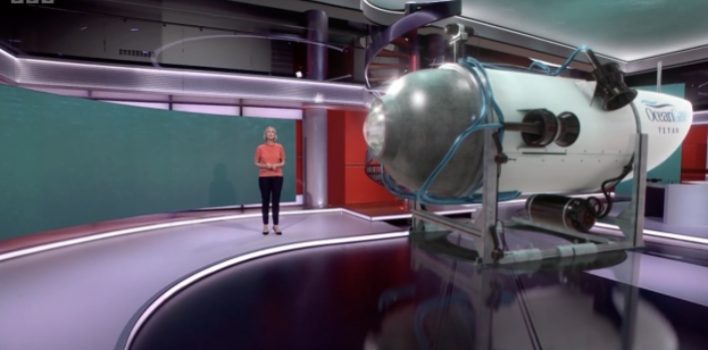
“We use AR and VR across all our platforms and output,” Williams confirms. “We’ll be using this in a newly relaunched ‘Trending’ on BBC Arabic but we often use these tools for major event production including the General Election, the World Cup and when we’re required to tell complex stories that require immersive graphics like explaining what happened with the Titan Submersible in 2024.”
“We are in the final stages of integrating browser-based edit (Cutting Room) into our own MAM system, Jupiter Cloud for Jupiter Edit. This is currently in BETA and will go live around April”
And, of course… AI
And we couldn’t miss the opportunity to ask Morwen Williams about artificial intelligence. AI is certainly another area where the BBC is experimenting with practical applications within production and editorial workflows. “We are currently piloting three AI production workflows,” Williams explains.
One of them, Style Assist, “allows us to publish more stories from the Local Democracy Reporters Network by adapting them into BBC style draft articles, which are then edited, checked and published by our journalists.”
Another initiative focuses on live sports coverage. “It helps audiences keep up with their football teams’ matches on the go by using our world-class EFL commentary to add expertise and texture to our live pages on the BBC Sport app, all overseen by journalists to ensure the highest quality and accuracy.”
The third pilot project, My Club Daily, explores the creation of audio bulletins for football teams using synthetic voice technologies, “making a one-stop-shop audio bulletin for EFL teams by using synthetic voice to read scripts sourced from articles on the Sport app, delivering content to come back for every day, all overseen by journalists and audio producers,” Williams concludes.
“We are moving to a fully HTML workflow for lower third graphics in the coming months/year (Project Overlay)”





Comments are closed