



All images are courtsey of VRT


VRT Innovation Manager Dieter Boen outlines TM BROADCAST the broadcaster’s technology roadmap, exploring its approach to AI, data and virtual production, the role of collaboration and a public service mission that ultimately guides its innovation priorities
*This content is included in the September issue of TM BROADCAST. You can access the full magazine here.
For VRT, innovation begins outside the laboratory. Belgium’s Flemish public broadcaster has developed an approach based on testing emerging technologies with real content and real audiences, while building an ecosystem of collaboration with start-ups, universities and industry partners. From virtual production and gaming platforms to AI, data and conversational interfaces, the goal is not simply to experiment with new tools, but to understand where they can deliver tangible value.
Throughout this year, TM BROADCAST has been exploring the technology roadmaps of broadcasters across Europe and beyond, from the BBC and RTVE to CBC/Radio-Canada. As part of this wider editorial initiative, we now turn our attention to VRT, a mid-sized public broadcaster whose approach to innovation offers a particularly interesting perspective. To explore its roadmap, we reached out to Dieter Boen, VRT’s Innovation Manager, who helps us unpack the philosophy behind its strategy and how it translates into practice.
Dieter Boen sums up VRT’s philosophy on innovation in direct terms: “No pain no gain. The only way to truly innovate is to test things in real life. In our case: this means with real content and a real audience. Lab tests work for early development, but you need to get out of the lab as quickly as possible. Only then, you can understand the real value of a new idea by seeing how the audience responds to it.”

Innovation through collaboration
This approach increasingly requires VRT to look beyond its own organisation. As technologies become more complex and their development demands greater scale, collaboration has become an essential component of the broadcaster’s innovation strategy.
“A good collaboration entails understanding what other project partners want to get out of a project and helping them get there. When a project involves multiple partners, local as well as international, it can get very complicated. At the same time, there’s no alternative. Technologies like virtual production and AI require a scale that lies beyond what VRT or Flanders can achieve alone. That is why strong cooperation with start-ups, universities, and industry partners is absolutely essential.”
AI currently cuts across much of this activity. Its potential extends from production to distribution and the way audiences interact with content. “AI affects everything. Generative AI offers major opportunities in video production. At the same time, conversational interfaces are rapidly transforming how news is distributed and how users interact with it.”
Dieter Boen also identifies data as another fundamental pillar. “Without proper data management, none of these new services will work. That’s also why collaboration is crucial – not just for scale, but because developments are moving so fast that you simply cannot do everything yourself. For example, we have a strong partnership with IMEC and other media organisations on AI.”
“Game productions seem unconventional for a public broadcaster, but if we want to reach everyone, we also need to be present on platforms where kids spend their time”
From virtual production to Roblox
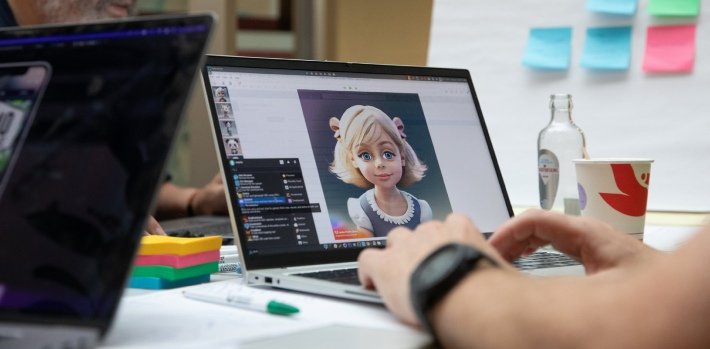
Some of VRT’s current developments have their origins in experiments carried out several years ago. Virtual production is perhaps the clearest example of how an initial technological exploration can eventually translate into new production capabilities — and even open the door to entirely different ways of reaching audiences. “Experiments with game engines that took place during COVID led to numerous virtual productions using Unreal Engine, and the investment in a studio with a 270° LED wall,” VRT’s Innovation Manager explains.
But the knowledge accumulated through these experiments has travelled beyond the virtual studio itself. The same expertise has subsequently been applied to gaming environments as VRT explores new ways of connecting its content and intellectual property with younger audiences. “What’s particularly interesting is how that knowledge evolved. The same team applied it in a completely different context: reaching young audiences on game platforms like Roblox. We have built a very successful presence there with our own IP, creating real content and storylines that extend our TV shows into those environments.”
The virtual studio itself has also moved beyond the experimental stage. Since its launch in 2023, it has become part of VRT’s regular production infrastructure. Once the technical challenges were overcome, the next challenge was operational: making the technology work naturally within everyday broadcast workflows.
“In our virtual studio, we run daily live shows since its launch in 2023. After solving the technical challenges, the real work was integrating it into everyday broadcast operations. Now that this is in place, we are taking the next step: using technology creatively within our programmes.”
AI, however, presents a different challenge because its impact cannot be confined to a single production environment or department. “AI is different and not limited to one aspect of our organisation. We implement AI in every part of our organisation and provide training on all aspects of media.”
“Workflows around data, AI and innovation have recently been brought together into a single directorate at VRT. But integrating data into workflows remains a major challenge”

Public service as a compass
With so many technologies developing simultaneously, deciding where to focus resources becomes an innovation challenge in itself. At VRT, Boen points to the broadcaster’s public service mission as the principle guiding those decisions. “Our choices are driven by our public service mission. For example: game productions seem unconventional for a public broadcaster, but if we want to reach everyone, we also need to be present on platforms where kids spend their time. A logical choice, in the end.”
That same reasoning informs the broadcaster’s approach to AI and its relationship with external production partners. “AI is something we need to embrace, because it fundamentally changes production and consumption patterns. For a lot of productions, we partner with innovative facilities companies. Some genres, especially scripted series, we do not produce ourselves anymore.”
“We have also strengthened our research department into a data-driven media intelligence unit. Real-time data is essential to make the right choices and to reach audiences in a more personalised way”
Data becomes a strategic asset
The growing importance of AI is also increasing the pressure on broadcasters to organise and exploit their data effectively. At VRT, workflows related to data, AI and innovation have recently been brought under a single directorate. Yet one longstanding challenge for media organisations remains particularly significant: metadata.
“Workflows around data, AI and innovation have recently been brought together into a single directorate at VRT. But integrating data into workflows remains a major challenge, particularly metadata is a well-known issue in media organisations. With AI, solving this becomes critical: without high-quality metadata, content simply won’t be visible.”
Data is also influencing decisions much earlier in the content lifecycle. Alongside the organisational changes, VRT has strengthened its research capabilities to support a more data-driven approach to understanding audiences and commissioning content. “At the same time, we have also strengthened our research department into a data-driven media intelligence unit. Today, you can no longer rely on gut feeling alone when commissioning content. Real-time data is essential to make the right choices and to reach audiences in a more personalised way.”
“We have to be ready for a world where content is not only consumed, but actively engaged with through dialogue. In that context, there’s only one option: you have to join the conversation”
Preparing content for a conversational future
For Boen, however, the most significant challenge ahead goes beyond achieving immediate efficiency gains through AI. The longer-term transformation concerns the nature of content itself and how it will need to be structured for an environment increasingly shaped by machines and conversational interfaces.
“It is important to go for short-term wins with AI. More important is preparing for the next form of content, which is machine-readable and designed for conversational interfaces. We have to be ready for a world where content is not only consumed, but actively engaged with through dialogue. In that context, there’s only one option: you have to join the conversation.”








Comments are closed