



AI generated image


Rethink TV, a division of Rethink Technology Research, has published its “Open Internet Contribution Protocols Forecast: 2026-2032” , analysing the global adoption and revenue of open internet contribution protocols. The report covers projections for the 2026-2032 period and includes data from 2022 to 2025 for context, as the company has claimed in a statement.
The forecast points to growth in open internet video transport at the expense of traditional satellite connections and dedicated internet access (DIA) fibre lines. This trend is being driven by an increase in new sources of live events, particularly lower-tier sports, news reporting, music concerts and livestreaming events. In this context, the prosumer market is also helping to drive adoption of these protocols.
Regarding the technologies covered, Rethink TV notes that SRT continues to consolidate its position as the de facto industry standard. Its adoption is now virtually universal in greenfield deployments, and finding equipment that does not support the protocol is increasingly difficult. RTP and RTMP, meanwhile, are expected to remain in use in certain legacy environments, although their presence is projected to decline over the period.
The report also highlights the different trajectories of Zixi as a protocol and as a platform. While traffic using the Zixi protocol is projected to decline, the SDVP (Software-Defined Video Platform) continues to handle traffic based on multiple protocols. According to the analysis, most of its customers use more than one protocol, meaning that the platform’s activity does not depend exclusively on the adoption of its proprietary protocol. The study also identifies Zixi’s acquisition by private equity firm Clearhaven Partners as one of the market’s main recent developments.
Regarding RIST, Rethink TV considers its adoption to be limited and does not expect it to reach SRT’s levels, although it forecasts continued growth. The report highlights several applications, including its use in infrastructure operated by Arqiva, as a redundant connection during C-band to Ku-band satellite migrations, and for updating VoD content on Disney Cruise Line ships, where its multicast capabilities are used.
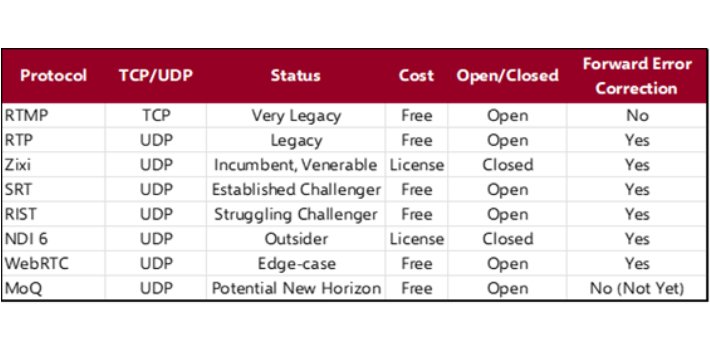
The study also points to a decline in NDI within the Media & Entertainment (M&E) market. Although the protocol had found opportunities among content creators and in certain graphics workflows, recent price increases and changes to licensing terms have affected its outlook. Rethink TV notes that, over the four years it has tracked the protocol, NDI has failed to make significant inroads against SRT and RIST in this market.
Nevertheless, NDI retains specific applications in audiovisual production, particularly in graphics workflows, thanks to its alpha channel, which allows fill and key data to be carried alongside video. In the ProAV market, the research firm considers the protocol well positioned as a simpler alternative to environments based on SMPTE ST 2110, IPMX and SDVoE.
The report also tracks the development of Media-over-QUIC (MoQ), a technology that has gained traction in the distribution market and is attracting growing interest for contribution applications due to its low-latency capabilities. However, Rethink TV considers that there is not yet sufficient reason to include it in its contribution market forecasts.
Finally, the study identifies a shift towards greater coexistence between different protocols, compared with the more polarised competition that characterised the market in 2022. The growing use of automation and large language model (LLM)-based coding tools is also helping to abstract protocol choices from the equipment used at each stage of the video chain. In this context, workflow flexibility and programmability are becoming increasingly important compared with reliance on a single technology.


Comments are closed