


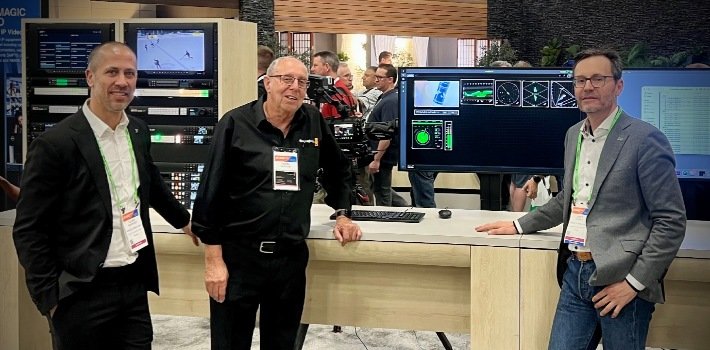
Bridge Technologies will use the upcoming IBC Show (11-14 September, 2026) to announce that its VB440 production probe now supports monitoring of Blackmagic Design’s IP10 codec. The stand (1.A71) will offer IP10 monitoring demonstrations, but also the company’s tools will be operating on the Blackmagic booth itself, with the intention of reflecting the two companies’ shared commitment to open, interoperable IP production workflows, as it has claimed in a statement.


IP10 is Blackmagic’s lightweight, low-latency codec designed to address a specific challenge in ST 2110 environments: fitting high-frame-rate Ultra HD video through a 10 Gigabit Ethernet connection while maintaining broadcast-quality, 10-bit 4:2:2 colour performance. It features a latency of eight-pixel samples and an extremely small FPGA footprint.
Additionally, IP10 is license-free and open, looking forward to allowing broadcasters to deploy ST 2110 workflows without the expense of 25GE or 200GE switching infrastructure. For broadcasters operating in OB trucks, remote locations, or smaller facilities, IP10 offers a path to uncompressed-quality IP production over widely available 10GE links.
The VB440 itself is equipped with dual 200 Gigabit Ethernet interfaces, capable of handling uncompressed ST 2110 streams at the highest data rates. But in contexts where the wider network infrastructure is operating on smaller bandwidth channels – with IP10 being used precisely to address that limitation – the VB440’s native support for the codec means engineers can monitor IP10-encoded streams with the same depth of visibility they expect from uncompressed workflows.
Facilities using IP10 as an underlying codec will thus have full access to the extensive range of tools present within the VB440, which combines both network monitoring and a full suite of practical production tools within a single RU appliance, thus truck roll weight, energy consumption and the cost and space associated with screens and cabling.
For camera painters, it delivers full waveform, vectorscope and histogram displays, HDR monitoring with SDR preview, and colorimetry tools, as well as AV and ancillary sync monitoring both within a flow and across redundant sources of the same flow.
For audio engineers, it supports 64 channels per flow across unlimited flows, with LUFS and Gonio meters, Dolby Atmos monitoring, single-channel isolation and stereo downmix listening, and direct IP speaker control. And for network engineers it provides signal generation for equipment-free network setup, as well as packet capture, PTP timing analysis, ST 2022-7 redundancy monitoring, and event logging, all visually intuitive and easily accessible through the Canvas interface, which allows each user to build custom workspaces, combining scopes, audio meters, and video previews on a single screen.
All of this is accessible via any HTML5 browser, in real time, for up to eight simultaneous users from anywhere in the world.
Commenting on the announcement, Bridge Technologies Chairman Simen Frostad shares: “IP10 is an elegant solution to a real-world problem. For broadcasters who want the benefits of ST 2110 but don’t have 200GE infrastructure, it removes the barrier. And for those who do have 200GE, it doesn’t get in the way. Supporting IP10 is not about picking a side, it’s about ensuring that wherever broadcasters are on their IP journey, the VB440 can be there with them. That’s how we see the industry: not as a collection of competing ecosystems, but as a shared project. The more we can make tools that work together, the more the industry as a whole can move forward”.
Hersh Burston, Principal Architect – Advanced Systems, Blackmagic Design concludes: “Bridge Technologies’ VB440 is quickly becoming the industry standard for analysing and generating ST 2110 signals. We’ve worked closely with them to ensure a smooth integration of our lossless IP10 compression codec. IP10 enables customers to send 2160p59.94/60 12G video and audio over a much more affordable 10G network infrastructure. The 8-sample latency of Blackmagic’s IP10 codec is incredibly low, and it’s an open standard with no license fees. Bridge Technologies’ implementation of our codec demonstrates both companies’ goal to advance ST 2110 in the broadcast market, and to develop even more high-end products with easy installation and even better interoperability with third-party systems”.





Comments are closed