


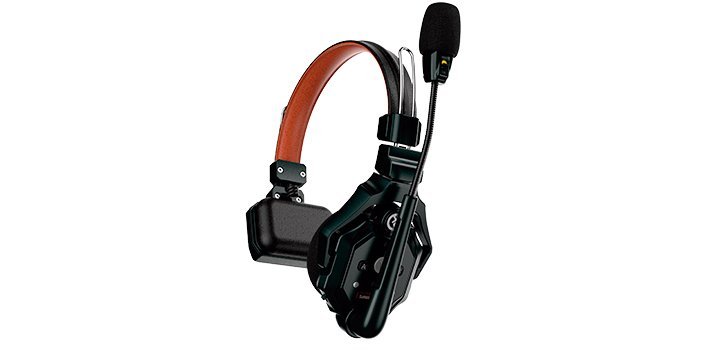
Better performance thanks to silence.


The big difference between the already known model and this new model, which carries the Pro label, lies in the major leap forward it offers to our communications thanks to the integrated noise suppression technology.
Text: Luis Pavía
We have now the opportunity to test in our lab equipment that meets the most desired requirements in any production: it is efficient, reliable, and also has a price tag that makes it especially attractive. This is an extension in range over an earlier model, already known for its good results, but adding a clearly differential feature that makes it even more interesting.
The Hollyland brand arrived to the market a few years ago, but in this short space of time it has managed to earn a good reputation because of the quality, reliability and competitiveness of its products for audiovisual production, most of them being related to the wireless transmission of signals, whether video or audio.
Conceptually, intercoms like the ones we tested on this occasion are equipment that has been an important part of many production environments for a long time. They are nowadays an essential element to keep all the members of a team effectively coordinated, thus facilitating discreet and secure communications among them.
The previous model already had a good array of features, among which stands out a good range of up to 350 meters in open spaces, and operation without a belt pack that does not limit its excellent range. Maintaining all the benefits of its predecessor, the most striking feature that provides an interesting leap forward in this new “Pro” version is the built-in noise reducer.
But let’s start by making it clear what this noise reduction consists of before moving on. Because it is real noise reduction. What does this mean? We should not confuse it with the concept of noise reduction of telephone earbuds to which most of us may be used to.
Phone earbuds are capable of eliminating the noise that surrounds us so that it does not bother the user, but they do not keep the person on the other side of the call protected from all that ambient noise. On the other hand, the ambient noise reduction provided by these Hollyland Solidcom C1 Pro consists of the ability to filter this ambient noise around us in a way that does not disturb the rest of the team with whom we are communicating.
Keep in mind that these intercom communications are frequently maintained between groups of several people, which can cause sources of unwanted ambient noise to multiply. This result is achieved thanks to the combination of a second external microphone with an internal processor, capable of “subtracting” that unwanted noise from our voice, thus making communications cleaner, more comfortable and effective, without sacrificing full-duplex bidirectionality.
Having clarified the scope and meaning of this concept to avoid confusion with the functionality of other equipment, let’s go with the complete analysis.
Physically, this piece of equipment is very similar to the previous model, which also remains in the catalogue: headband intercom, hands-free, no belt pack, suitable for operation with or without base station, with distinct padding in natural color and the leather-look of the headband, as well as the label with the model name. There are versions of one and two earpieces to meet different needs. There is also the possibility of working with a base station for both types of headphones.
If we opt for the variant with a base station, the maximum number of simultaneous users is greater and the network that can be created more extensive. When such a base station does not exist, one of the units will always play the role of “master”, being it necessary to keep it on for all communications, even if it is not a part of them. It is only distinguished by the color of the label -red- while remaining blue in all other secondary units.
Technically, it operates within the 1.9 GHz band (DECT 6.0) with encryption, in order to ensure utmost confidentiality in our communications. Bandwidth ranges from 150Hz to 7kHz, more than enough range for quality voice transmission.
The system provides full-duplex communications, meaning that the line remains open in both directions and simultaneously for all equipment that has not been muted. But it can be switched to PTT mode, that is, push-to-talk, so that communications will be unidirectional, in which case we have a button in the center of the headset that we must press to speak, remaining our broadcast automatically cut off the rest of the time.
Returning to the full-duplex mode, the activation of the mute mode is extremely simple and effective, as it is enabled by simply lifting the microphone towards the top of the headband and disabled when lowering it to the normal use position. In both the one-earpiece and two-earpiece versions, the microphone arm is articulated in both rotation directions, making it easy to use from one side or the other side of the head. This is a particularly interesting aspect in the one-earpiece headset, which is also the one we had the opportunity to try.
The switch to enable and disable the noise suppressor is located next to the microphone, comfortably accessible from the outside, while inside we have a LED that indicates the relevant status: red if we are muted, green if the microphone is open, and blue if the microphone is open and we have the noise suppressor enabled. This LED is easily distinguishable, and it can be seen changing to red as we lift arm, since obviously, we will not be able to see it when it is at the very top.
On the outside of the headset, and next to the large central button to select and enable the PTT function, we find a pair of buttons to turn the volume up and down. The other pair of buttons, A and B, are useful for linking to one of the two different groups arising from the activation of the base-station mode. Keep this small detail in mind if you need to communicate with two different and independent workgroups so you send information only to the group for which it is relevant without distracting the rest of the team. Let’s just add that this base station, in addition to being powered by the mains, also works with batteries, thus facilitating its use in any location.
In a case like ours, without a base station, only button A is functional for pairing new units to our system, or pair one of our secondary ones to another different master unit. In our case, it seemed to us that the possibility of dispensing with a base station in our communications may mean that in the case of groups of up to 8 people, the convenience of transport and ease of use will be additional advantageous factors to take into account.
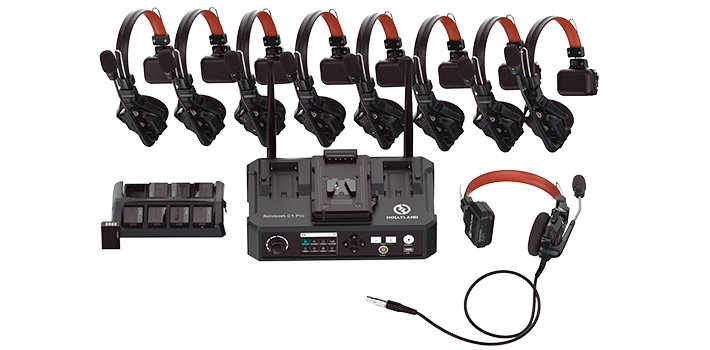
Our test unit seemed very light, 170 gr according to catalogue specifications, and very well-balanced even in the case of a one-earpiece headset, since the battery housing is on the other side. It features a lid keeping it in place and insulating it from the outside. Despite their compact size, batteries offer a surprising usage time: the manufacturer announces more than 10 hours for the secondary units even with noise reduction activated, and more than 5 hours for the master unit with noise reduction activated and 5 additional units connected.
Considering that the equipment we had the opportunity to test -version 4S with the indispensable master unit and 3 secondary units- is supplied with 8 batteries in total -two per module- and also that the charger supplied as standard allows the 8 batteries to be charged simultaneously in about 2 and a half hours with a simple 220V to 12V 2A charger, we are assured of the possibility of covering endless sessions without any difficulty. It seems that power supply won’t be a concern under any circumstances.
By the way, among the facilities we found when unpacking our test unit, we saw that the equipment is provided already synced and the batteries come fully charged. Open and use with maximum efficiency.
Commercially, it can be ordered in versions of 1, 2, 3, 4, 6 and 8 units without a base station, or 4 or 8 units with a base station. If our communication needs are above that figure, we can always resort to setting up a small network by adding up to three base stations with up to 8 equipment units per station, to reach a maximum of 24 units connected in simultaneous communication.
It is also very handy to know that, if we have initially acquired a set of fewer units, we can add and synchronize secondary units to have them synced with our master unit up to the limit of 8 in the group, even without a base station. Also, as expected, a secondary unit can only be synchronized with one master, so if we sync it with a different master, it will be linked to that new group and will no longer belong to the previous one.
Going into the practical results, we start with the starring aspect to check the effectiveness of the noise suppressor in environments being similar to those we will be facing, and we found pleasantly satisfactory results. According to specifications, the relative attenuation between microphones is 20 dB. It is true that this does not suppress all noises on all levels in every circumstance, but we have done some quite particular tests with interesting results.
For starters, without using the noise suppressor and in normal environments, the sound is always clear, the voice is perceived with all its nuances, and the volume adjustment has sufficient range for practically all situations expected in a production.
When the sounds are in frequency ranges more or less far from the vocal frequencies, the result is excellent -as would be expected- as it cleans artifacts very well and without affecting the voice at all. Talking next to a highway with the noise suppressor activated turns the passage of cars into a distant murmur, although without this feature enabled the noise is quite annoying.
Then we deployed our long-suffering interlocutor in the middle of a completely full terrace, with quite an “atmosphere”, not to say turmoil, created by the multitude of simultaneous voices while keeping at a certain distance. The difference between turning the noise suppressor on and off was the difference between being able to have a normal conversation, or the latter becoming barely intelligible.
We decided to raise the bar in an even more complicated environment and one even more crowded voices of all kinds of tones and a generous volume: kids leaving a school. And the outcome for communication was just as satisfactory with the filter, and practically unfeasible without it. But what seems to us most important of all: in none of these cases did the voice of our interlocutor suffer the slightest distortion, always remaining clear and with a uniform volume.
Another peculiarity of this model is that in addition to the noise suppressor with electronic processing, it features a new fabric filter in front of the microphone in order to minimize the action of the wind in a merely passive way.
As for the range, the result is within the foreseeable parameters. The nominal range reaches 350 meters, although this figure will always be the comparable reference in open spaces and without interference. But as we find buildings, concrete walls (vertical or horizontal) and other similar structures in the way, the range will naturally decrease. In this case and given the immense number of cases that can be presented, we advise doing some testing if needing to operate in industrial environments or with a lot of solid architecture involved.
The unit is comfortable to wear for hours and very easy to operate in most cases and for practically all the time. We must only touch it briefly to move the micro up or down to activate the muting, if we remain in bidirectional mode, full duplex, always keeping our hands free.
Regarding this aspect of mobility, the only objection that could be raised is that in case of sudden movements it could de displaced as it does not exert excessive pressure. It offers a good balance between pressure and comfort, favoring long use times, these being the circumstances that will be the most frequent.
What more features could be asked for? In the configuration without a base station it is not possible to send exclusive communications to a single terminal, although given its conception of maintaining maximum simplicity of use, it would be complex to select a destination unit without making operation more complicated. We do not know if this functionality exists in the configuration with base station.
As an extremely practical and no less important detail, in addition to finding it configured, synchronized and with charged batteries -as we have already mentioned-, the equipment comes in a flexible case that houses all the headset, the charging station with its power supply, and a series of spare pads, with each headset also having its own case.
It is noteworthy that the replacement pads come in two different sizes and materials to suit different tastes or needs. The large ones with the padding covered in faux leather, and other small ones in foam, the same material that we also have as spare part for all microphones.
There are many uses and purposes for this equipment, not only in the field of audiovisual production, but in any other field in which close, safe and effective communication is convenient. From live events or shows to installations: we can think of a lot and the list would be a long one. There is an anecdote that we cannot fail to mention in relation to the potential users that the manufacturer has in mind and that we find ourselves unable to imagine: the manual indicates that this equipment should not be used inside microwave ovens, conventional ovens, pressure cookers, or fires of any kind.
Anecdotes aside and now as a conclusion, we find this a reliable, safe and very economical piece of equipment that allows us to significantly increase our efficiency in production, simply because of the myriad of possibilities we have at our disposal by keeping our entire team communicated and coordinated without the need to increase our investment or our costs.




Comments are closed