


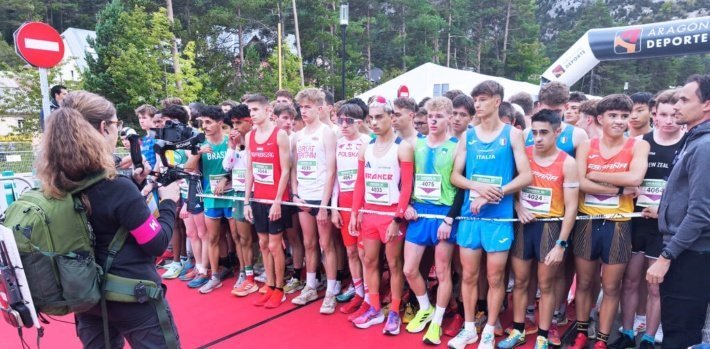
Held in Canfranc-Pirineos, Spain, at the heart of the Pyrenees—Europe’s second highest mountain range—the 2025 World Mountain & Trail Running Championships (WMTRC) marked the first time this world-class event was hosted in the region. From September 25 to 28, more than 1,700 elite athletes from 80 countries competed across five demanding races, from a 6K uphill sprint to an 82K ultramarathon, as Kiloview has claimed in a statement.


Bringing together mountain and trail running, WMTRC 2025 posed a broadcasting challenge: delivering stable multi-camera coverage across rugged terrain and supporting multilingual streams under fluctuating network conditions to a global audience.
With the aim of meeting these challenges, Javier, Director of anticontinente.com and Technical Broadcast Partner for WMTRC 2025, partnered with Kiloview to try to deploy an IP-based live streaming solution that could bring this event to viewers around the world.
Live Broadcast Challenges in the Pyrenees
Capturing a race across rugged mountains required a large team and multiple camera positions. Operators managed drones, cameras on runners and bikers, and fixed cameras to cover the full course. Coordinating everything posed some difficulties, including:
 Unstable network conditions across remote and mountainous areas.
- Capturing dynamic mobile feeds from moving cameras on drones, runners, and bikers.
- Synchronization of coordinating multiple camera feeds across locations.
- Simultaneous multilingual output (EN/ES/FR) to keep all audiences in sync.
- Zero tolerance for failure, especially at sprint finishes or key climbs.
In response to these conditions, the team turned to a Kiloview-powered AV bonding workflow.
The equipment used:
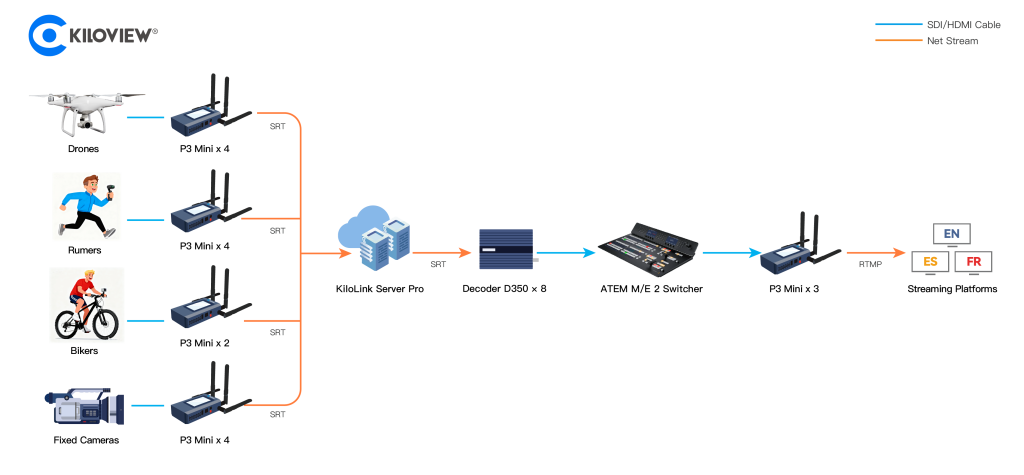
- On-Site Capture & Output: Kiloview P3 Mini Wireless Bonding Encoder
- Aggregation & Management: KiloLink Server Pro
- Decoding & Distribution: Kiloview D350 Decoder
- Production: ATEM 2 M/E Switcher
Live Coverage
Having deployed Kiloview in previous international events, the team selected the solution for this race. To top it off, from mobile encoders to centralized device management and bonding, and multi-language distribution, every step was optimized for reliability and flexibility in:
- Multi-Network and Starlink bonding for continuous streaming
Supporting up to 5-CH cellular bonding and Starlink, P3 Mini ensured stable transmission in remote mountains:- Adaptive Multi-SIM Bonding: each P3 Mini with three SIMs and a router maintained streams across variable networks.
- Starlink Backup: Compatible with Starlink, they kept drone and fixed camera feeds online in network blind spots.
- Centralized signal bonding for multi-feed management
All P3 Mini feeds were aggregated on cloud-based KiloLink Server Pro via Kilolink technology, and decoded via Kiloview decoders D350. - Multilingual output with low-latency encoding
From capture to output, P3 Minis handled the entire workflow. Compatible with multiple streaming protocols, three units encoded EN/ES/FR via RTMP from the Switcher. - Monitoring and system-level redundancy
The system combined real-time monitoring with hardware redundancy:- Real-Time Link Management: KiloLink Server Pro monitored all feeds and dynamically balanced bandwidth to prevent interruptions.
- Hardware-Level Reliability: Multiple Kiloview encoders and decoders provided robust failover for seamless live coverage.

Results
From mountain peaks to finish lines, WMTRC 2025 marked the first large-scale use of AV bonding in a mountainous World Championship, delivering multi-camera, multi-location coverage under highly variable mobile networks.
“The system showed outstanding reliability, even under extreme coverage conditions. The flexibility of multi-SIM bonding was decisive for broadcast continuity, and Starlink integration minimized signal loss in remote areas. The crew also appreciated the ease of setup, management, and robustness of the Kiloview infrastructure”, notes Javier, Director of anticontinente.com
Kiloview enabled low-latency, multilingual streaming (EN/ES/FR), reaching over 1 million live viewers worldwide through the official event channel and the World Athletics website. The solution was validated successfully and is now considered a standard approach for upcoming international championships.






Comments are closed