


DAZN has inaugurated in the heart of Madrid an innovative production hub that has been reshaping the standards of the sports audiovisual industry for six months, since February of this year. This development is due to the need to reconvert a purely office space into an audiovisual production center that allows them to both manage media flows and broadcast live from a virtual production studio. This project for conversion and integration of audiovisual equipment, carried out by Telefónica Broadcast Services (TBS), not only marks a milestone in sports content production, but also exemplifies the evolution of broadcast studios in this era of continuous innovation.


Last 30 of June, TM Broadcast had the opportunity to learn about the new facilities of the sports streaming giant, led by Raúl Izquierdo Alía, Director of TBS, Silvia Moreno, Head of Production of DAZN Spain and Ignacio Cañas, Head of Production Operations of DAZN Spain, to whom we thank for all the information provided during the visit, as well as to Roberto Jimeno Jiménez, Manager of Exploitation and Technical Media at TBS, for the documentary support provided.
The technological core of DAZN
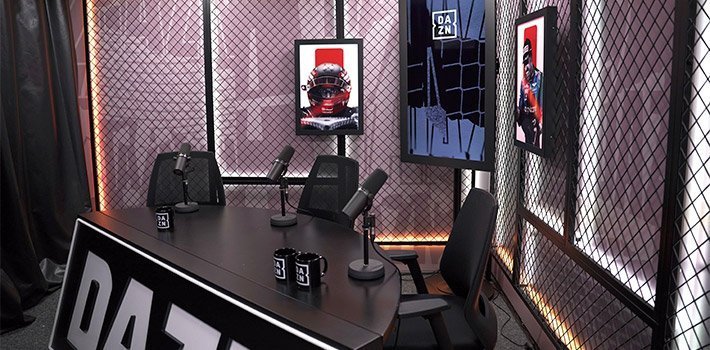
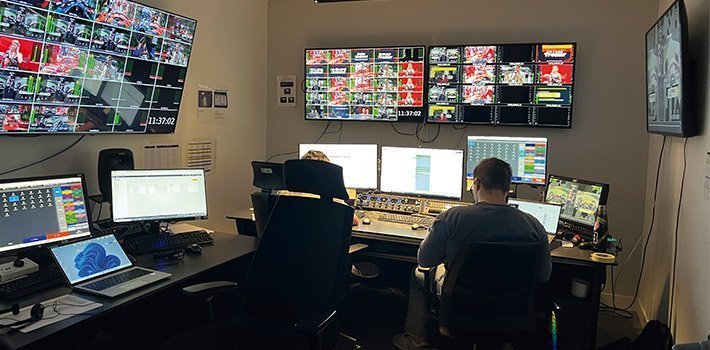
DAZN’s facilities are a testament to the efficiency and versatility of audiovisual production. The hub has two full-fledged studios, each one equipped with its own control gallery and independent sound room. This twin configuration allows great flexibility, with the ability to allocate resources to different productions according to the needs of the given moment.
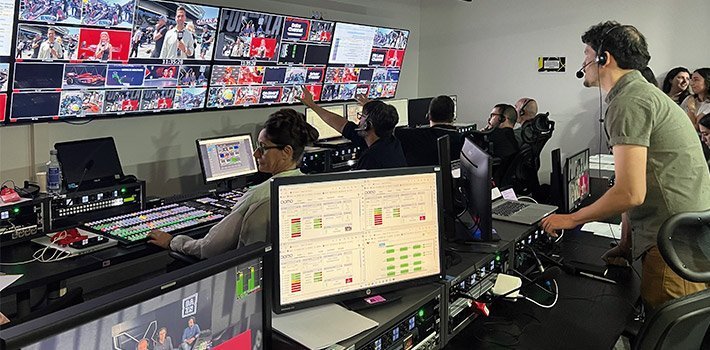
A key element of this infrastructure is the MCR (Master Control Room), which manages the acquisition and contribution of signals, as well as the quality control of external connections. The technical core of the system is a hybrid audio/video matrix that distributes all resources between galleries, sets, booths and parlours, thus creating a fluid and highly efficient workflow.
The virtual studio: a window into the future of production DAZN’s virtual set, inaugurated on February 28, 2024, coinciding with the Bahrain GP, is the jewel of the crown within the facilities. By making use of Vizrt technology, the studio offers a 360º scenography that enables the creation of immersive and highly detailed virtual environments.
Cutting-edge technology
The system is based on Viz Engine, Vizrt’s real-time rendering engine, with each studio camera having its own dedicated engine. This configuration allows for optimal performance and exceptional visual quality, to such an extent that representatives of Vizrt have commented that they have not seen a set with so many elements and a similar level of detail in all of them anywhere else in the world, as Roberto Jimeno, Operations and Technical Resources Manager at TBS, commented during TM Broadcast’s visit.
Unprecedented realism
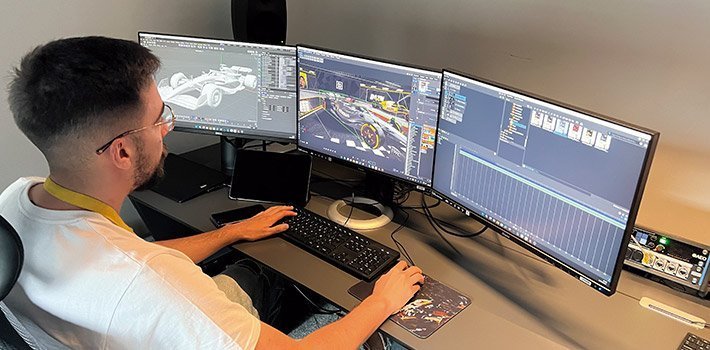
The level of detail achieved in this virtual study can be impressive. The TBS creativity team, led by Alberto Gonzalo, has taken realism to new heights, implementing wear effects on the floor of the virtual set and “graining” on elements such as the wheels of Formula 1 cars, with the intention of increasing the feeling of authenticity.
Spatial efficiency and versatility
One of the most remarkable features of these facilities is the clever use of space, as the team conveyed to us from the beginning: “we have made the most in everything, as you will see,” said Ignacio Cañas, Head of Production Operations of DAZN Spain, when he was showing the audio production room, located in the leftover space of a meeting room, near the cafeteria area. This is how DAZN has managed to create a world-class production hub within a conventional office building, an achievement that underlines the innovation and adaptability of the project managed by TBS.
Multipurpose booths
The old voice-over booths have been ingeniously converted into multifunctional spaces, as Silvia Moreno, Head of Production of DAZN Spain, pointed out with satisfaction. These areas serve now as post-production rooms, online editing, graphics and even commentary booths for various sports competitions.
Centralized control
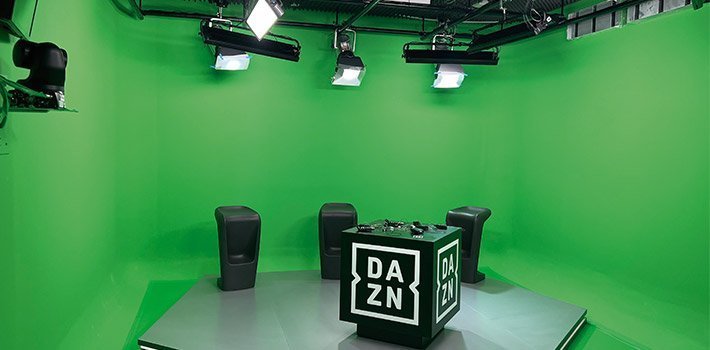
Adjacent to the virtual set we find a graphic control room and CCU (Camera Control Unit) that centralizes all studio operations. From here, technicians have full access to the set control, including augmented reality elements, virtual scenography (Viz ARC), PAN-TILT cameras, and lighting control.
Global connectivity
The DAZN hub is not only a unique space for its internal capabilities, but also for its global connectivity. For the coverage of Formula 1, for example, point-to-point fiber optic connections have been established from each of the 24 circuits of the world championship up to the DAZN facilities in Spain.
But, according to what Ignacio Cañas told us, this connectivity infrastructure extends beyond F1. The hub is connected to the main production and distribution nodes of the company and its partners, including a permanent connection with DAZN’s Central Control in London and two-way connectivity with Movistar’s Central Control in Tres Cantos, underlined the Head of Production Operations.
Remote management: The key to operational efficiency
One of the constant trends in the audiovisual sector is the optimization of resources and operational efficiency. In order to boost both features, TBS has integrated remote management holistically into DAZN’s audiovisual production, leveraging the most advanced technologies to create a flexible and efficient workflow. This strategy not only improves operational efficiency, but also allows for greater flexibility in content production and distribution.
A virtual production platform
The TBS platform has been integrated with DAZN’s existing audiovisual production hub in Madrid, which operates under a new generation remote production platform developed by NEP and offshored to the Netherlands. This platform allows remote access to a wide range of audiovisual production functionalities, including:
- Real-time access to resources
- Content editing
- Live commentary and narration
- Graphic design
All these resources are hosted in a virtual environment, which makes them accessible from anywhere in the world through an internet connection, thus streamlining media flows.
Multipurpose production booths
What was a string of voice-over booths has been converted into a corridor of production rooms that can be adapted to different needs and converted into:
- Post-production rooms
- Online editing stations
- Spaces for graphic design
- Commentator positions for different sports competitions
Remote control of equipment in locations
Remote production is part of the DNA of sports broadcasts, and to enhance it, DAZN and TBS have implemented systems that allow remote control of part of the technical staff and equipment on Formula 1 circuits from the General Perón (Madrid) facilities. For example, the sound consolo in the circuits can be controlled from the production center.
Added benefits of remote production
The DAZN team, with Ignacio Cañas (Head of Production Operations) and Silvia Moreno (Head of Production) told TM Broadcast what have been the main benefits derived from the boost of remote production capabilities:
- Cost reduction: By centralizing production and allowing remote access, DAZN has managed to optimize resources and reduce operating expenses such as transfers, trips…
- Increased flexibility: The ability to access and control resources from any location allows DAZN to quickly adapt to changes in scheduling or production needs.
- Efficient expansion: The implementation of remote production offices is much faster than the installation of traditional physical infrastructures, thus facilitating DAZN’s expansion into new markets.
- Enhanced collaboration: The virtual platform allows teams in different locations to work together more efficiently on common projects.
Custom graphics: The visual identity of DAZN
One of the secrets of DAZN’s custom graphics system in 360º environments is the advanced management provided by Vizrt technology, which enables the creation a complete and highly detailed virtual scenography. This system plays an essential role in the customization of content, which is key for this sports content platform, and “especially for Formula 1 coverage”, the team told us.
Vizrt technology
DAZN’s audiovisual production space uses the Vizrt system, specifically the Viz Engine, for real-time rendering of 3D graphics. Each camera in the studio has its own dedicated engine, thus allowing for optimal performance and high visual quality.
360° virtual scenography
DAZN’s virtual set, with such small dimensions that no one would tell by looking at the result, offers a complete 360-degree scenography thanks to a green chroma that covers three quarters of the space, thus allowing the creation of immersive environments for different types of content, such as Formula 1 analysis, track representations, single-seaters and pits.
Customization and flexibility
In addition, the system allows quick customization of virtual studio elements, such as changing colors and logos to represent different teams, or converting a Ferrari vehicle into a ranking graph in just one move and in a smooth way. This flexibility facilitates adapting the environment to different production needs.
Real-time video integration
This is what in some environments is called ‘game-changing’ functionality: in DAZN’s new audiovisual hub, it is possible to integrate live video feeds within elements of the virtual studio, allowing, for example, to show reporters in remote locations within the 360-degree environment.
An exceptional level of detail
And a streaming platform is not only about technology: a dynamic and professional creativity team is also in place, which has taken advantage of Vizrt’s capabilities to add an unprecedented level of detail, such as wear and graining effects on the wheels of F1 cars, as we mentioned, implementing wear defects in floors and polishing in detail the reflections and lighting effects that viewers would not find in broadcasts from an actual physical set.
Key tools and technologies
- Viz Engine: This real-time rendering engine is critical for creating animated 3D graphics at all resolutions.
- Viz Artist: This Vizrt system is used for creation and control of 3D graphics in real time, allowing rapid customization and adaptation of the graphic elements according to the needs in each production.
- Viz Trio: For the play of 2D signage in an agile way, integrated with all other graphic elements and automated data update.
- Viz ARC: This tool is used for the management of virtual scenography, thus allowing rapid changes in the virtual studio environment to adapt to different sports or competitions.
- RCS Foundation: DAZN collaborates with Reality Check Solutions (RCS) to use this cloud-based data management service. RCS Foundation enables fast and complete delivery of sports data, which is then integrated into real-time graphics.
- Custom control apps: RCS has developed bespoke control applications that allow the DAZN team to enable automated data-driven match chart carousels without relying on specialist chart operators.
- Singular.live: This platform has been used to create DAZN Match Central, an automated scoring and statistics channel that uses data from multiple providers and social media platforms.
In addition, the management of these graphics for different formats is done through the Adaptive Graphics function of Viz Engine 5. This feature automatically adapts graphics to different aspect ratios and resolutions, ensuring a consistent look across multiple platforms, from traditional TVs to mobile devices and studio video screens.
Augmented and mixed reality: enriching the visual experience
Augmented reality is vital for sports broadcasts, and its use has almost become a hallmark for this sports platform. When we asked the team about the benefits gained from this long-standing partnership between sports and Augmented Reality, these are the points they made:
- Flexibility and versatility: AR enables quick creation and modification of virtual environments, adapting them to different sports or competitions without the need for physical changes in the studio.
- Improved visual narrative: AR elements allow to present data, statistics and analysis in a more dynamic and interactive way, improving the viewer’s understanding.
- Streamlining of resources: By using a virtual environment with augmented reality elements, DAZN can reduce the costs associated with building and maintaining physical sets.
- Immersive experience: The combination of virtual scenography and AR creates a more immersive experience for viewers, thus increasing the engagement with the content.
Integrating AR into sports broadcasts
But how has DAZN integrated AR into its sports broadcasts? First of all, AR is a great help for tactical analysis; that is, they use this technology to superimpose graphics and animations on images of the game, which allows a more detailed and visual tactical analysis.
In addition, AR is critical to creating real-time statistics, as data and statistics are dynamically integrated into the broadcast, and augmented reality elements are used to present them in an engaging and easy-to-understand way.
On the other hand, virtual reconstructions facilitate commentators’ explanations of technical aspects during sports broadcasts, and real-time video integration allows reporters to be included in remote locations within the 360° environment, as already pointed out.
Finally, content customization -essential for agile and quality broadcasting- is quickly generated thanks to AR by creating graphic elements for different markets or audiences and adapting the content to local preferences.
As for implementation of all these technologies, this is done through a graphic control room and CCU (Camera Control Unit) that centralizes all studio operations. From here, as mentioned before, technicians have full access to the set control, including augmented reality elements, virtual scenography (Viz ARC), PAN-TILT cameras, and lighting control.
Cameras and control systems: The basis of a quality production
DAZN’s broadcast and audiovisual production space is equipped with high-definition 4K cameras, designed for studio production and live events. The use of 4K cameras allows for superior image quality, as viewers can see every day, with a resolution of 3840 x 2160 pixels.
Control systems
- Robotic cameras: The studio has three robotic cameras, which can be controlled remotely from the control room.
- Centralized control: Adjacent to the virtual set a graphic control room and CCU (Camera Control Unit) centralizes all studio operations, including control of PAN-TILT cameras by means of a joystick.
- Remote control: The system allows remote control of the cameras, making it easy to produce from distant locations.
Scalability of the equipment and studio capabilities
Another must in the era of transformation that the broadcast and audiovisual production world has to do with the constant evolution of technology and techniques used in the sector, so scalability is essential in an audiovisual production hub that feeds one of the most viewed sports content platforms on the planet.
Scaling up production in 4K and HDR
Currently, DAZN facilities allow 4K and HDR productions, although these capabilities are not fully utilized due to limitations in consumer devices. However, there are plans to expand these capabilities as these output devices evolve and support the new technologies.
In addition, other possibilities for evolution that both platform and integrator indicated they are considering were:
- Expansion of the connectivity infrastructure: with the collaboration of Tata Communications, DAZN has already established a robust fiber optic infrastructure for global connectivity. There is a possibility to expand this infrastructure in order to support more events and improve redundancy and stability of connections.
- Increased storage and processing capacity: as content production grows, so do data storage and processing needs. DAZN can scale its network attached storage (NAS) and cloud storage systems to handle higher volumes of video data, ensuring fast and efficient access to content.
- Improvement of control and automation systems: Implementing more advanced control systems and automation can improve operational efficiency. This includes upgrading camera control systems and integrating artificial intelligence for workflow management, capabilities that are expected to evolve in the near future.


Comments are closed