


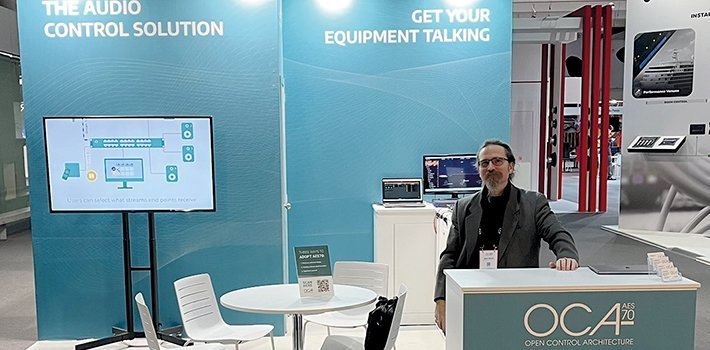
The OCA Alliance, short for the Open Control Architecture Alliance, is a consortium of industry-leading companies dedicated to advancing open standards in the field of professional audiovisual (AV) and media networking. Established in 2011, the alliance seeks to foster interoperability and innovation within the AV industry by promoting the adoption of the AES70 standard.


This standard is a clear way to establish seamless communication between various AV devices, providing a common language for AV professionals and simplifying system integration and management. Over the years, the standard AES70 has steadily gained traction as the industry’s go-to standard. Its robustness and versatility have enabled seamless integration and management of diverse AV devices. With this interview, we wanted to know what were the main obstacles the Alliance met during its journey and what to expect for the coming years.
Join us as we discuss how OCA Alliance and the standard AES70 have navigated through technological shifts, embraced innovation, and fostered collaboration, with Plattform Strategist Ethan Wetzell. Together with him, we will understand how OCA Alliance and this open-source standard, AES70, have paved the way for a more interconnected, flexible, and user-friendly AV landscape as well as which are the challenges for them to face nowadays.
By Platform Strategist Ethan Wetzell
When does OCA Alliance started? What was the initial proposition and what did you want to achieve with building up this non-profit corporation?
The OCA Alliance was formed in 2012 by a collection of 12 pro audio manufacturers. This was around the time that a lot of the IP revolution in media transport was happening in the industry, and there was a group of us who were involved with these activities but saw that the topic of control was not being addressed directly. Our question at the time- something that has become a bit of a quick pitch for the technology now- was “you can send your content over the network, but how are you going to do anything with it when it gets there?”
And so we gathered this group of like-minded manufacturers for different areas of the industry around a table at a trade show and decided to join together to create a group that would develop a technology and open public standard that would answer that question.
How AES70 works and which are its uses and benefits for the industry?
AES70 is an open public standard that provides a complete professional solution to device configuration and control. It is based on three fundamental elements: AES70-1, the framework, AES70-2, the class structure, and AES70-3, the binary protocol. New elements of the standard, including a JSON format and media networking connection management adaptations are coming, as is the AES70-2023 revision that is soon to be made available.
These elements cover the fundamental areas of system control, such as describing and enumerating device parameters, establishing connections to them for sending and receiving control and update messages, how to interface with devices and controllers, and numerous other functions. Moreover, it does this in a manner that meets the needs of professional systems and is capable of scaling upwards to very large networks of thousands of devices as well as scaling down to very small and compact solutions and systems.
Equally important though is what AES70 does not do. It does not dictate how a device parameter is implemented- for example, it does not care about a specific algorithm implementation, it only describes a way to interface with it. Likewise, it does not dictate what a user interface looks like, it simply provides the tools to create one efficiently.
When we talk about benefits for the industry, we like to focus on the value of open public standards and what this means for developers and users. Developers gain the benefit of quicker time to market and access to a fully engineered control solution that is freely available yet maintained by professional standards bodies and engineers. For users, this means more reliability, interoperability opportunities, and more flexible integration options.
What were the key challenges and industry needs that prompted the development of AES70 and the Open Control Architecture (OCA)? How has AES70 addressed these challenges over the years since its inception?
Control is an extremely complex topic, particularly when considered in the context of a device’s design. While an audio networking solution is something that can be attached to the output of a devices and leave the inner workings and design largely untouched, control is different. It gets to the heart of the design and everything about the device’s design, use, and operational philosophy have an impact on the technology used to control it.
To that end, the design of AES70 has had to balance rigidity and standardization vs. flexibility and freedom. One example of this is how to describe a parameter- AES70 provides a number of strongly-typed classes (OCA.Gain, for example) but also offers the option for a developer to use a weakly-typed class or even develop their own subclasses that can be discovered and controlled by external controllers.
Another challenge was scalability. The needs of a massive, multi-site system made up of thousands of devices are radically different than that of a simple embedded wall controller. However, we needed to find a way to make the technology useful for both- and we have achieved and demonstrated this.
Can you provide examples of real-world applications and use cases where AES70 has made a significant impact in streamlining control and configuration of professional AV equipment? What benefits have users experienced in these scenarios?
In the field, we have heard from some AES70 adopters that they are able to build complex control systems that they simply would have been able to build with other technologies. We also have examples of how some adopters have been able to implement AES70 in their devices alongside their legacy control protocols to maintain compatibility while migrating to a newer control technology. There are also places where AES70 can complement other technologies, such as providing connection management for AES67. This allows the creation of more complete media networking solutions for vendors and better functioning and more easily integrated products for customers.
Interoperability and compatibility are crucial in the professional AV industry. How does AES70 ensure interoperability among devices from different manufacturers, and what efforts has the OCA Alliance undertaken to promote AES70 adoption within the industry?
There are three important way this has been addressed. First, AES70 leverages other open public standards, such as mDNS. Second, AES70 is agnostic as to what other media networking technologies it can be used with. Dante, MILAN, AES-67, or no media network at all, AES70 will happily operate alongside any of those. Third, the OCA Alliance makes available several documents and tools to ensure proper implementation of the standard. An example of this is the AES70 Compliancy Test Tool- available for free at ocaalliance.github.io that implementers can use to validate that their implementation is compliant with the standard.
AES70’s flexibility in supporting various network protocols is an essential feature. Could you elaborate on how this flexibility allows designers and implementers to tailor their product solutions to specific requirements, and how it contributes to the success of AES70 in different AV environments?
There are strengths to all the available media networking technologies that are available today and our view is that AES70 exists to make devices and systems easier to use, not to place restrictions or barriers on how systems are designed and deployed. This is particularly critical in situations where different technologies may come together in one place. As an example, you could have something like a stadium where audio is moved over MILAN for the main PA, Dante for the systems in the concourses and suites, and ST 2110 for broadcast facilities. AES70 can happily exist with all of these and cross the system boundaries as needed to support the users in what they need to get done. It’s this type of flexibility and scalability that is aimed at allowing the users to spend less time worried about the technology and more time focusing on the production.
As AES70 continues to gain traction in the market, what are the OCA Alliance’s future plans and objectives for further developing the standard and expanding the ecosystem of AES70-compliant products and solutions?
For the standard itself, the goal is to continue to enhance the core standard and extend the functionality AES70 brings to the table. In the upcoming AES70-2023 revision, we have made numerous enhancements in the core standards that make it easier to use and develop with and made additions to provide new or improved functionality. At the same time, we are introducing several new standards that we call adaptations that will bring new- but optional- functionality, such as connection management solutions, to the standard.
The OCA Alliance will continue to support this technical work through promotion, education, demonstration, and outreach to the industry to continue to encourage adoption and grow the OCA ecosystem.
According to your point of view and aside standards as AES70, which would be the developments AV industry requires at this very moment?
From my personal perspective, I think the most important thing is not so much more technology, but rather a mind shift in how the technology is developed. We have reached a high level of maturity in the technologies that came about with the IP revolution over the last decades. Our next step should be to work to enhance the usability and user experience of working with these technologies. To get there, we need to focus on the users, workflows, and making these technologies as frictionless as possible for people to adopt and work with. Mature technology is critical, but as this comes, the focus needs to shift to making it ever more user friendly and accommodating to not only what the task at hand is, but how the user wants to operate and carry out what they are trying to do. Technology for technology’s sake isn’t going to make anybody’s life easier- we need to focus on next-level problem solving.
AES70 is a freely-available open standard, so which do you consider is the ROI for OCA Alliance?
Our one and only goal is adoption, full stop. Our return on investment is when this technology makes it into products, and it begins to make the lives of developers, designers, and users easier. The individuals who make up the working groups in both the AES and OCA Alliance are, in many cases, competitors in our day jobs. However, we all believe very strongly in the common good that this standard brings to the industry and our customers. Our goal is- and always has been- to try to solve problems for people through open public standards that are freely available to all. After all, if a designer doesn’t need to worry about a control solution anymore, they can spend more time developing killer features into their products.





Comments are closed