


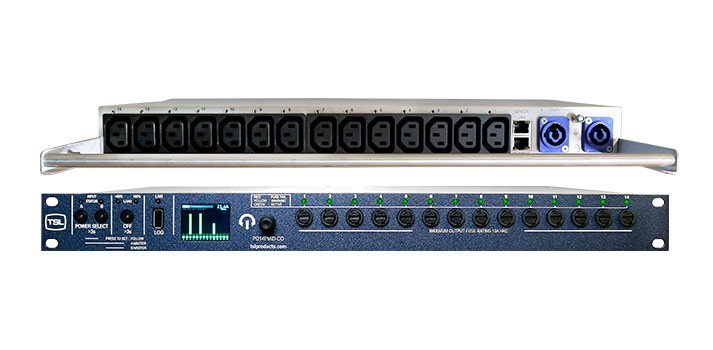
TSL will announce new updates to its Power Distribution Units (PDU) at NAB 2022 (Booth C5240). As remote means of production are implemented, technological solutions must also adapt to these new processes. TSL’s enhancements respond to this need.


“Power is one of the most exciting investments we have made at TSL,” says Mark Davies, Director of Products and Technology at TSL. “These latest upgrades to our power products are based on a massive R&D effort that is 18 months in the making. We listened to our customers to understand their ongoing challenges and delivered a new solution that provides them with more power and control over their workflows with added security.”
TSL’s ethernet connected PDUs have been designed to handle up to 32 amps (A) with optional auto-failover/auto supply and lifted the entry level amps from 16 to 20. The design also includes an upgrade from 12 to 14 outputs, each one capable of delivering up to 10A, enabling customers to power more units from one PDU.
The PDUs have a front panel LCD screen for local monitoring and control. The display shows voltage and power factor measurement for each outlet; input voltage and total current/power measurement; CLASS I (‘billing grade’) measurement accuracy; and earth leakage current measurement. The new units also feature sequential, immediate or user configured delayed start-up.
Additional settings include power loss configuration (all-off, all-on and last-state); fast-configuration via USB or front panel LCD; data logging (Syslog or to USB); SNMP monitoring and alarms (optional control); email and SMS alerts and a power input fail alarm.
Also included is an internal temperature sensor with adjustable alarm and a rear mounted port that can be connected to industry standard 1 wire sensors for external environment monitoring.
It is mounted in a rigid steel case with 14 outlets, each rated at 10A capacity. The units feature soldered joints with bus bar construction. The new units include a front mounted 2-pole 20A or 32A hydraulic magnetic circuit breaker to guard against accidental overloading







Comments are closed