


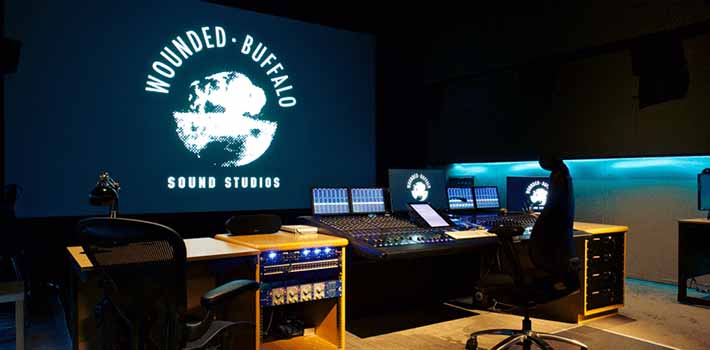
Wounded Buffalo Sound Studios: Crafting soundscapes for natural history and award-winning productions


In Bristol, England, Wounded Buffalo Sound Studios stands out as a major player in the post-production audio world, especially in the niche of natural history documentaries. Renowned for its immersive soundscapes in series like Planet Earth III, Earthsounds, and Our Great National Parks, Wounded Buffalo’s team combines a passion for audio authenticity with cutting-edge technology to produce audio environments that captivate global audiences.
Tackling the challenges of natural history audio
One of the unique challenges in natural history documentary sound is recording animals or natural environments without disturbing them. “Most things are filmed on very long lenses. So, you can film something from 400 yards away, but you can’t easily capture the sound from that distance,” explains veteran mixer Ben Peace. This often results in poor or absent field audio, which is why the Wounded Buffalo team painstakingly recreates or layers soundscapes from scratch, ensuring they reflect the natural settings as closely as possible.
When authentic sounds are available, however, they can provide invaluable reference points. “We do get some atmospheric sound if we’re lucky,” Peace adds, noting that even subpar audio from remote camera microphones helps guide their work. To keep things true to life, the team collaborates with scientists and producers familiar with the wildlife or ecosystems depicted, verifying that “each layer is pretty fastidiously researched,” says Studio Manager Jim Jacobs. “The wrong bird at the wrong time of day can ruin the authenticity.”
Crafting underwater soundscapes and creative atmospheres
Underwater environments present their own set of challenges, requiring careful sound design to capture their unique auditory signature. To avoid contaminating natural soundscapes, Peace and his team work with field recording teams, often advising them to reduce external noise, like boat engines, before recording. “Underwater stuff is actually quite tricky,” says Jacobs, noting that in post-production, certain sounds must be creatively enhanced. “Swimming generally doesn’t make much noise, but when you see it, it kind of needs to make a sound to look right.”
For children’s programming, Peace has leveraged Atmos technology in creative ways, such as positioning parental voices in height speakers to reflect a child’s perspective. “When you’re watching it, you’re in the kids’ shoes, and the voices come from above you,” he explains.
Wounded Buffalo’s state-of-the-art facilities
Wounded Buffalo’s facilities feature three advanced dubbing theaters and six editing suites, with notable technology such as:
– Dubbing Theatre A (Dolby Atmos): Equipped with an Avid Pro Tools HDX system, S6 M40 console, and a surround sound setup.
– Dubbing Theatre B: Houses an Avid S6 control surface and Pro Tools.
– Dubbing Theatre C: Contains two Avid S1 modules and Avid Dock.
– Sound Editing Suites: Outfitted with Pro Tools and essential noise reduction plugins like iZotope RX.
Avid S6 Control Surface
The integration of Avid’s S6 control surface has transformed Wounded Buffalo’s workflow, enhancing efficiency across complex projects. “When the S6 came along, we jumped ship and went to Avid,” says Peace. The upgrade not only streamlined operations but also centralized various processes. Jacobs confirms, “Everything is in one place. The integration is seamless, and it brings forward everything we need for a session.”
Theatrical audio production
Wounded Buffalo is increasingly applying its skills to the cinema. With natural history visuals becoming ever more cinematic, there’s growing demand for these productions on the big screen. “We’re seeing a bit of an upturn in theatrical work,” Jacobs notes, adding that immersive audio formats like Dolby Atmos are especially effective in theaters. The team is excited about the prospect of creating larger-than-life audio landscapes to match the visual spectacle.
From humble beginnings to post-production pioneers
Both Jacobs and Peace have followed unique paths to Wounded Buffalo. Jacobs, who began as a runner, spent years expanding audio departments, designing studios, and even writing music before finally joining the studio in Bristol. Peace, on the other hand, joined Wounded Buffalo in 1997, witnessing firsthand the transition from early audio technologies to today’s digital sophistication. “I started messing around with DJing raves back in the 90s,” Peace recalls.
As they look to the future, Wounded Buffalo remains committed to evolving with industry trends, embracing new technology and pushing the boundaries of what’s possible in sound design. “We’re constantly evolving,” says Jacobs, underscoring the studio’s mission to use Avid solutions to maintain the high standards that have made their work iconic in nature documentaries worldwide.



Comments are closed