


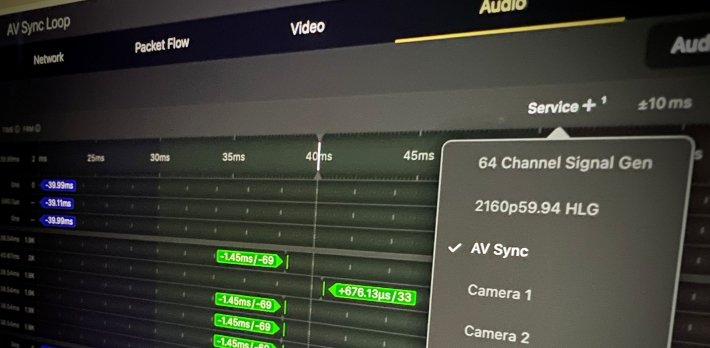
Bridge Technologies has announced a new enhancement to the AV Sync function contained within its VB440 production probe. The new multi-service AV sync comparison feature is designed to try to enable frame-accurate synchronisation assessment across multiple delivery paths of the same service, as the company has claimed in a statement.


Designed for live IP production environments where redundancy is critical, but applicable in a range of contexts, the new capability aims to allow engineers to assess and compare multiple flows carrying the same service – for instance, across satellite, SRT, or other IP routes.
This added functionality builds upon the core of the VB440’s AV Sync Generator feature, which was introduced at the beginning of the year. Its original function was to act as an innovative ‘first line of defence’ approach to synchronisation between audio and visual components within a single service. In this function, the system embeds machine-readable electronic markers directly into the audio and video signals themselves. When the complete service is reconstructed at the client, these physical markers are analysed to assess frame-accurate alignment between audio and video in real time.
More recently, this capability was expanded to include ancillary data synchronisation, allowing the client to precisely visualise the delta between video and audio and the metadata, including immersive audio. It offers additional visualisation tools such as rolling shutter simulation, blink-and-beep reference cues.
The newly introduced multi-service comparison capability builds on this foundation. In scenarios common to live sport and premium broadcast – where the same service may be delivered via multiple, genuinely independent paths for resilience – those paths arrive with different timing characteristics. The VB440 places multiple incoming services onto a shared timeline within the sync client, visually stacking and comparing them against a chosen reference. Engineers can instantly see frame-accurate offsets between flows, and use this information to adjust delays accordingly. As with all of the VB440, the UI has been designed to try to facilitate decision making with a workflow: new services can be added to the timeline with the click of a button, where they are stacked in a workspace so that engineers can undertake even complex multi-path alignment quickly and easily. The addition of APIs also means that users can develop automation tools to perform alignment, drawing frame-accurate data from the probe to facilitate other sync-related processes.
Commenting on the development, Bridge Technologies Chairman Simen K. Frostad explains: “Multiple transport methods carrying the same service is a practical reality in modern IP production, particularly when expenditure and resilience are both priorities. What matters is not eliminating that reality, but giving engineers the tools to manage it precisely and predictably, so that there is no compromise to end delivery”.
He continues: “This development is yet another example of our commitment to building the most comprehensive multifunctional production probe on the market. In the VB440 we bring together an ever-increasing range of functions and capabilities within a single platform, all designed to represent best-in-class examples of their type. By consolidating what were once multiple standalone tools for audio, video and engineering into one browser-accessible system, the VB440 reduces the cost, space, energy use, and operational complexity associated with maintaining disparate single-function appliances, along with their screens and cabling”.






Comments are closed