


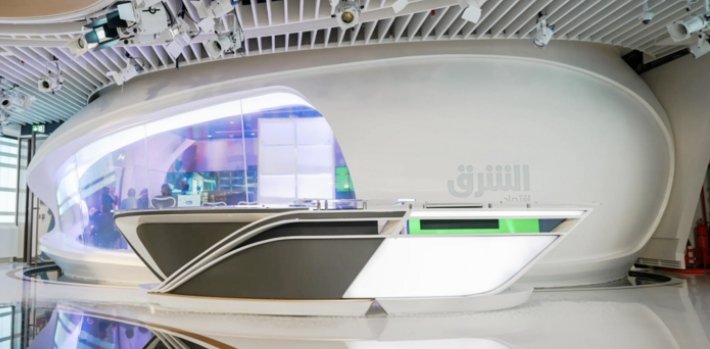
Qvest has delivered Asharq’s new full-IP broadcast station at SRMG’s headquarters in the King Abdullah Financial District (KAFD), Riyadh. The company has also completed the migration and cutover of its live news operation from Dubai in just two months, without interrupting broadcasting, as it has claimed in a statement.


Asharq’s facility spans four floors of the SRMG headquarters as well as a rooftop satellite farm and is more than twice the size of the previous facility in Dubai. Across this space, Qvest was responsible for the design and implementation of the scalable end-to-end production environment, including four studios, two newsrooms, post-production and graphics, media management and archive, master control room, playout, transmission, satellite operations, as well as broadcast and corporate IT.
The two newsrooms serve as the operational heart of media production, connecting editorial workflows and news production processes for up to 160 journalists.
“The new Riyadh broadcast facility brings our key production capabilities together in one connected environment designed for the demands of continuous live news. It gives our teams greater flexibility across newsroom, studio, production and distribution workflows, while providing a strong foundation for the continued development of our operations from Riyadh”, explains Omran Abdallah, VP Engineering IT & Technology at SRMG NEWS & Asharq Bloomberg.
“We greatly valued the close and trusted collaboration with Qvest throughout the project. Their strong technical expertise, project coordination and reliable delivery were key to bringing this complex environment into operation and transitioning our live news operation without interrupting broadcasting”, he adds.
Each studio has a defined production profile. Studio 1 measures 350 sqm and combines three fully robotic camera chains, two manual pedestal cameras, a tracked camera crane and six video walls. The equally large Studio 2 is geared toward highly automated bulletin production and extensive virtual production, with four fully robotic camera chains, a tracked crane and seven video walls. Studio 3 provides a 250 sqm environment for daily bulletins and interviews, while the 150 sqm Studio 4 is dedicated to green-screen and XR workflows for virtual sets, financial and data-driven formats, elections and breaking news.
At the core of the setup is an SMPTE ST 2110 architecture that connects the production environment on a shared IP infrastructure. PTP synchronization, redundancy, and hitless switching aim to ensure the resilience and precision required for live production, while the IP-based architecture provides flexibility for future development and distributed workflows. The multi-vendor environment brings together technologies from a broad ecosystem of broadcast and IT partners, coordinated and integrated by Qvest.
“What makes this project stand out is the combination of technical scale and operational continuity. We brought together a highly complex production environment and completed the migration and cutover of a live news operation without taking it off air. Managing technology, systems integration and project delivery as one coordinated process was central to making that transition work”, remarks Philipp Glänzel, Managing Director MENA, Qvest.
Qvest covered the full project lifecycle, including technology and workflow design, project and commercial management, engineering, procurement, logistics, systems integration, vendor coordination, change management, training, and commissioning. The final migration from Asharq’s premises in Dubai to the new facility in Riyadh was completed within two months.
The Riyadh broadcast facility is connected to Asharq’s wider production network, with facilities in Cairo and Riyadh’s Diplomatic Quarter linked to KAFD via fiber. This looks forward to enabling centralized operation of production resources and supports remote and distributed workflows with minimal crews.


Comments are closed