


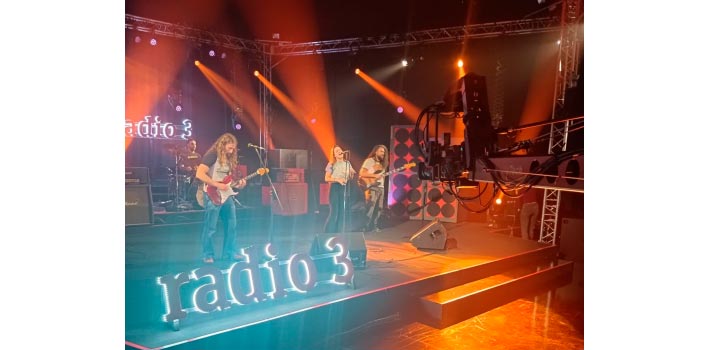
Last weekend, Spain’s RTVE (Radio Televisión Española) set new technical standards in live television, broadcasting its popular programme ‘Los Conciertos de Radio 3’ using 4K technology with Sony FX9 full frame sensor cameras to achieve a cinematic look and stunning image quality – the first live TV production to do so.


Migration to HD
The need to switch to HD was a requirement that the music programme had been seeking for more than a year. The idea was to replace the 2/3 format SD cameras with full frame sensor cameras in order to be able to broadcast in 4K and achieve that shallower depth of field and the much sought-after cinematic look. An important premise – those responsible for the project point out – was to maintain the previous production workflows and to have remote control of the cameras and production in RTVE’s Prado del Rey (Madrid) studios, with the usual RCPs (Remote Control Panels).
“We needed to migrate to HD and achieve a cinematic look, but at the same time, it was essential to continue with the previous workflows and remote control of cameras using the RCPs and remote access to the camera menu,” commented Francisco Collado, Assistant Director of Engineering and Support for Studios and Mobile Units at RTVE.
One of the challenges of this migration is the use of new lenses to fit this type of sensor, so a detailed study of the different sensor sizes that the camera would allow (full frame and Super35) was necessary, which would affect, for example, the viewing angles, zoom capabilities, bokeh effects or the depth of field, with the necessary adaptation in their operation.
Recording with large format sensor cameras
When the programme team considered the Sony FX9s, the advantages of working with a full-frame camera represented one of the main arguments for making this technological leap. Thanks to the larger sensor size, these cameras capture more light and detail, resulting in sharper images with greater dynamic range. In addition, during a live broadcast, the use of large-format sensor cameras allows for more accurate colours and shallower depth of field, providing total control of the narrative by focusing the viewer’s attention where desired at any given moment while blurring everything else out of focus.
These cameras are also able to handle difficult lighting conditions, such as high contrast or low light scenes, without losing quality. This is crucial at live events such as ‘Los Conciertos de Radio 3’, where conditions can change quickly and there is no opportunity for further adjustment. The ability to shoot in high resolutions, such as 4K, ensures that every detail is captured with clarity, providing an immersive visual experience for the audience.
Another key aspect of live recording of this kind is dynamic range. The Sony FX9 camera is capable of capturing detail in both the brightest areas of the stage and the darkest areas, allowing users to play with focus on any point of interest such as instruments, reflections on surfaces, signs, etc. and even the hot head. A wider dynamic range allows the camera to record a wider range of light levels, resulting in more balanced and detailed images, less noise and ultimately richer, more natural colours.
Autofocus: making camera operators’ work easier
The camera’s autofocus is another of the Sony FX9’s strengths, as everyone who works with it points out. The agility of this focusing system that automatically adjusts focus in real time ensures that the selected subject is always sharp, even if it moves, which is crucial in a concert.
The Sony FX9’s precision focusing makes it much easier for camera operators to concentrate on other aspects of shooting, such as composition and framing, without constantly worrying about manually adjusting focus, which is especially critical at these shallow depths of field.
“The camera operators have had to adapt to the new way of working but, on the other hand, this has given them incredible creativity. The fast autofocus reacts immediately to the rapid changes in a concert, allowing an unprecedented visual experience,” says Pedro Pablo del Cura, Chief Producer of Los Conciertos de Radio 3.
Film Broadcasting. The process of storytelling through images
Los Conciertos de Radio 3 has become the first broadcast with a cinematographic aesthetic on Spanish television. Now viewers can enjoy every detail, every note of this live programme, as if they were in the front row of the concert, but from the comfort of their own home – a leap into the future of audiovisual production, designed to surprise viewers.
“Sony’s large-format sensor camera and powerful autofocus has given us unimaginable artistic possibilities, completely changing the aesthetics and facilitating a narrative through images,” says Pedro Pablo del Cura.
“We have worked with RTVE for many years and this knowledge has given us a clear understanding of the challenges and the ability to provide them with the best solution for their live programme,” adds David Anaya, Channel & Key Account Manager Regional Sales South at Sony. For more than 26 years, Los Conciertos de Radio 3 have offered a space on public radio and television with artistic contributions from established groups, but also from new talent, and for us it has been a privilege to walk with them on this path towards such a pioneering image quality and cinematographic style.”




Comments are closed