


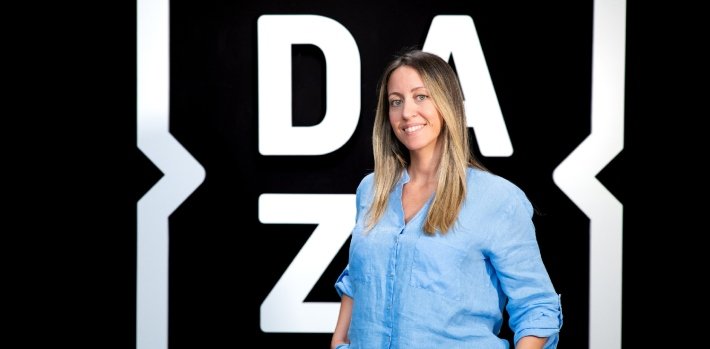
We complete our report on the Spanish GP with DAZN’s perspective on the strategic aspects of its coverage and the evolution of Formula 1 and other sports broadcasts.


*This content is included in the October issue of TM BROADCAST. You can access the full magazine here.
Forty-five years later, Formula 1 returned to Madrid. And the coverage of the event also represented a milestone for DAZN. According to Silvia Moreno, Head of Production at DAZN Spain, the on-site deployment “tripled”: three RF cameras, three PTZ cameras and four ENG/LiveU cameras, as well as up to 14 on-air professionals, including commentators, presenters, pundits, analysts and reporters.
The increase in resources was accompanied by more broadcast hours: “For this 2026 Spanish Grand Prix, we produced 50% more live television than we normally do on a standard F1 weekend,” Silvia Moreno tells TM BROADCAST. She puts the number of additional live programmes at ten compared with any other Grand Prix weekend.
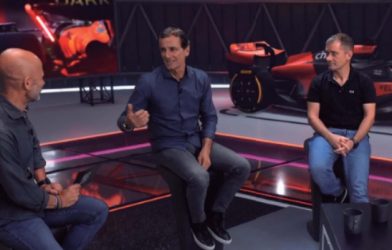
Among the special productions was a “mobile studio” aboard a bus, from which Antonio Lobato, Pedro de la Rosa and Toni Cuquerella travelled past some of Madrid’s iconic landmarks before arriving at Madring. “This was one of the most technically complex programmes of the week, as there could be no more than four people inside the vehicle while it was moving, and we asked TBS to devise a complete remote live production plan that would be stable, maintain coverage and work throughout the entire route.”
For this, TBS deployed four PTZ cameras with stabilisers and vibration isolators, an ENG camera with a LiveU 800, headset microphones, a HyperDeck as a backup recording system and lighting, as well as support vehicles.
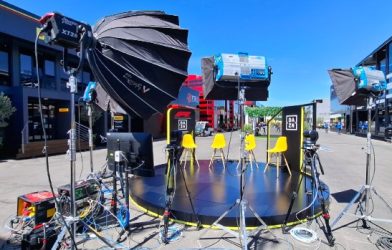
The special programming also took Box, Box, the opening programme for the Grands Prix, to the new circuit’s Monumental corner, “with the added complexity of being outside the RF antenna coverage area”. The location also lacked television lighting and a power supply for the equipment, so the production relied on LiveU.
In this interview, Silvia Moreno breaks down the strategic aspects of the deployment, its main challenges and the evolution of Formula 1 and other sports broadcasts.
The Madrid Grand Prix marked both the debut of a new event and that of a completely new circuit. From a production perspective, how did DAZN approach coverage of these characteristics, and what did you want to do differently compared with other races held in Spain, where the deployment is already usually larger?
We wanted to convey the novelty of the circuit to viewers. Yes, it was a Spanish GP, as we have experienced before in Barcelona, but it was different because it was the first time (in this current era) in Madrid, at a new circuit. Everything was new and there to be shown. That was where the difference lay: in what was unknown to the viewer, but also to us. Because we spent these months of construction visiting the circuit and following its development; but if you know F1, what a circuit looks like on a Monday bears little resemblance to what you will find on a Thursday in the paddock, garages, pit lane, etc. And we wanted to be the window through which viewers who were not attending and who did not have access to that more exclusive area could unwrap the gift alongside us and discover everything that was new.
That was DAZN’s challenge: how do you prepare a production plan for a circuit you do not know, when you do not know what demands it will place on you or what realities you will encounter when the real action begins? The guiding principle was therefore to have the largest possible deployment to cover every centimetre of the vast Madring circuit.
“We have spent these months of construction visiting the circuit and following its development. But in F1, what a circuit looks like on a Monday bears little resemblance to what you will find on a Thursday in the paddock, garages or pit lane.”
As I understand it, in Madrid you reached around 30 hours of live coverage over the course of the Grand Prix. What does this figure represent compared with DAZN’s usual Formula 1 coverage? How many hours of live broadcasting do you normally produce during a Grand Prix?
For this 2026 Spanish Grand Prix, we produced 50% more live television than we normally do on a standard F1 weekend. We produced ten more live programmes compared with any other Grand Prix weekend. That figure means not getting much sleep… [Laughs]. Joking aside, we wanted the action to start with us at the circuit and then link together all the sessions, qualifying sessions and support and F1 races within the same broadcast on our platform, so that viewers had that sense of continuity and of being constantly connected to what was happening on the Madrid track.
In what format was DAZN’s Madrid Grand Prix coverage produced and distributed? Did you maintain the usual HD model, or were there any particular differences in terms of resolution, HDR or image treatment?
We maintained the HD signal distribution format. We did include a different camera setup from usual to give certain moments of our broadcast a more cinematic style.
Indeed, for the first time in your Formula 1 coverage, you incorporated a cinema camera. What did you want to add through this visual language, and to what extent are these types of cameras changing the aesthetics of sports broadcasts?
We were looking for the versatility that this type of camera gives us, not only because of the way it can be used —and its stability for moving shots— but also because of its ability to record at high frame rates, allowing us to use those shots as transition material during the live broadcast.
Sports broadcasts are changing because this type of camera allows you to offer shots that are different from those produced by standard broadcast cameras, which weigh close to 12 kg. Cameras such as the FX6/FX9 give you greater manoeuvrability, are lighter and provide the option of high-frame-rate recording. But they are not only used for live broadcasting; they are also a very good source of material for post-produced content.
“One of the most demanding challenges is audio: not only providing microphones for all the talent, but the most complicated part —the IFB feeds and instructions for all of them.”
One of the distinctive aspects of the coverage was moving a larger share of the production on site. What challenges did this approach involve, and what did it give you compared with the usual model?
At a Grand Prix where we combine on-site coverage with the studio experience at our facilities in Madrid, we usually take two RF cameras —or occasionally add a third depending on the specific requirements of that GP. For this Spanish Grand Prix in Madrid, our deployment tripled. Our setup here consisted of three RF cameras, three PTZ cameras and four ENG/LiveU cameras. We had up to 14 talents on site: commentators, presenters, pundits, analysts, reporters…
And one of the challenges that is rarely talked about but is among the most demanding is audio: not only providing microphones for all these talents, but the most complicated part —the IFB feeds and instructions for all of them, as well as for those of us involved in the production around them who need to stay connected with each other and with the production control room, where the final decisions on content and the running order are made.
How do you coordinate a production in which Formula 1’s international feed, DAZN’s unilateral content, the team deployed at the circuit and the General Perón production hub all coexist? From your perspective, where does the greatest complexity lie?
It is coordinated through a detailed knowledge of the exact timings of the international feed. The positive thing about F1 is that it always sticks to the timings set out in its Running Order; everything is scheduled down to the smallest detail and there are never delays. And you —at DAZN— simply have to work with the time you have around those slots to try to offer viewers a personalised experience.
From there, everything is based on generating content ideas, executing them and maintaining very good communication so that, in those moments of improvisation —which do happen, particularly when surprise guests appear— you have enough flexibility to incorporate them into your show without losing sight of the established timings, both those of the F1 Running Order and those of commercial breaks and the broadcast slots established on the platform.
Hence the importance of what I mentioned earlier about audio working properly in an environment packed with frequencies, where telephone communications are often impossible. Having direct, reliable and instantaneous communication between the circuit and General Perón is therefore key in an operation like this.
“Having direct, reliable and instantaneous communication between the circuit and General Perón is key in an operation like this.”
DAZN had more live positions and greater mobility both inside and outside the circuit, from the RF cameras and the presence at the Monumental corner to the mobile studio that travelled around Madrid in the days leading up to the event. How do you decide what is worth producing yourselves compared with everything already provided by Formula 1’s international feed?
Everything is based on finding different ways of communicating that entertain our viewers. That was the idea behind taking the DAZN bus out onto the streets, travelling past iconic locations in Madrid, with Lobato, De la Rosa and Cuquerella acting as tour guides to the city hosting the Grand Prix, while always making references to the F1 championship and their professional careers.
This was one of the most technically complex programmes of the week, as there could be no more than four people inside the vehicle while it was moving, and we asked TBS to devise a complete remote live production plan that would be stable, maintain coverage and work throughout the entire route. They installed four PTZ cameras with stabilisers and vibration isolators, an ENG camera + LiveU 800, headset microphones with a HyperDeck for backup recording, plus all the lighting, accompanied by support vehicles to make sure everything was working.
That was for Wednesday, but on Thursday we also wanted to unveil the circuit in a big way: we produced our Grand Prix opening programme, Box, Box, from the Monumental corner itself, with the added complexity of being outside the RF antenna coverage area, using the LiveU system, in an area with no television lighting or electrical power for the equipment. There was also the distinctive banking for which the corner is already known, which meant having to work with the presenters’ physical balance and the camera axes.
Now that the Grand Prix has taken place, how do you assess the production model designed for Madrid? Was there any decision or format that worked particularly well and could be carried over to future Formula 1 coverage?
We are a demanding team and you are always left with the feeling that perhaps we could have done more, but we are proud of the work carried out and the results achieved. Thirty hours of programming over four days involves a great deal of personal and technical effort, and I would say that, on a scale of ten, we could give ourselves an eight.
All the teams gave 100% to ensure that everything we had planned went perfectly, so the overall assessment is very positive. We should not forget that this was year one and that we lacked knowledge of the venue, as we mentioned earlier. Now that we know it, and although many things will probably change for year two as a result of the promoters’ and the competition’s own growth and learning process, we have already identified the areas where we can still raise the bar.
“The key is identifying the editorial moments when it is essential to be 100% on site because of the needs of the product, and combining them with the flexibility that remote production gives you on other occasions.”
Beyond Madrid, how is DAZN’s Formula 1 production evolving? Do you think we will see a greater on-site presence, or does the future lie in finding a balance between remote production and the resources deployed at the circuit?
Since we started in 2024 with the exclusive F1 production rights, we have worked with a hybrid production system, but this is not limited to this competition; it also happens in other sports and at other companies within the sports broadcasting sector. At DAZN, we have always been known for being present where the action happens, and that is something we never stop doing, even though we work with a mixed remote and on-site model.
The key is identifying the editorial moments when it is essential to be 100% on site because of the needs of the product, and combining them with the flexibility that remote production gives you on other occasions.
Beyond the competition itself, there seems to be growing interest in everything that happens before and after the on-track action. From your perspective, to what extent are these moments gaining prominence within Formula 1 coverage? How is this evolution influencing the way production is approached?
It is proving to be a complicated year from a sporting perspective because of the regulation changes, which are complex, have both supporters and detractors, and can be difficult for the casual fan to understand. That is why everything that happens around the race, before and after it, is becoming increasingly important, and our job is to try to explain what happens on the track in the least cumbersome way possible.
That is why, at every Grand Prix, we work to explain and innovate, contributing and exploring different ways of communicating everything that happens in this sport: not only what happens when the lights go out, but also what comes before and after, both for the cars and for the protagonists themselves, the drivers.
“The positive thing about F1 is that it always sticks to the timings set out in its Running Order. Everything is scheduled down to the smallest detail and there are never delays. You simply have to work with the time you have around those slots to try to offer viewers a personalised experience.”






Comments are closed