


Teradek’s technology was used during the Supercars Championship in Australia with the objective of delivering immersive, in-car streaming from 25 supercars simultaneously, as the company has claimed in a statement.


For this race, the vision of Supercars Australia was trying to bring to the fans the experience of being inside the cockpit to share every moment in real-time. For this, they needed a technology that could deliver quality and uninterrupted live streams from cars at over 300 knm/h.
Chris Beaumont, Head of IT at Supercars, collaborated with Teradek to try to achieve their goal. The primary objective was to maintain high-quality, uninterrupted video feeds in highly-congested venues. The team faced hurdles, including:
- Handling connectivity with large crowds on mobile networks
- Managing manual intervention and setup with GoPro
- Maintaining high-quality, uninterrupted video feeds in packed venues
- Managing power consumption and safety during races
- Addressing technical hurdles in change control and integration
Solution
Teradek tried to face the problems with different tools:
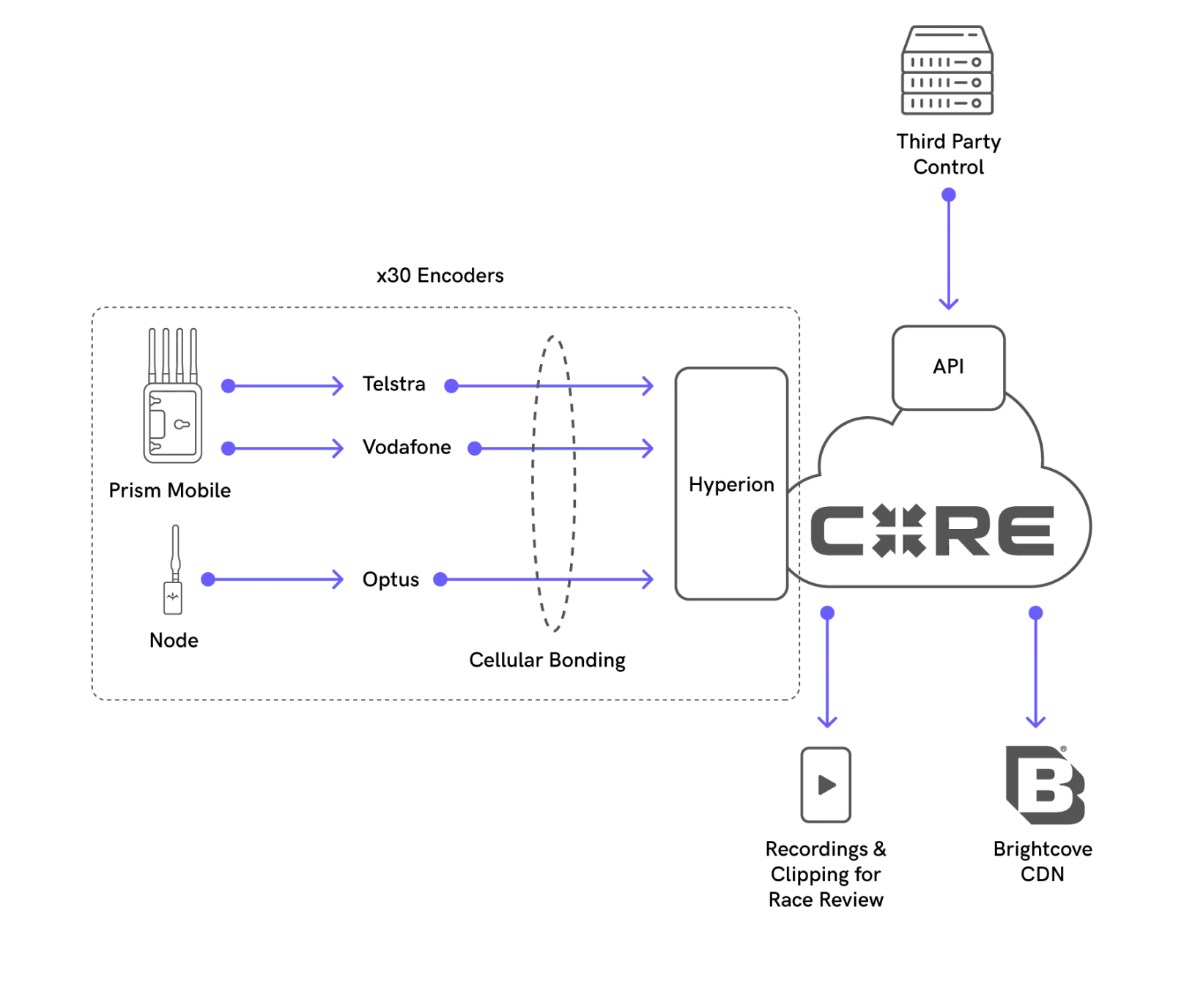
- Prism Mobile: Mounted securely within the cars to try to acquire high-quality video capture.
- Node: Secured connectivity looking forward to support across three carriers.
- Teradek Core: Handled stream debonding and directed video feeds to Brightcove CDN.
- Teradek Core API: Automated various workflow aspects.
Teradek’s Prism Mobile encoder — designed to deliver broadcast-quality H.265 video — formed the backbone of the in-car setup. Teradek’s Node modems, both LTE and 5G, provided the connectivity for the bonded cellular transmission across Australia’s three carriers (Vodafone, Optus, and Telstra). Teradek Core, a cloud-based management platform, enabled remote management of Prism Mobile, debonded feeds, and distributed video to the CDN, while the Teradek Core API orchestrated transcoder activation and CDN connections, adapting to the on/off cycles of the race cars.
“Interestingly, maintaining a connection at high speeds is not a big challenege. What does become a big challenge is when you’ve got 50,000 people on the mobile network at the same time. That is where having the bonding servics across the 3 carriers has been fantastic”, explains Beaumont.
The implementation process involved working closely with the Supercars commission to address safety regulations. The team fabricated custom mounting equipment for the Teradek devices in the cars, to try to achieve secure and compliant installation. A new safety feature was implemented to cut power to the devices based on g-force measurements in case of accidents.
“It was essentially plugging in some SIM cards, connecting them to Teradek Core, and they were ready to go”, adds Beaumont.
Technical requirements
- Hardware: Prism Mobile units, Node modems.
- Software: Teradek Core, Teradek Core API.
- Network: High-speed LTE Cellular, 5G Connectivity.
- Team: Dedicated IT and technical support team for setup and ongoing monitoring.
Streamlined live video workflow
The setup process for streaming live video from the Supercars was structured with the intention of providing high-quality, uninterrupted broadcasts directly from the race cars. The workflow integrated Teradek’s Prism Mobile encoder and Node devices to try to maintain connectivity across multiple cellular networks.
Initial setup and configuration
- Device Preparation: Each car was equipped with Teradek’s Prism Mobile encoder and Node modem, for a total of 3 cellular connections.
- Network Integration: SIM cards were installed in the Node modems to enable connectivity across Australia’s three major carriers — Vodafone, Optus, and Telstra.
Connection to teradek core
- Registration: The Prism Mobile encoders were registered and connected to Teradek Core.
- API Automation: The Teradek Core API was employed to automate various aspects of the workflow. A custom Node.js application was developed to monitor the status of each device and manage reconnections automatically.
Live streaming and distribution
- Stream Initialization: On race day, the setup was streamlined to require minimal manual intervention. With the Teradek Core API, a single operator could initiate the entire system with one click, waking up all devices and starting the live streams.
- Feed Management: The live video feeds were transmitted from the cars to Teradek Core, where they were managed and distributed to the CDN (Brightcove). This process included real-time monitoring and adjustments.
Post-event analysis and replay
- Data Retrieval: After the live events, the recorded feeds were retrieved from Teradek Core for replay and analysis. This included accessing footage for technical analysis.
- Continuous Improvement: Feedback from each event is used to refine the setup and workflow.
Results
The system worked, streaming live video from 25 cars to fans. They also included a ‘Shotgun’ feature in the Supercars app, which allowed fans to choose any driver’s cockpit view, with real-time telemetry data and immersive audio.
“You can choose a driver. You can see the cockpit. You can see them driving – all of their telemetry data. When they’re accelerating, when they’re braking. The g-force on their turn. You can see the driver turning the steering wheel. You can hear the engine noise. It’s an inmersive experience of what it looks like in the race car”, details Beaumont.
According to the company and its case study, the switch to Teradek’s solutions resulted in 15 different benefits for Supercars:
- Bang for Your Buck: “We were looking for a way to put the live stream of the cars in the app. To do that, you need to have live feeds in all 25 cars, all the time. We realized that if we were to do this efficiently and cost-effectively, 4G and 5G was going to be the way to do it”.
- Automatic and Reliable Streaming: “As soon as the car turns on, the feed establishes. It’s live and ready for us”.
- Improved Connectivity: “Having bonding over the 3 different carriers working so seamlessly has made the difference”.
- Seamless Setup: “The setup of the devices themselves, it was essentially plug in some SIM cards, connect them to Teradek Core, and they were ready to go”.
- Low Power Consumption: “The devices are fairly low power consumption in comparison to some of the other equipment we’re running in the cars, which is great”.
- Improved Connectivity: “Whenever we have a large event, a large proportion of our fans are on the Telstra network… Having bonding over 3 different carriers working so seamlessly has made connectivity really good”.
- Customization Options: “The ability to — on the fly — configure the devices, change resolutions, change buffer times — all of the video settings is really awesome”.
- API Integration: “With the introduction of the API, all we need now is one person to click the start button, and the whole thing wakes up”.
- High-Quality Video: “The quality of the video was nicely packaged. The team has even improved from 720 to 1080 on some cars”.
- Enhanced Fan Experience: “You can choose a driver. You can see the cockpit. You can see them driving — all of their telemetry data. When they’re accelerating, when they’re braking. The g-force on their turn. You can see the driver turning the steering wheel. You can hear the engine noise. So it’s an immersive experience of what it looks like in the race car”.
- Simplified Management: “Just having everything all in the one dashboard and available in multiple screens, multiple browsers. It’s really versatile and a very simple-to-use platform”.
- Versatile Usage: “We now also have a circuit presenter that does the technical analysis of the sport. He talks about things within the car, or how the drivers are driving, and does comparisons using the footage”.
- Enhanced Replay Capabilities: “A lot of the feed usage is collecting replays. If they want the feed from within the car, they’re downloading them (from Teradek Core)..
- Positive Feedback: “Viewership of the ‘Shotgun’ product has absolutely grown. I can 100% say that”.
- Trusted Support: “Teradek’s been absolutely fantastic. Really, really knowledgeable. They jump on issues quickly. Even stayed up late to support us through some of the bigger races”.
“We wrote a Noode.js application that checks the statuses of the devices and destinations every second. If it finds there’s a drop, instead of manually going through all the devices, figuring out what’s wrong… It’s now handled by the Teradek Core API. It’s absolutely fantastic”, continues Beaumont.
The application of API
- Automated System Start-up: It allows the entire system to be started with a single click.
- Automatic Reconnection: If the application detects a drop in connection, it uses API commands to both Teradek Core and the Brightcove CDN to reestablish the connection automatically.
- Resource Efficiency: It replaced the need for manual monitoring and intervention.
- Transcoder Management: It starts and stops individual transcoding servers for each device.
- Real-Time Configuration: It allows for on-the-fly configuration of devices, including changing resolutions and buffer times.
- Improved Reliability: The automated system has reduced manual errors and improved uptime.
- Simplified Troubleshooting: The API-driven system allows for quicker identification and resolution of issues.
- Scalability: The API solution made it easier to manage an increasing number of devices and streams.
- Custom Control Panel: Chris and his team developed a control panel that leverages the API, giving them control over streams and devices.
“The partnership with Teradek has been fantastic. The technology stands-up to our requirements and is always improving. I thank the team at Teradek for their ongoing support”, concludes Beaumont.




Comments are closed