


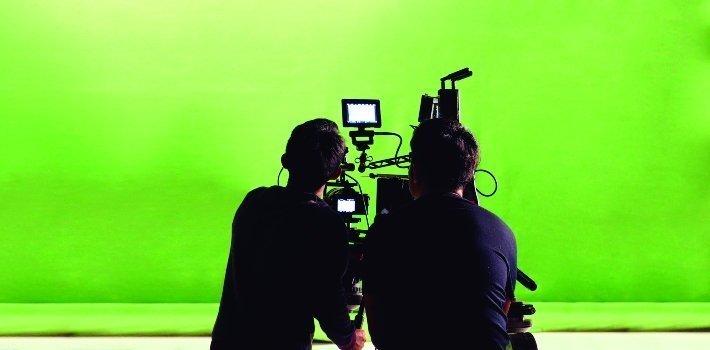
This article brings together the insights of Quite Brilliant, dock10, and Dimension to identify key takeaways and offer a clearer understanding of how the market is actually using this increasingly popular technology.


*This content is included in the May issue of TM BROADCAST. You can access the full magazine here.
In previous issues of TM BROADCAST, we had the chance to speak with the technical leads of three internationally renowned studios specializing in virtual production—Quite Brilliant, dock10, and Dimension (You can access the full interviews via the embedded links.)
This article brings their insights together to identify key takeaways and offer a clearer understanding of how the market is actually using this increasingly popular technology. We also explore the different ways it is being applied across advertising, television, and cinema.
Virtual production is enjoying a moment in the spotlight and has emerged as one of the hottest topics of the year so far. Although it isn’t a brand-new technology—it has evolved steadily over the past decade—recent advancements in LED displays, real-time engines, immersive experiences, and AI have propelled it to new heights.
These innovations don’t just fire the imagination of creative teams by enabling the creation of unprecedented hybrid environments; they also open the door to a broader range of projects by improving efficiency and lowering costs.
As with any technological breakthrough, the industry initially raced to explore its possibilities—often making missteps or facing misunderstandings along the way. But once that initial wave passes, there’s room for more measured reflection. That’s when a more accurate analysis of the benefits and challenges begins to take shape.
With that in mind, we spoke in recent months with technical directors at Quite Brilliant, dock10, and Dimension. They helped us understand how virtual production is truly being applied in the field today, and how studios are tailoring it to the specific needs of advertising, television, and cinema.
“Studios are now using the technology for the right reasons, focusing on scenes where it truly adds value,” says Russ Shaw, Head of Virtual Production at Quite Brilliant, when assessing how this technology is currently being used—a view shared by all the studios we interviewed.
In this respect, it’s important to note that virtual production isn’t a one-size-fits-all solution. “In the early days, there was considerable hype surrounding the technology, and many productions rushed to explore its potential. However, there was often a misconception that projects needed to be entirely location-based or entirely virtual,” Shaw points out.
Another key trend is the increasing accessibility of virtual production for projects that previously couldn’t afford it. “As prices have decreased, the accessibility of virtual production has improved dramatically. Studios are now using the technology for the right reasons, focusing on scenes where it truly adds value. Lower-budget projects are increasingly adopting virtual production because of its efficiencies,” Shaw adds.
Callum Macmillan, CTO at Dimension Studio, agrees: “There’s absolutely more demand from a wider range of projects for virtual production support.”

“A few years ago, it was predominantly reserved for the biggest projects with significant ‘blockbuster’ budgets, but now we’re working with more independent projects thanks to the way virtual production technologies have become more efficient, and therefore more cost effective.”
One of the key advantages all three studios agree on is the ability of virtual production to streamline workflows—sometimes even improving the final quality in the process. A major factor here is the leap forward in real-time rendering. “The most recent advancements in real-time rendering has been transformative. Right now, we can achieve photorealistic ICVFX results in realtime that used to need hours of post-processing,” says Callum Macmillan.
Paul Clennell, CTO of dock10, echoes that: “Using the latest real-time rendering, you can see how each shot will look as it happens either live in the studio or via secure remote viewing.”

Still, this remains a work in progress, and the technical directors we interviewed agree that rendering will be a crucial area of innovation moving forward. As Russ Shaw explains: “Rendering quality will continue to improve, driven by faster GPUs and better connectivity standards like SMPTE 2110. This will enable low-latency, synchronized, HDR, and high-frame-rate streaming, reducing technical challenges on large LED walls.”
This new landscape disrupts the traditional linear nature of content creation. It also reshapes workflows, creating new points of coordination between departments and particularly impacting post-production.
“This doesn’t eliminate post-production but rather transforms it,” Callum Macmillan notes. He illustrates the shift with Dimension’s experience on the film Here:
“We were able to capture final-pixel quality imagery in-camera while maintaining flexibility for creative decisions. The integration of realtime depth information and sophisticated environmental controls means that many traditional post-production tasks are now being handled during principal photography. The result is a more efficient, creative, and collaborative process that maintains the highest quality standards while enhancing efficiency and reducing costs in post-production.”
Another major factor in virtual production’s evolution has been the improvement in LED screen technology. “Looking back to 2020, the quality of Unreal Engine environments was just passable for real-time production, and LED screen resolutions were far from optimal. Directors of photography often relied on shallow depth of field to obscure background imperfections,” explains Shaw.

“Today,” he adds, “advancements such as micro-LED technology and finer pixel pitch screens have significantly enhanced the realism of virtual environments. Unreal Engine has also improved, with innovations like Nanite for high-detail meshes and Lumen for enhanced lighting and shadow quality, resulting in sharper and more lifelike content.”
Callum Macmillan adds: “LED wall technology has matured significantly, enabling better color accuracy and higher resolution. We’re now on our third iteration of panel technologies and second generation of image processing hardware which is having a huge impact.”
Approaches to virtual production
Virtual production is a broad term, and studios are applying it in different ways depending on their resources, goals, and creative direction. Quite Brilliant, known for its work in advertising, has adopted a modular approach and built a strategic alliance with London’s historic Twickenham Film Studios—one of the UK’s oldest facilities. The partnership has even opened doors to projects in the film sector.
Russ Shaw (Quite Brilliant): “Studios are now using the technology for the right reasons, focusing on scenes where it truly adds value”
“Operating primarily out of Twickenham Film Studios gives us access to multiple sound stages, some permanently set up for virtual production and others readily adaptable for bespoke solutions,” says Shaw. “Being partially modular allows us to customise the size and shape of the LED walls to meet specific production needs. This flexibility is crucial, as directors often require tailored setups to bring their creative visions to life and don’t want restrictions or extra work in post-production unnecessarily.”
And he adds: “We are equally comfortable with building solutions off-site when required, as we prioritise the financial and logistical needs of our clients.”
Dock10, which is more focused on TV production, has opted for a different route. Instead of creating a single dedicated virtual set, the company has integrated virtual production capabilities into all ten of its studios. “These solutions use the latest real-time games-engine technology from Epic and Unreal Engine with Zero Density, together with the Mo-Sys star tracking system. By centralising the systems in our CTA we give our customers the flexibility to choose the right size studio for their production – anything from 1,000sq ft to 12,500sq ft.”
Paul Clennell highlights the studio’s philosophy: “Our next-generation virtual studio capability is a powerful creative toolset for delivering even greater onscreen value—enabling the creation of even more content-rich sets. Our proven technology seamlessly combines physical, virtual and augmented reality in real time, together with live data.”
“The results are entirely realistic, including the addition of shadows and reflections as well as the perfect integration of even single strands of hair. Cameras can be pointed in absolutely any direction across the whole of the studio to deliver a continuous on-screen set.”
Dimension, which has a strong focus on fiction, stands out for its work on virtual humans. “Perhaps one of our most exciting innovations has been combining Virtual Humans (either puppeteered metahumans or volumetric video captures), with ICVFX virtual production environments, creating hybrid experiences that weren’t possible even a few years ago,” says Callum Macmillan.
“Our recent project Evergreen demonstrates really well how we can create directable mid-ground characters that are fully virtual. Populating real-time VP environments with virtual humans to bring life to the mid and background elements of a scene is also something we’ve recently done for the Colosseum shots that Dimension worked on for the Amazon Prime series Those About To Die.”
Callum Macmillan (Dimension): “The future of virtual production will be an increasingly seamless integration between physical and virtual elements”
Training the workforce
One of the major challenges with virtual production is training staff—given the need for expertise across multiple disciplines. “While we typically hire studio staff with strong 3D skills due to our use of Unreal Engine, internal training is essential to support live shoots effectively,” explains Shaw.
“Virtual production studios vary significantly, as they incorporate equipment from different manufacturers, each with unique software and setup requirements. For example, setting up LED walls, processors, camera tracking devices, media playback servers, and lighting controllers demands a deep understanding of many disciplines from frame synchronisation, down to types of networks, video and display cabling.”

In general, all studios interviewed emphasized the value of having a high-caliber human team—engineers, designers, and technical specialists—beyond just the hardware or software. “Our production crew are also highly experienced in camera setup and calibration,” says Shaw. “For clients bringing their own crew, we offer free technical recces, enabling them to experiment with both studio and personal equipment before the shoot. This hands-on preparation is invaluable for ensuring a smooth production process.”
Dock10 has taken this one step further by creating an in-house Innovation Team, which has become a leading R&D reference in the UK television industry. “Its objective is exploring ways for the industry to adopt more interactive, immersive and game-like forms of entertainment at a time when traditional linear, 2D video is in decline, particularly amongst younger audiences,” Clennell explains.
“Having delivered hundreds of hours of innovative content, the Innovation Team has earned a strong reputation for developing the bespoke tools and workflow required for cutting edge productions. It also plays an important role in educating and informing the sector about new ways to create content.”
Clennell points to an example of their work: “The team’s first development within the R&D studio was DMX-VL, a real-time software solution that allows for the control of both physical and virtual moving lighting from a single industry-standard lighting console. This helps to deliver infinite lighting possibilities for productions without additional kit, crew or cost.”
At Dimension, the approach to talent development is described as comprehensive and based on three key pillars: “We have strong ties with academic institutions; we operate a structured work placement program, partnering with training institutions, and we’re constantly developing our onboarding process, where senior team members provide hands-on guidance across various disciplines,” says Macmillan.
“This makes sure that we can transfer knowledge and get teams up to speed quickly with our workflows and best practices. AI is helping here too.”
Artificial intelligence
AI has become an extraordinarily useful tool throughout the virtual production process. As Russ Shaw illustrates: “An AI-generated background can be created and approved in less than a day, compared to the three or more days required to build a comparable Unreal Engine scene.”
That said, the technology still has its limitations. “AI-generated content often lacks control and adaptability, meaning we still rely on traditional 2D visual effects software for subtle adjustments or artifact corrections,” Shaw adds. “Additionally, camera movement can be restrictive, as AI content often uses 2.5D layering to create a sense of depth and fails if pushed too far or held on for too long.”
Even so, AI helps overcome challenges that would otherwise be far more difficult to solve. Paul Clennell offers one example: “The Innovation Team is developing techniques for creating realistic shadows and reflections in multi-camera green screen virtual production. For years, this has proven to be a huge challenge for production.”
“The solution is the development of a bespoke AI model. Called AI Composure, this proves that green screen virtual production can look better and be delivered more cheaply than LED volume stages; and it isn’t limited to the size of the LED wall.”
Callum Macmillan explains that AI is integrated into Dimension’s entire operation:
“We use large language models to optimize our production workflows and project tracking, while also maintaining comprehensive departmental knowledge bases. Our artistic teams use text-to-3D and mesh-to-3D tools, and generative AI accelerates our pre-visualization processes through fast 2D imagery generation.”
“One of our most significant implementations is in procedural content generation, which has revolutionized our environment and layout building processes. This multifaceted AI integration demonstrates how machine learning can enhance both technical and creative aspects of virtual production.”
The future of virtual production
Virtual production is not yet a fully mature technology, and all the technical directors we spoke with expect continued progress that will unlock new capabilities and greater efficiency. Beyond what has already been mentioned, Russ Shaw highlights another trend to watch: “We also anticipate growing interest from post-production companies through tools like Chaos Arena, which streamline the integration of V-Ray pipelines with LED walls without the need for preprocessing. These advancements will further enhance the efficiency and accessibility of virtual production workflows.”
Callum Macmillan adds: “The future of virtual production will be an increasingly seamless integration between physical and virtual elements. We’re seeing a convergence of realtime technologies, AI, and traditional filmmaking—systems will become more modular, volumes will become more flexible and dynamic… be that for LED production, performance capture, or volumetric capture, they all exist in a volume—that’s revolutionising how stories can be told. The viewer experience will become more immersive as the line between practical and virtual elements continues to blur.”
Paul Clennell (dock10): “Using the latest real-time rendering, you can see how each shot will look as it happens either live in the studio or via secure remote viewing”
Success stories
Finally, we asked the three technical directors to share a standout virtual production project they feel especially proud of. Here are their responses:
Russ Shaw (Quite Brilliant): While every project we’ve undertaken has unique and interesting elements, a recent campaign for Nissan with City Studios and The Gate Films stands out. Over 60% of the TV commercial was shot virtually in the studio, featuring Manchester City’s manager Pep Guardiola. Despite his limited availability—just 90 minutes on set—he appeared in 20 shots.
The biggest challenge was the tight timeline, leaving no room for errors. To ensure success, we captured all the necessary plates a day prior to the VP shoot, creating a rough animatic for everyone to visualise the car’s position, camera placements, and background locations for continuity. Thanks to meticulous planning, an excellent director, DOP and experienced crew, the project was executed flawlessly, earning unanimous praise.

Paul Clennell (dock10): The Innovation Team is working to perfect the integration of technology that enables animated content to be rendered in real-time within a live, multicamera studio setting. This builds on dock10’s work on BBC Bitesize Daily, which made significant strides in animating motion-captured performers in live virtual studio pipelines.
This technique was developed further in dock10’s work on Channel 5’s Dinosaur with Stephen Fry, where pre-animated dinosaur actions were manipulated in the gallery to allow for new playback sequences to be created live in the studio.
Off the back of these successes the Innovation Team created a dedicated R&D TV studio, working closely with dock10’s engineering department and key external suppliers to incorporate numerous innovative technologies into one space. The UHD / HDR multi-camera studio features a three-wall infinity curve with multi-talent motion capture, face capture, optical talent tracking and video / audio recording capabilities.

Callum Macmillan (Dimension): Our work on Robert Zemeckis’ Here represents a particularly significant milestone in virtual production innovation and was a project on which we really pushed the boundaries of what’s possible with realtime technologies.
The project required us to create an evolving virtual world viewed through a single window across different time periods. We implemented sophisticated vehicle simulation systems with 55 physics-enabled vehicles, developed complex weather systems including rain, snow, and seasonal changes, and pioneered new approaches to interactive lighting. The use of realtime depth cameras based on laser systems (nLight’s HD3D) provided unprecedented depth information integration, enabling seamless blending between physical and virtual elements.
This project exemplifies how far virtual production has evolved from simple LED volumes to sophisticated realtime production tools.




Comments are closed