


The new Madring circuit marked a double debut: a new Grand Prix in Spain and a completely new track. As a result, broadcast services company TBS deployed a special operation as part of the technical service it provides to DAZN for its F1 coverage. The operation strengthened on-site production, with a mobile studio through the streets of Madrid and new spaces at the circuit itself. Roberto Jimeno, Technology and Operations Manager at TBS; Elena Borque, Head of Event and Outside Broadcast Production; and Jorge Cabrerizo, Head of Sound, break down the key aspects of the deployment in a three-way conversation with TM BROADCAST


*This content is included in the October issue of TM BROADCAST. You can access the full magazine here.
The arrival of Formula 1 at a completely new circuit represents an enormous challenge for the drivers, but also for the technical teams responsible for bringing the competition to viewers’ screens. Over the weekend of 11–13 September, with no previous on-site experience and faced with a semi-urban track featuring characteristics never before seen in the World Championship, Spanish broadcast services company TBS, part of Telefónica Group, undertook a special operation to support DAZN’s coverage of the first Madrid Grand Prix, held at Madring.
TBS has been working as DAZN’s main technology provider for Formula 1 for three seasons, with a presence both at the circuits and at the production hub located at the platform’s General Perón headquarters in Madrid. This collaboration is also taking place against a backdrop of continuity for DAZN, which recently renewed its Formula 1 rights in Spain until 2030.
“DAZN is the rights holder and has full editorial control. In other words, any content seen on screen from an editorial point of view is DAZN’s responsibility, while the production resources, operations and technology are provided by TBS. That is the partnership,” explains Roberto Jimeno, Technology and Operations Manager at TBS.
This division of responsibilities extends to every Grand Prix. Formula 1 Management produces the international, or multilateral, feed, which TBS receives at the General Perón control room, while DAZN generates its own content to personalise its coverage in Spain.
DAZN’s usual personalised coverage resources include two RF cameras that move around the circuit and various unilateral feeds that TBS transports back to Madrid. “For example, the onboard cameras of the Spanish drivers. We don’t have to wait for the F1 World Feed director to cut them into PGM; instead, we take the feed that FOM makes available in the cloud from its MCR (Master Control Room) in Biggin Hill, England, and bring it into General Perón, Madrid” says Roberto Jimeno.
Within this group of signals and content additional to the international feed, TBS also transports various information feeds to General Perón that do not necessarily go to air —with information about the drivers, track conditions or weather— as well as a clean feed for replays and recordings and other content and interviews generated at the circuit during Grand Prix week.
The number of RF cameras, operating autonomously and able to move around the circuit, increased from two to three. The third also introduced a new aesthetic to DAZN’s coverage: a cinematic camera
Madrid breaks with the usual model
TBS’s operation for DAZN usually grows for Grands Prix held in Spain, as is the case at Montmeló (Barcelona), where its status as a home race translates into a larger deployment of equipment and resources. In Madrid, however, this coincided with the debut of both the Grand Prix and the circuit itself, taking the operation one step further. “Madrid is special because it is not only a Grand Prix in our country, but also the first edition of the Grand Prix at this circuit and, on top of that, the circuit itself is making its debut,” Jimeno points out.
The expanded operation also required planning to begin earlier. TBS started working with DAZN on the specific Madrid deployment approximately two months before the Grand Prix. From June onwards, the two companies defined the additional production requirements and studied the technical solutions needed for each of them.
“From then on, we had various conversations with them, pinning down those requirements and looking at what technical solutions we could offer for each particular situation,” explains Elena Borque, Head of Event and Outside Broadcast Production at TBS.
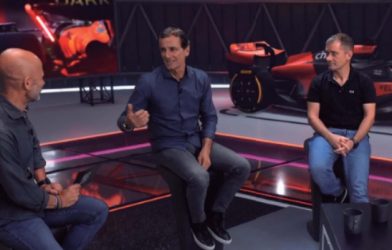
The deployment itself began a few days before the on-track activity. On Wednesday, DAZN produced special programming from various locations around Madrid, centred around a “mobile studio”: a vehicle in which three protagonists —Antonio Lobato, Pedro de la Rosa and Toni Cuquerella— travelled through the streets of Madrid from the city centre to the Madring venue, with TBS providing cameras, microphones, production and return feeds to enable a live production on the move.
“We are used to seeing, for example, team celebrations where a camera is carried around, but having an entire programme presented from inside a vehicle and produced as a multicamera production is relatively new,” says Roberto Jimeno.
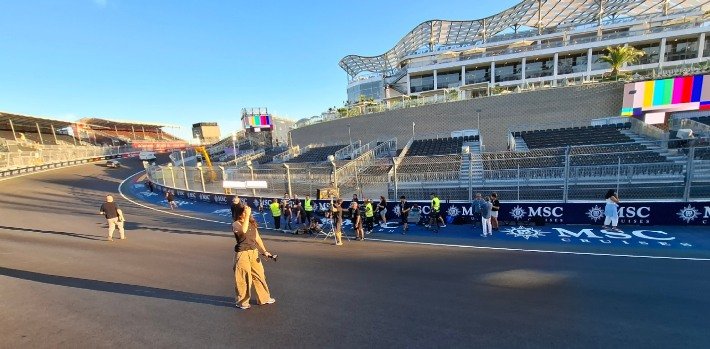
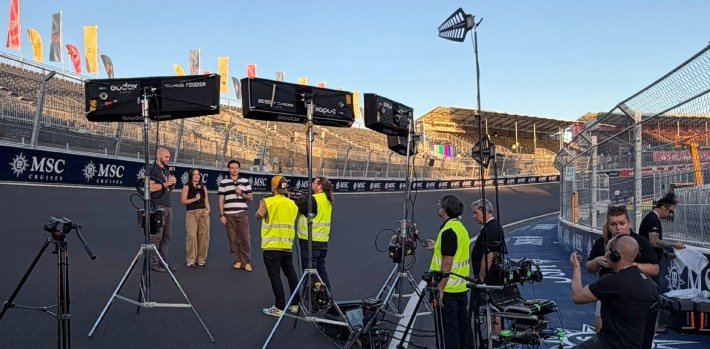
The special coverage continued on Thursday with ‘Box, Box’, one of DAZN’s Formula 1 programmes, which also moved away from the usual Grand Prix locations. TBS produced an edition from the Monumental corner itself, one of Madring’s most distinctive points.
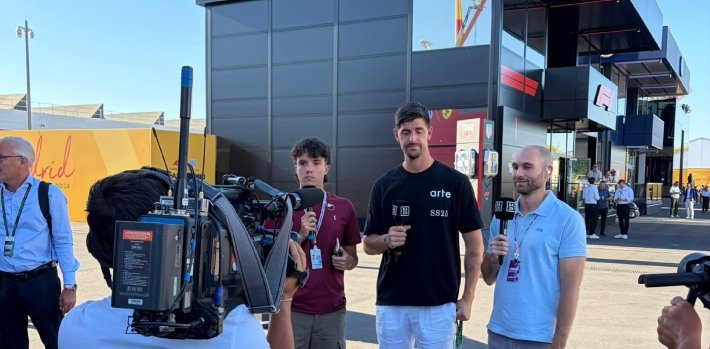
The Monumental corner continued to play a prominent role throughout the rest of the weekend. From Friday to Sunday, DAZN had a live position there with a reporter, supported by an ENG camera equipped with a 4G device. The choice reflected expectations that this section of the track would become one of the most recognisable locations of the new Grand Prix.

“We are used to seeing, for example, team celebrations where a camera is carried around, but having an entire programme presented from inside a vehicle and produced as a multicamera production is relatively new,” Roberto Jimeno
Three RF cameras and a new cinematic look
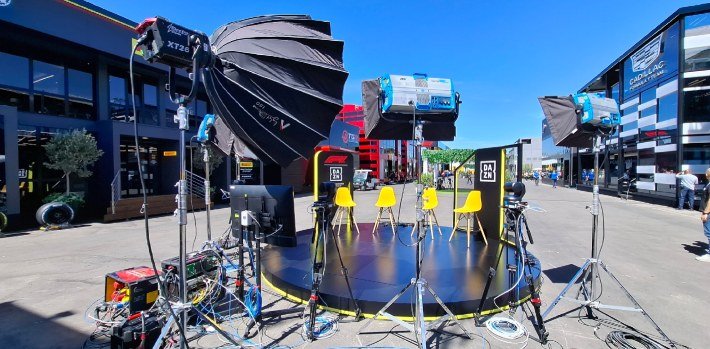
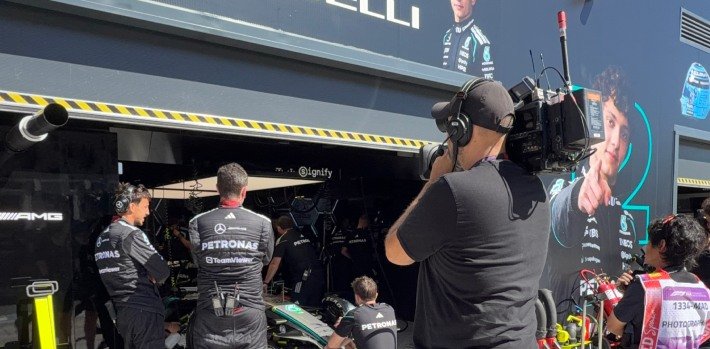
The operation also grew over the weekend. TBS deployed around 30 professionals and added a permanent three-PTZ-camera set in the paddock, from where DAZN provided continuity coverage of the on-track activity from Friday to Sunday, including not only Formula 1 but also the supporting F2 and F3 competitions.
“Normally, that continuity is produced from General Perón, but in this case all the continuity coverage of the day’s on-track activity is produced from the circuit. That means more resources on site, more personnel and also more hours that would normally be handled from Madrid,” explains Elena Borque.
The number of radio frequency (RF) cameras, operating autonomously and able to move around the circuit, also increased from two to three. The third introduced a new aesthetic to DAZN’s coverage: a full-frame Sony cinema camera from the FX range, equipped with a cinema lens and stabiliser. “It is the first time we have used one in Formula 1 coverage for DAZN,” Roberto Jimeno points out.
The addition follows a trend that is becoming increasingly common in sports production, with this type of camera being used to introduce a more cinematic look to certain shots. TBS already uses them regularly in its Spanish ACB basketball productions, while other competitions, such as LaLiga, have also incorporated this resource into their broadcasts.
A circuit with no previous references
In the days leading up to the Grand Prix, beyond the increase in resources, one of the main difficulties lay in the very nature of Madring. There was no accumulated experience that could be used to anticipate all the production constraints on site.
“It is a new circuit where it is not just that we haven’t been there before: no broadcaster has been able to work there, no team has been able to drive there and no media organisation has been able to be on site,” explains Elena Borque.
That said, as TBS points out, the team was not starting entirely from scratch. Formula 1 provides advance information on working distances, cabling, access points and antenna farm locations. However, something fundamental at other Grands Prix was missing: the experience accumulated from one edition to the next. “We are not going in blind, but we don’t have the certainty we have at other circuits, where there is already a certain degree of continuity in terms of both personnel and resources.”
Distances added another difficulty. According to Elena Borque, they were considerably greater than usual, affecting both setup and live operations, particularly for reporters and RF camera operators who had to move between different points around the circuit.
A paddock unlike any other in the championship
Another aspect that shaped the operation from a technical perspective was the infrastructure of the venue itself. As this is a semi-urban circuit, part of the paddock is located inside halls 3 and 4, in a covered area, while the hospitality and motorhome area is outside. “There is no other circuit like this,” says Roberto Jimeno. “The fact that we have two separate areas here, one indoor and the other outdoor, represents a significant technological challenge.”
The challenge particularly affects wireless systems. “For all the wireless microphone coverage, wireless returns, communications and wireless cameras, we have the challenge of covering both indoor and outdoor areas while maintaining range.”
“In terms of coverage, resources that are normally very clearly defined at other Grands Prix are doubled or even tripled here if we want to achieve full coverage,” adds Elena Borque.
A remote production that moved closer to the circuit
Despite the increase in on-site resources, the core of the production architecture did not change. The final programme received by DAZN viewers continued to be produced from the General Perón hub.
What did change was the weight of each end of that remote production. The virtual studio normally used in Madrid for DAZN’s continuity coverage gave way during this Grand Prix to a physical multicamera set located in the paddock, from where the weekend’s continuity coverage was produced.
This had consequences for graphics. While graphics relating to the race are Formula 1’s responsibility, TBS handles those associated with DAZN’s programme. With a larger share of the production moved to the circuit, the need for certain virtual resources was reduced.
“The more the operation at the circuit grows, the more the graphics side decreases,” explains Roberto Jimeno. The TBS executive uses the work normally required for the virtual studio as an example: “When that continuity coverage is produced from a virtual studio, we have to use some graphic ingenuity to virtually put ourselves inside a garage, bring out a car or incorporate augmented reality elements, such as drivers.”
In Madrid, the physical presence at the circuit made it possible to reverse that approach: “In this case, it won’t be augmented reality, but actual reality: we will be there.”
“In terms of coverage, resources that are normally very clearly defined at other Grands Prix are doubled or even tripled here if we want to achieve full coverage,” Elena Borque
Sound, one of the major challenges
If there was one area where the growth of the operation translated directly into technical complexity, it was audio and, particularly, communications. The number of presenters, reporters and teams distributed across locations several kilometres apart meant that cross-communications had to be multiplied. To address this situation, TBS added two high-density audio codecs to its usual equipment.
“Normally, communications are, so to speak, fairly limited and straightforward: there are four IFBs, camera instructions and little else,” explains Jorge Cabrerizo, Head of Sound at TBS. “With this deployment, we are talking about around 14 different IFBs: communication between production at the circuit and DAZN production, floor management with DAZN, internal technical communications, technical communications between the circuit and Madrid, TBS production with TBS production at General Perón…” In total, Cabrerizo puts the operation at around 30 calls, all over IP.
The mobile studio added another layer. The mix was assisted from a support vehicle, while IP communications relied on bonding over 4G connections. TBS worked with Prodys on this part of the operation.
Producing from a corner without an OB van
One of the most interesting decisions in the deployment was precisely what was not used: a conventional OB van for these additional productions.
TBS’s usual Formula 1 infrastructure travels from Grand Prix to Grand Prix in flightcases, with a container holding approximately 600 kg of dedicated equipment. Additional equipment for the new productions was added to this system in Madrid.
The clearest example was the aforementioned ‘Box, Box’ programme. DAZN wanted to produce the programme from the asphalt of the Monumental corner, a location where Formula 1 does not allow a trailer to be installed. “We would love to bring our OB van. We could put a trailer there and be much more comfortable,” Roberto Jimeno acknowledges. “But, obviously, Formula 1 tells us that we cannot put a trailer on the track.”
The restriction required another solution to be designed: “If our client, DAZN, asks us to produce a programme from the asphalt of the Monumental corner, we have to find a way to produce a complete programme, with a multicamera set, without an OB van.” For Jimeno, this limitation is itself part of the project’s technical interest: “The fact that there are no OB vans is, once again, an engineering exercise and a technical challenge.”
“Communications are normally straightforward: four IFBs, camera instructions and little else. But with this deployment, we are talking about around 14 different IFBs. In total, around 30 calls, all over IP,” Jorge Cabrerizo
When 100 kilos of batteries disappear
The reliance on lightweight, mobile solutions also resulted in one of the most striking unforeseen incidents during preparations. Working without an OB van inside the track means relying heavily on batteries and portable charging systems, TBS explains. This is compounded by restrictions on transporting high-capacity lithium batteries by air, as they must travel under specific conditions as dangerous goods.
And precisely in the week before the event, Jimeno says, “the special container carrying the batteries and all the associated equipment disappeared without any logical explanation.” In the period between packing up at one circuit and arriving at the next, the equipment is usually stored in a designated area at the circuit until the logistics operator responsible for transporting Formula 1 equipment collects and transports it. “Well, even today, we still don’t know how, but that equipment never arrived in Madrid,” he explains. “We are talking about a 100 kg box handled by an international logistics operator under controlled conditions. These things can happen, and it is an unforeseen situation we have to deal with.”
The timing could hardly have been worse: “It happened at the worst possible Grand Prix, because this is the one where we need the greatest battery autonomy.” Once the setback had been accepted, TBS subsequently replaced the equipment required for the deployment.
A spectrum where “there isn’t room for a pin”
Added to all these constraints was an invisible but fundamental factor: radio spectrum management. Broadcasters cannot freely introduce RF devices at a Grand Prix. Every frequency must be coordinated with Formula 1 and subsequently obtain the corresponding authorisations from the national authorities. This is also why TBS could not, for example, consider introducing drones on its own initiative: during the race, the airspace is closed and any use of these systems is the responsibility of Formula 1.
Roberto Jimeno, who has worked on football, Champions League, basketball and other sports productions, places Formula 1 at a particularly demanding level. “I think Formula 1 is an unparalleled example in terms of frequency coordination. It is absolutely strict. I would say it is the ultimate in coordination in this respect.”
Planning also continues on site. Frequencies scheduled in advance may have to be reassigned depending on the specific circumstances at each circuit, using spectrum analysis to support these decisions.
And Madrid took that complexity one step further. “The spectrum at a Formula 1 Grand Prix, and even more so in a European capital like Madrid… I can tell you that saying it is saturated is an understatement,” he concludes. “There isn’t room for a pin.”
TBS deployed around 30 professionals and added a permanent three-PTZ-camera set in the paddock, from where DAZN provided continuity coverage of the on-track activity from Friday to Sunday







Comments are closed