


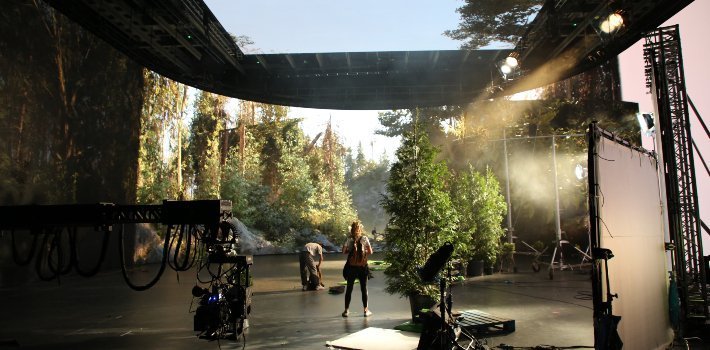
Virtual production and IP, long-standing technologies in the market, have experienced a decisive boost. Streaming, meanwhile, is further consolidating its prominence over traditional broadcast


—
By Daniel Esparza
Coinciding with the summer, it’s the perfect time to reflect on the key news and trends that have defined the first half of the year. Broadly speaking, we’ve observed that technologies such as virtual production and IP, which have been present in the market for years, are now gaining definitive momentum. Meanwhile, various streaming services are undergoing ambitious technological upgrades, further consolidating their prominence over traditional broadcast.
One of the main topics we’ve focused on is virtual production. With the pandemic as a turning point — and propelled by recent advances in LED displays, graphics engines, and artificial intelligence — this technology has firmly established its dominant role in the industry during the first half of the year.
Having moved past its initial hype, virtual production has reached a level of maturity that allows it to be deployed where it truly adds value — not as a one-size-fits-all solution. Among its main advantages are cost savings and vast creative possibilities.
To understand its real impact on workflows and how it’s currently being used in advertising, television, and film, we compiled a special feature including key insights from the technical directors of three pioneering production companies — Quite Brilliant, Dock10, and Dimension. Quite Brilliant, in fact, has just launched a new virtual production facility located at the iconic Twickenham Film Studios in London.
Beyond content production, the television industry is also undergoing significant infrastructure changes, with the shift to fully IP-based systems gathering pace. After speaking with major broadcasters such as Italy’s RAI, Sweden’s SVT and Denmark’s TV 2, among others, we identified a strong commitment to IP, albeit with each broadcaster at a different stage — and greater skepticism around UHD.
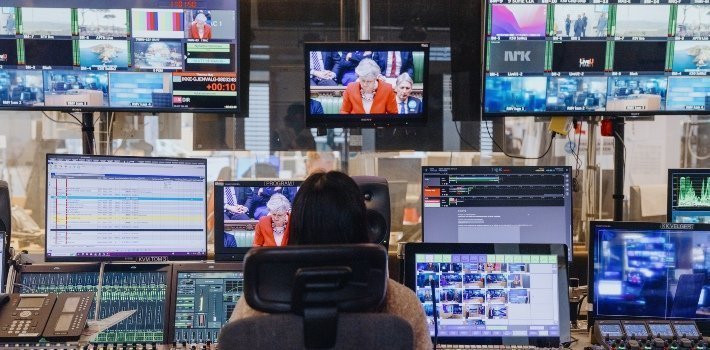
Their hybrid approach to cloud technology and growing interest in 5G networks are among the key strategic directions. Competition with global streaming platforms stands out as a major challenge.
In this regard, internet-based content distribution has emerged as one of the key forces driving change, bringing both challenges and new opportunities for broadcasters in their relationship with audiences.
Within this segment, the rise of FAST (Free Ad-Supported Television) channels has particularly caught our attention. That’s why, in recent issues, we’ve explored specific case studies such as Rakuten TV or the American network NBC, speaking directly with top executives.
From a business perspective, the sustainability of OTT services is built on three main pillars: monetization, advertising, and data analytics. From a technological standpoint, artificial intelligence — which we could hardly fail to mention — is playing a key role in content personalization and advertising strategies.
More broadly, it’s worth noting that the broadcast and media sector is taking on a pioneering role with AI, despite being a traditionally cautious industry when it comes to adopting new technologies into its workflows.
And to conclude this analysis, let’s take a look at radio. While its room for innovation is more limited and its transition to the digital world — particularly in terms of distribution — still lags far behind television, we’ve also observed signs of accelerated technological progress.
Indeed, digital radio has gained momentum in the last six months in countries such as Turkey, Greece, Ireland, Bosnia, and Thailand. That’s why we recently published a global overview of its current state, highlighting the main challenges and opportunities, with the help of WorldDAB — an organization promoting the adoption of digital radio based on the DAB standard, predominant in Europe and the Asia-Pacific region.








Comments are closed